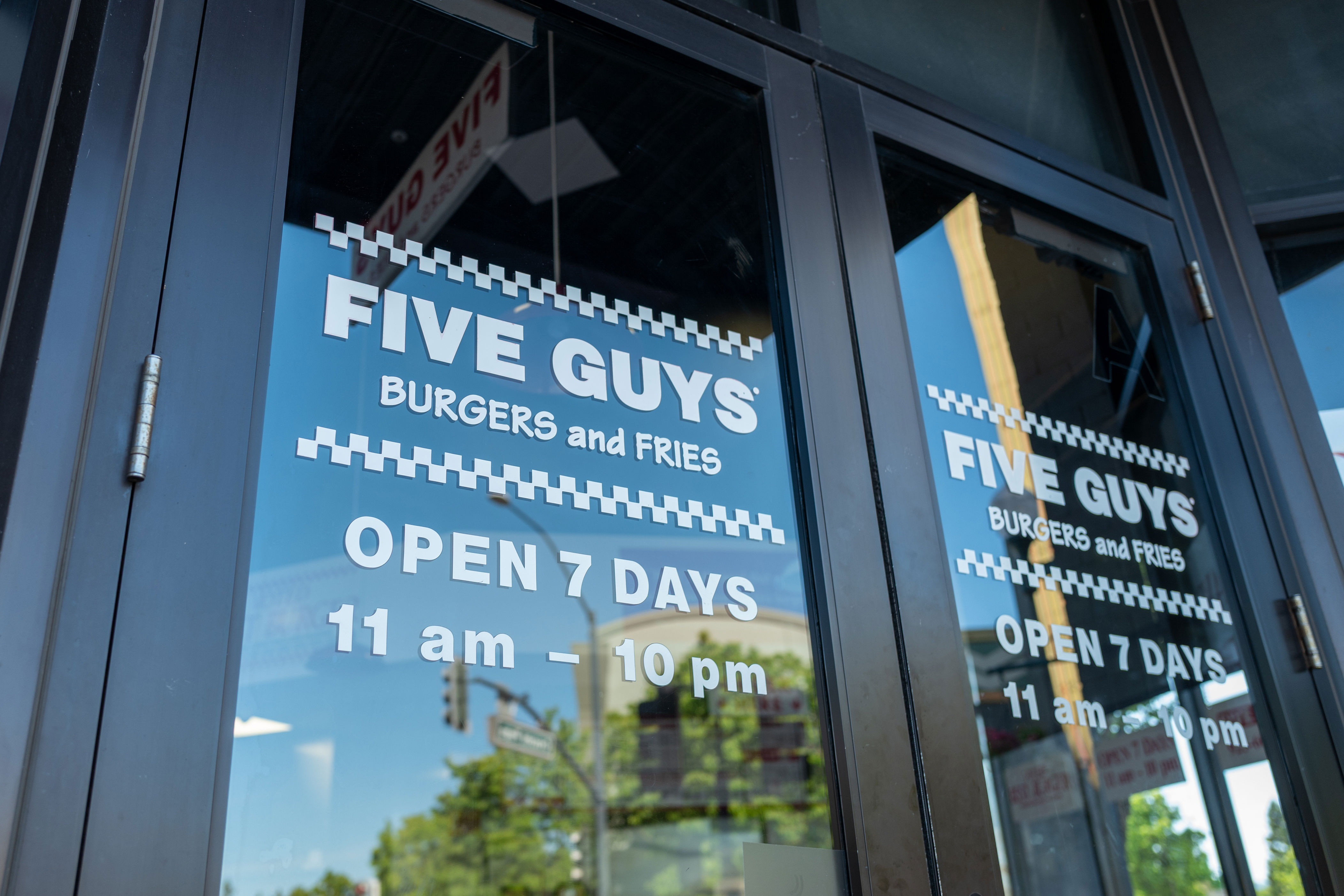
Five Guys will be closing four locations in California between late May and early July, resulting in 55 job losses, according to public filings reviewed by Newsweek.
While the scale of the closures is modest, the move raises broader questions about the future of premium fast-casual dining. As inflation-weary consumers rethink $20-plus combo meals, restaurant operators are facing sharply higher labor and operating costs—especially in California. While Five Guys, a popular burger chain, has long positioned itself as a high-quality alternative to traditional fast food, today’s budget-conscious diners are increasingly unwilling to pay the premium.
List of Five Guys Restaurant Closures
State labor filings show four locations in Southern California will be closing. They include locations in:
- Whittier–13 employees laid off (effective May 25, 2026)
- City of Industry–15 employees laid off (effective May 26, 2026)
- Merced–13 employees laid off (effective June 26, 2026)
- Hanford–14 employees laid off (effective July 2, 2026)
The closures were disclosed through Worker Adjustment and Retraining Notification (WARN) filings, which are required when employers permanently shut a location or conduct large layoffs. Five Guys cited “financial hardship” as the reason for the closures.
Is Five Guys Going Out of Business?
Five Guys is not going out of business and is still operating hundreds of locations across the country. That includes over 130 locations in California, alone, meaning the current closures are only about 2 percent of the locations the company operates in the state.
As a global operation, Five Guys operates more than 1,700 locations worldwide.
What is happening, analysts say, is a “middle‑tier squeeze.” Five Guys sits between value fast food and sit‑down restaurants, and that position has become harder to defend as prices rise. Industry observers note that a burger, fries and drink costing close to $25 can push budget‑conscious customers toward cheaper competitors or home cooking.
California’s business climate has added to the pressure. Restaurants there have faced higher payroll costs since the state’s $20 fast‑food minimum wage took effect, along with elevated rents and food prices. The minimum wage went to $16 an hour in general and up to $20 per hour for covered fast food workers. Labor unions championed the change, saying it would help employees address the cost of living, but businesses warned it could force them to raise prices or hire fewer workers.
In a study of the impact of the minimum wage increase, UC Santa Cruz economics lecturer Stephen Owen said in March there’s been more interest in fast food jobs, but less demand for workers because of the cost. Across 18 McDonald’s franchise locations, hours employees worked declined nearly 12 percent, equivalent to a loss of 62 full time jobs for a year.
“Restaurants are a notoriously tough business, with slim margins, so if you have to raise labor costs, which is a significant portion of operating costs, it won’t be long before some will go under,” Owen said. “Businesses can absorb increased costs to a certain extent, but the question is for how long. I would argue that we will likely see closures ahead.”
A Wider Trend in Fast Food and Fast-Casual
Five Guys is far from the only chain adjusting its footprint. Major players in the traditional fast-food space are experiencing similar, if not larger, pullbacks.
Wendy’s, for instance, is carrying out a much larger retrenchment. The fast food chain announced plans to close about 300 U.S. locations in early 2026, focusing on older or underperforming units as part of a broader turnaround strategy to shift back toward value pricing. This follows 240 Wendy’s closures in 2024.
Other household names—including Pizza Hut, Papa John’s, Jack in the Box, and Panera Bread—have also announced selective closures or layoffs as they navigate slowing foot traffic and rising overhead.
Related Articles