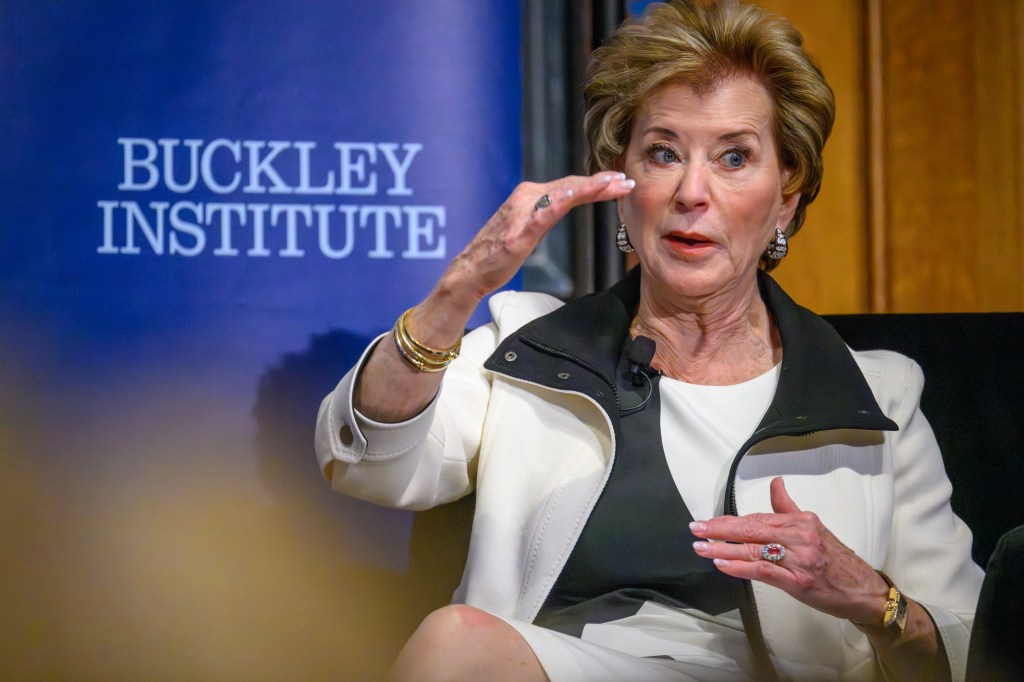
The decision to slash staffing at the Department of Education’s Office for Civil Rights has left the agency buried under a massive backlog of discrimination complaints, with Secretary Linda McMahon testifying yesterday that it’s now working to hire more people.
Lawmakers cited roughly 12,000 unresolved cases nationwide; data shows the department resolved 30 percent fewer complaints in 2025 than the year before and reached resolution agreements in fewer than 1 percent of investigations. If a case is not resolved, schools aren’t required to change their policies, provide accommodations for students or correct alleged discrimination.
While McMahon conceded that the cuts slowed case processing, she told lawmakers it was pointless to rehash the layoffs.
“That is hindsight,” McMahon said when pressed about how layoffs impacted the backlog, seemingly growing irritated when a lawmaker questioned what she meant by “hindsight.”
“You know perfectly well what it is,” she said.
The staffing crisis stems from sweeping layoffs carried out in 2025, when the Education Department cut more than half of OCR’s workforce and closed roughly half of its field offices. Those cuts were part of broader Trump administration plans to dismantle the department and shift many of its responsibilities to other federal agencies.
The Trump administration’s attempt to carry out mass layoffs was blocked by a federal judge in the fall. Judge Susan Illston later extended the pause on layoffs in December, and the department ended up putting employees on paid administrative leave instead of laying them off. A recent Government Accountability Office report found that the department spent up to $38 million to keep laid-off employees on paid leave during that period.
The impact of employee losses was immediate and severe, according to reports cited during Tuesday’s hearing. The New York Times reported that the Education Department resolved about 30 percent fewer discrimination complaints in 2025 compared with the previous year. At the same time, the OCR was left with a backlog of roughly 12,000 cases. Of those, the office reached just 112 resolution agreements in 2025—less than 1 percent of investigations—and in 15 states, none were resolved.
McMahon partially blamed the Biden administration for the backlog, saying during the hearing that the Trump administration had inherited a backlog of 19,000 cases.
Senator Chris Murphy said during the hearing that none of the 70 civil rights cases filed in Connecticut had a positive resolution in 2025. He asked McMahon how they defended it.
“It is very difficult when I’m trying to address those particular issues except to know those things were happening and we are looking forward to making sure they stop happening,” McMahon said, adding that cases should be being dismissed or finding resolutions to them.
McMahon acknowledged that reductions in force at the department, particularly within the OCR, left the agency unable to process complaints at an acceptable pace. As a result, she said the department is reversing course by rescinding hundreds of layoffs and returning to active hiring, especially for civil rights attorneys.
“We are moving to resolve as many cases as we can, but we are bringing back many of those lawyers, which were part of that RIF,” McMahon told senators, referring to the reductions in force implemented last year. She added that there was a period when the department “was not processing cases as quickly as we should,” but said officials are now focused on clearing the backlog.
McMahon said everyone who was laid off who did not take early retirement is being hired back, and the department was working to hire even more attorneys. McMahon also praised the hiring of Kimberly Richey as the top civil rights official in the Education Department, saying she’s been successful in clearing the backlog in the past.
Even as she conceded that some cuts went too far, McMahon continued to defend the administration’s broader goal of shrinking—and ultimately eliminating—the Education Department, praising her own role to shrink “our bloated bureaucracy.”
At the same time, McMahon said the department must rebuild critical capacities that were hollowed out by the cuts.
The reversal marks one of the clearest acknowledgments yet from the administration that its aggressive downsizing of the Education Department undermined its ability to function. While McMahon has emphasized that the department is “moving forward,” lawmakers on both sides of the aisle have questioned whether the damage can be easily undone—or whether other programs will face similar disruptions as dismantling efforts continue.
Related Articles