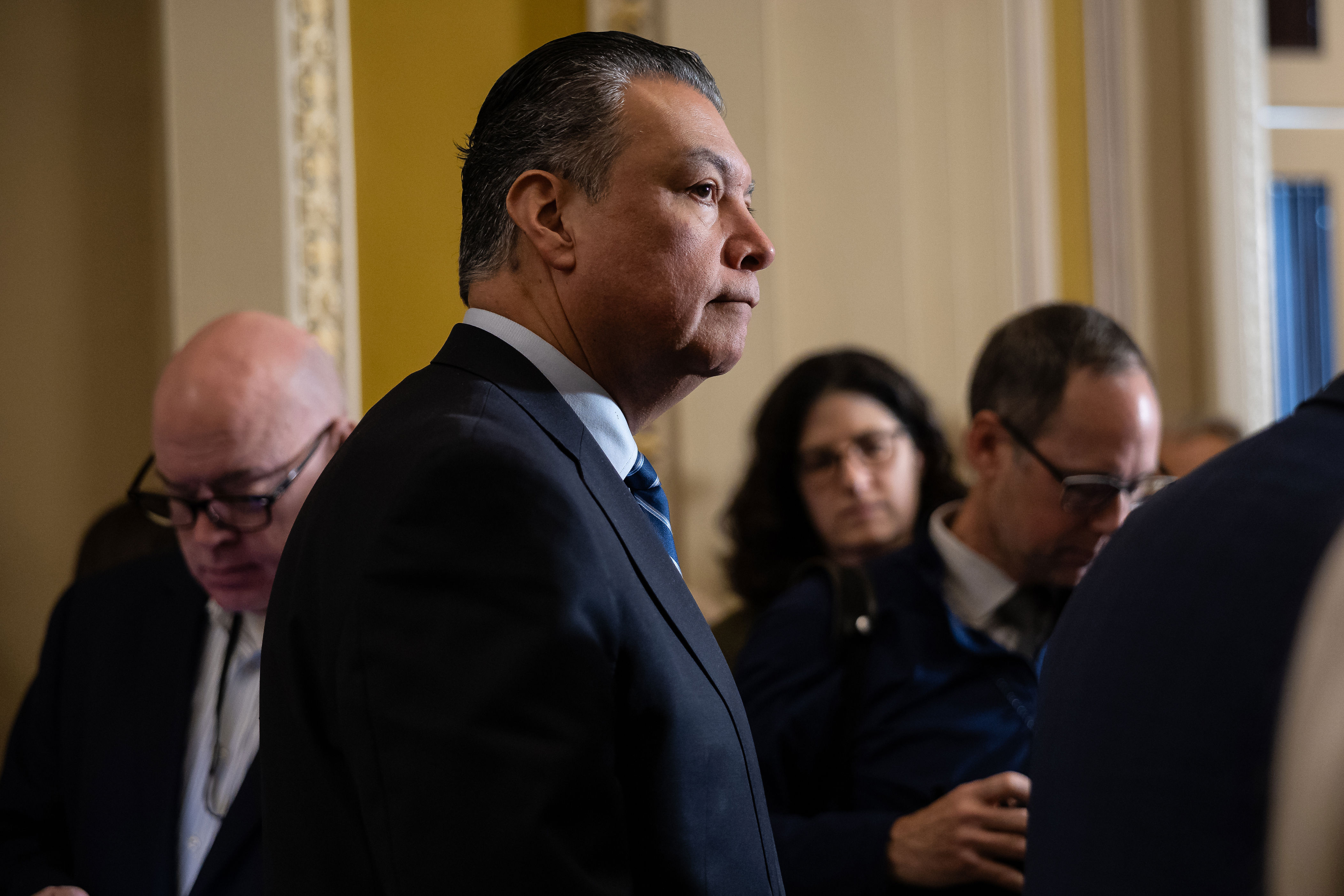
Sen. Alex Padilla was in the Library of Congress with several dozen other senators when their phones all buzzed with the news of the Supreme Court’s ruling on the Voting Rights Act. He was dismayed, but not shocked, to read the landmark law had been gutted.
To Padilla, Wednesday’s decision marked the convergence of two distinct trends in American elections: the decades-long effort by the right to chip away at the Voting Rights Act and the more recent push under Donald Trump to stack the deck for Republicans in the midterms.Padilla has more bona fides than most of his Democratic colleagues when it comes to election law — he served six years as California’s secretary of state and is now the highest-ranking Democrat on the Senate Rules committee which oversees federal elections.
He spoke with Playbook about the implications of the court’s ruling and what, if anything, Democrats can do about it.
This interview has been edited for length and clarity.
This ruling was not unexpected. Was the final outcome better or worse than what you anticipated?
There's the old adage, you hope for the best and prepare for the worst. And this is almost as worse as it could’ve gone. It greenlights the threatened discriminatory redistricting that several states have promised to do.
Nondiscriminatory, fair redistricting is just as fundamental to our democracy as access to the ballot. So to undermine the redistricting process is just as harmful as any other voter-suppression proposal that we've been battling since the Shelby v. Holder case in 2013.
Justice Alito’s opinion says there has been “vast social change” that means the country doesn’t need the same kind of guardrails against discrimination, like race-conscious redistricting, as it did in the past. It sounds like you’re saying that will never be the case, that there always needs to be some framework that guards against this discrimination and this is not just a response to the abuses of the Jim Crow era.
The Federal Voting Rights Act stood for more than half a century and did its job well, given the protections that it called for, including the pre-clearance requirement. Once that was lifted in 2013, that's when you saw several states — that happen to be led by Republicans — unleash the voter ID laws, the purging of voter rolls, all the changes in elections that made it harder for eligible people to register to vote, to stay registered to vote and to actually cast their ballot.
It's important to call out that this ruling today is just one piece of the comprehensive Trump/MAGA playbook to rig the November election. What's their motivation? They know their record hasn't just been unpopular — it's been so damaging to working families across the country, their only hope to stay in power is to change the rules. That's why, from the very beginning of this second term of President Trump, the executive order he tried to change the rules on the election. That was challenged in court, and he lost. That's why, legislatively, they've tried the SAVE Act, the SAVE America act, whatever they call it these days, that also threatens to make it harder for people to vote. They have threatened states for access to all the personal information of every registered voter in their state. Why? To purge the rolls. And that's what they're doing in states that have voluntarily participated in this pilot.
And this redistricting issue goes back to the one phone call from Donald Trump to Governor Abbott in Texas saying find me five more Republican seats, much the same way he called the Georgia secretary of state after the 2020 election, saying, find me 11,000 more votes.
Should minority voters in California feel concerned about their representation going forward?
Not as much in the state of California. Between Governor Newsom, Governor Brown and the Legislature, we've gone a long way to ensure both the safety and security of our election system, but also making it as accessible and convenient for eligible voters as possible. I wish I could say the same for every state in the nation.
When California Democrats redrew their congressional maps last year for what would ultimately be Proposition 50, the map was constructed to align with the Voting Rights Act, unlike the redistricting in Texas. Some people have argued that, absent those considerations, they could have drawn an even more partisan map. Given that the Democrats see the upcoming midterms as having such high stakes, was it a mistake to not maximize the number of seats they could win?
No, I think the Prop 50 map struck the right balance. It respected not just the federal criteria for redistricting, but the state criteria for redistricting, as outlined in the creation of the independent redistricting commission.
You’re part of the new election task force announced by Sen. Chuck Schumer. What can Senate Democrats reasonably do with this task force, given they’re in the minority in the Senate?
You saw one example — it took us several weeks, but it seems that we have been able to fend off the SAVE act. So the legislative pushback, the legislative leverage we do have, we're going to continue to employ. We are partners with not just state attorneys general, but other organizations in their litigation efforts, anywhere and everywhere that we need to be. Communicating to our constituents, to the public in general, about the stakes, about what to look out for, about the misinformation and disinformation to not fall for, is going to continue to be important, and we're going to continue to do our part to organize.
Speaking of the November elections, here in California, the voter ID ballot initiative qualified for the ballot last week. Do you think that Democrats are prepared enough to mount a robust response?
I believe we will. The voter ID effort in California — first of all, it's a solution in search of a problem. Every report, every study, every audit shows that voter fraud is exceedingly, exceedingly rare. But no doubt, it is part of that comprehensive Trump MAGA playbook to influence who gets to vote, and they're desperate to attempt to hold on to power.
What else do you think people should take away from the court’s ruling?
On the redistricting piece, it’s another reminder that it should be voters electing their representatives, not the other way around. It’s an important distinction between how we did Prop 50 in California versus how other states are changing their maps. In California, it was the people who spoke. In Virginia, it was the people who spoke. In Texas and elsewhere, it’s a Republican governor and Republican legislature imposing it on their constituents.
I can't let you go without one political question. You have not weighed in on the California governor’s race and have said you don’t plan to do so, at least for now. It seems like Xavier Becerra now has a viable shot at being California’s first Latino governor in the modern era. Do you feel any sense of desire or obligation to throw your support behind a potentially history-making candidate?
I know the entire field of candidates on the Democratic side. I have experience working with each of them uniquely, some more than others. I want to be as respectful as I can to the voters of California. The only thing that would change my inclination to not endorse or not weigh in is if this top-two Republican scenario that people seem to fear seems [to be] coming to fruition. I don't think it will, but that’s something I’m keeping my eye on.
Like this content? Consider signing up for POLITICO’s California Playbook newsletter.