CARLSBAD, Calif.—John Levy Jr. built his dream home by a lagoon overlooking the Pacific Ocean and turned it into a private retreat he christened “Levyland,” complete with his own pickleball court.
Then, the California Coastal Commission came for him. In October, the powerful state agency hit the 74-year-old and his associated trust with up to $2.5 million in penalties, alleging he locked a gate to a beach and blocked a trail to a lagoon, among other things. Levy says the gate isn’t on his land and the trail is private.
“I’m quite frankly troubled by what I see as a brazen disregard,” Commissioner Ray Jackson remarked about Levy during a public hearing, characterizing the situation as “a direct affront to the people of California.”
Levy joined the hearing via Zoom from a second home in New Zealand and could barely contain his anger. He accused the agency of spreading falsehoods and siccing activist groups on him, including one represented by a former reality star known as “Mitch the Bitch.”
“Now everyone knows where the rich dude that blocks public access lives,” Levy told commissioners, as the sun rose behind him.
While disputes over California beach access aren’t uncommon, Levy’s battle is being watched nationally for challenging the Coastal Commission’s most potent tool: its authority to impose massive fines. Levy is suing the agency, arguing that its power to level “ruinous financial penalties” without proving allegations in court violates his constitutional right to due process.
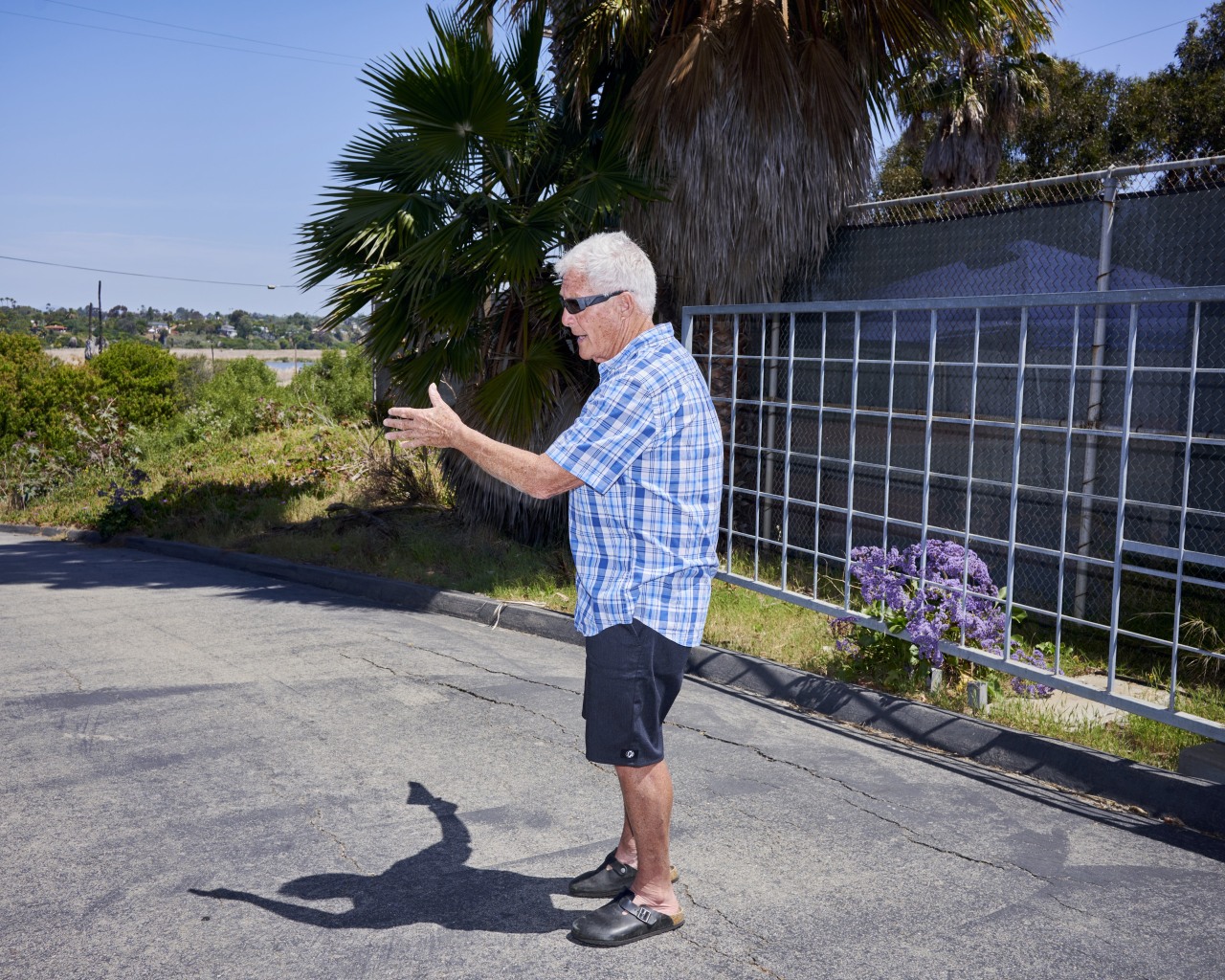
“They’re the investigator, they’re the prosecutor, they’re the judge, and they’re the jury,” said Levy, in a checked shirt and shorts, at his home in north San Diego County.
Few state agencies wield more muscle than the Coastal Commission, which was established in 1972 to safeguard public shoreline access and has tangled with luminaries including Hollywood powerhouse David Geffen, who was forced to open access to the beach in front of his then-home in Malibu. In 2014, California’s legislature gave the agency even more power, permitting it to impose fines up to $11,250 per violation a day. Two years later, the commission used that authority for the first time by dropping a $4.2 million penalty on a homeowner.
Proponents say the commission is all that keeps California’s breathtaking coastline open to the public. Critics argue it stifles development and inflates costs with heavy-handed unchecked regulations.
‘I love it’
Levy grew up surfing in San Diego County, then made his money selling dog collars and other pet products. In 1996, he spotted the land that would become his home while walking his dogs in upscale Carlsbad, the birthplace of skateboard legend Tony Hawk.
The 3-acre parcel sat on construction fill dumped in the lagoon decades earlier. A title dispute with the state had kept anyone from developing there. Levy bought it and spent two years navigating multiple agencies—led by the Coastal Commission—to win approval.
He built the quintessential bachelor pad: 3,700 square feet with 30-foot ceilings, but just one bedroom, on a spacious second floor, the bed facing the waves.
“I was a single guy, and it was like, I’m building just for me, and I love it,” Levy said as he led a tour past framed photos of surfers and picture windows. He recently added a touch: a giant teddy bear he bought at Costco.
“I said, ‘I got to have that thing.’”
He later married, had two children and in 2006 moved the family to New Zealand, renting Levyland to guests, some of whom used it for weddings. (Now single again, he sprinkles Kiwi-isms like “a wee walk” into his surfer lingo.)
Neighbor complaints about noise at a wedding led to a wider investigation by the Coastal Commission, said Chandra Slaven, a land-use consultant for Levy. It sparked the continuing, nearly decadelong fight that centers on two gates.
The first: a locked electric gate on Mountain View Drive, at the top of Levy’s driveway. Though Levy upgraded the gate with local approval when he moved in, it actually sits on land owned by a nearby townhome homeowners’ association—not Levy. He argues he can’t control a gate that isn’t on his property.
Commission staff disagree—they say Levy controls the gate and that the current HOA board claimed they weren’t even aware they owned the land. The HOA declined to comment.
The second gate raises a different question: whether a footpath on Levy’s land, on the lagoon’s edge, is public or private. When Levy built his home, he offered a public-access easement as a condition of his permit. But the city of Carlsbad, he argues, never accepted it. So he kept a chain-link gate to the trail locked. “I’m not gonna let people come into my property and fall and trip and sue me, am I?”
Commission staffers counter that an updated city trails map included the easement and that city staff at the time said the pathway was accepted.
But current Carlsbad officials have sided with Levy—and have hired outside counsel to challenge the commission’s claims.
Alex Helperin, a lawyer for the commission, attributed the apparent shift in Carlsbad’s position to a “change of political control.”
Threats mount
In 2017, the commission ordered Levy to open the gates or face daily penalties of up to $11,250. While the beach is accessible via a nearby public stairway, the agency argues that route is insufficient for the disabled or, for instance, those with strollers.
When threats didn’t work, the commission in 2024 slapped Levy with a cease-and-desist order, which started the process of full-blown enforcement. The agency added new charges, including the unpermitted construction of a pickleball court. Levy says he wasn’t aware a permit was needed and has since applied for one.
Advocates rallied on both sides. The Pacific Legal Foundation, a national public-interest law firm, is supporting Levy. Through public-records requests, Levy’s team discovered the commission had alerted environmentalists—including former reality star Mitch Silverstein, nicknamed “Mitch the Bitch” on “Married at First Sight”—and others to the case. Commission officials said they waged no such campaign. Silverstein declined to comment.
During the fall hearing requested by Levy, a representative for him dismissed the lagoon path as a “trail to nowhere,” prompting a philosophical reply from Commissioner Mike Wilson.
“Sometimes nowhere is where you want to be,” Wilson remarked.
After more than three hours of deliberation, the commissioners voted unanimously against Levy. He agreed under protest to open the electronic gate in return for the commission’s reducing his fine by $1.1 million, to $1.4 million, secured by a lien on his home. He later also unlocked the lagoon trail (though thick vegetation still blocks the entrance). “This is straight-up extortion, what they’re doing to me,” Levy said later. His lawsuit against the commission continues.
Lisa Haage, the enforcement chief, said “90% of the time” the commission is able to settle such cases without fines. “We don’t care about the money,” she said. “It’s a deterrent to try and protect public access.”
In Levy’s neighborhood, locals are divided over that new access.
“I want to say it was the happiest day of my life, but I have two children,” said Debra Schiff, 69, a bird-watcher, while admiring a turtle at the lagoon.
But Tim O’Connor, 65, whose condo overlooks the lagoon, worries about an influx of fast-moving electric bicycles and transients. “It’s a safety issue,” O’Connor said from his deck as an e-biker zipped past.
Write to Jim Carlton at Jim.Carlton@wsj.com