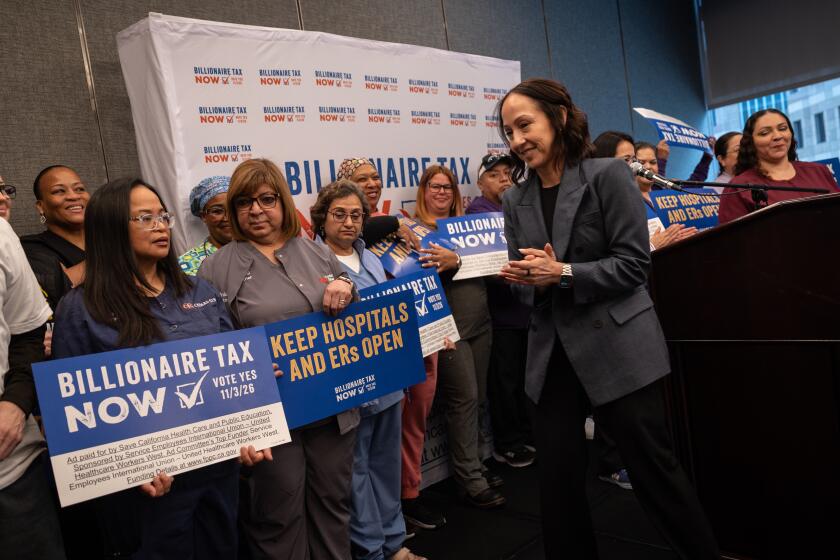
Supporters of a billionaire tax said Monday that they are submitting nearly twice as many signatures as necessary to qualify the controversial proposal for the November ballot.
Advocates say the proposed tax is critical to compensate for federal healthcare funding cuts, approved by President Trump and the Republican-controlled Congress, that will harm millions of the state's most vulnerable residents.
"We are out here today because California's health is at stake. Last year, Trump and Congress kicked 3.4 million Californians off their healthcare and doubled and tripled premiums for everyone else. Hospitals are closing and people will die," said Liz Perlman, the executive director of AFSCME Local 3299, which represents more than 40,000 University of California workers, at a news conference in downtown Los Angeles. "Why? So billionaires can get another tax cut that they don't need. It's immoral and needlessly cruel. And this measure does one thing, it rights that wrong."
Proponents of the ballot measure began submitting nearly 1.6 million signatures to county election officials at noon Monday. To qualify the proposal for the November ballot, they need to submit the signatures of nearly 875,000 registered voters by June 24.
Opponents of the measure said the proposal would destroy California's economy and budget, while doing nothing to address the state's underlying financial issues.
“This wealth tax would have a devastating impact on our economy, state budget, and the cost of living for all Californians," said Rob Lapsley, president of the bipartisan California Business Roundtable. "The measure doesn’t do anything to reduce the state’s $35-billion-plus budget deficit and does nothing to address the decade of overspending that led to the structural deficit. In fact, because the state relies so heavily on high-income-earner tax revenue, this measure could lead to reduced budget revenue in the long term as highly mobile wealthy individuals leave the state to avoid this new tax."
Supporters of the "Transparency Act," a so-called poison pill proposed for the November ballot, announced Monday that they plan to submit about 1.5 million signatures to county elections officials on Wednesday. This competing effort is portrayed as an effort to increase transparency and reduce waste in state spending, but it includes a provision that would require all new special taxes to be subject to a voter-approved spending cap. The proposed billionaire tax, as written, would be exempt from this cap. If both measures qualify for the ballot and are approved, if the transparency act receives more votes, it would nullify the billionaire tax.
“Californians are fed up. We are paying some of the highest taxes in the nation on top of the exorbitant costs of basic living expenses, yet tax dollars are being misused and wasted, which impacts real communities across the state.” said Paul Granillo, president and CEO of the Inland Empire Economic Partnership, in a statement. “The Transparency Act will finally provide the accountability, trackable progress and transparency that voters need and deserve.”
The proponents of the "Transparency Act" mailed signature petitions to Californians, an expensive effort in a state with 23.1 million registered voters.
Tech billionaire Chris Larsen and his cryptocurrency company, Ripple, have contributed a combined $10 million to oppose the billionaire tax. A committee established in March to fund the Transparency Act has collected $36.3 million, the vast majority transferred from the Building a Better California committee which has received $57 million this year from Google co-founder Sergey Brin. He is among several of the state’s billionaires who moved their residency or business entities out of the state in recent months.
The controversial wealth tax has divided Democrats, both in California and nationwide. Progressive icon Sen. Bernie Sanders (I-Vt.) quickly endorsed the billionaire tax, while Gov. Gavin Newsom denounced it. Newsom has consistently opposed state-based wealth taxes.
Among the Democrats running to succeed Newsom, former Health Secretary Xavier Becerra, San José Mayor Matt Mahan, former Los Angeles Mayor Antonio Villaraigosa, former Rep. Katie Porter, Riverside County Sheriff Chad Bianco and conservative commentator Steve Hilton oppose the wealth tax. State Supt. of Public Instruction Tony Thurmond supports the proposed tax, while billionaire Tom Steyer says he supports increasing taxes on the wealthy, such as himself, and has expressed measured support for the proposal while saying he has concerns about how it was drafted.
The proposed tax on billionaires was crafted by Service Employees International Union-United Healthcare Workers West, which represents more than 120,000 healthcare workers, patients and consumers, to counter massive healthcare funding cuts that Trump signed last year.
The union has contributed more than $23.7 million to support the measure.
The proposal would impose a one-time tax of up to 5% on taxpayers and trusts with assets valued at more than $1 billion, with some exclusions, such as property. The levy could be paid over five years. Ninety percent of the revenue would fund healthcare programs, and the remaining funds would be spent on food assistance and education programs. The proposal would cost the state’s richest residents about $100 billion if a majority of voters support it.
Supporters pushed back on the notion that the state's wealthiest residents would flee the state.
"It's clear that most Californians and most billionaires recognize how reasonable and necessary this proposal is, both to keep emergency rooms open and to save California businesses from closing," said Mayra Castaneda, an ultrasound technologist at St. Francis Medical Center and an executive member of SEIU-UHW. "A very small group of the most controversial billionaires on the planet tried to stop us, from being able to save our local emergency rooms and hospitals. But this is a David versus Goliath battle. David has just won the first round."
Times data journalist Gabrielle LaMarr LeMee contributed to this report.
This story originally appeared in Los Angeles Times.