
While recent weather headlines may still involve the word snow, spring is right around the corner, and we are itching for warmer, mowing days ahead. Now may be a good time to start thinking about the coming growing season. If your property has a yard that spans half an acre or more, then you know a standard walk-behind lawn mower simply isn’t big enough to efficiently keep your grass looking trim throughout spring, summer, and fall. Unless you want to spend a few hours every week mowing those massive yards, a riding lawn mower will widen your cutting path, reducing the amount of time it takes to cover an area.
Riding lawn mowers vary quite a bit from model to model. There are small rear-engine mowers for yards up to an acre and lawn tractors and zero-turn lawn mowers that will make quick work of larger jobs. Additionally, since you aren’t walking, you’ll be less fatigued and have more energy for whatever else the day brings.
Any model, regardless of your needs, is going to be a relatively expensive piece of machinery. You don’t want to rush into a purchase without figuring out what you need. We’ve put in our fair share of miles on these large yard machines and have recommendations for the best riding mower for your needs.
Best Riding Lawn Mowers
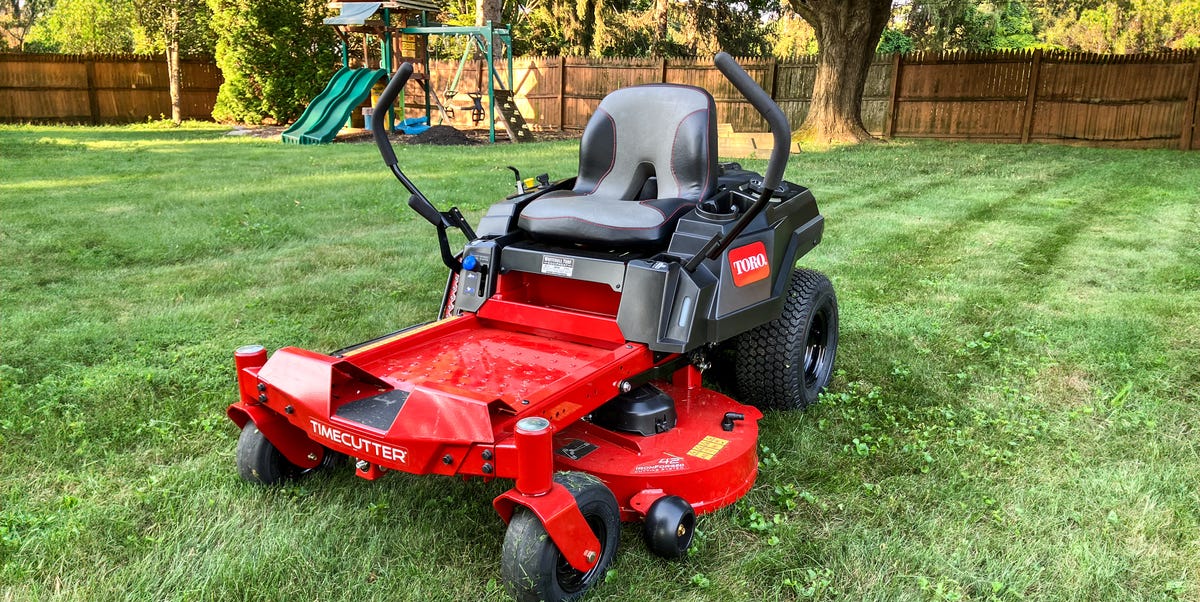
- Best Overall Zero Turn: Toro TimeCutter 42-Inch V-twin Gas
- Best Overall Tractor:Cub Cadet Enduro XT1 Riding Lawn Mower
- Best Electric Tractor:Ego Power+ T6
- Best Value: Cub Cadet 30-Inch 10.5 HP Riding Mower
- Tightest Turn Radius:Craftsman T2200 Hydrostatic Turn Tight Riding Lawn Mower
- Best Electric Zero-Turn:Greenworks 60-Volt 42-Inch Zero-Turn Mower
- Best Entry-Level Lawn Tractor:John Deere S100 Riding Lawn Mower
How We Selected
Our recommendations are based on testing and research from veteran contributor Tony Carrick and the Popular Mechanics test and review teams, including input from Deputy Reviews Editor Colin Aylesworth. Some riding mower tests were performed at a nearby college, while others were tested by members of our staff at our homes and properties.
Mower testing involves living with these machines. We subjected them to various types of grass (and weeds) in wet and dry conditions; we also mowed flat sections, up and down hills, and in different seasons. We depleted the batteries on the electric mowers and recharged them to determine real-world runtimes. We also evaluated how easy the riding mowers were to learn to drive and control over time. Basically, we try to subject our tested mowers to the most plausible real-life scenarios that an owner may encounter.
Full Reviews
The Toro 77401 TimeCutter zero-turn mower is a moderately priced mower with a 22-horsepower Briggs and Stratton gas engine and a 42-inch deck, which is representative of the type of mower many people may buy from their local dealer or Lowe’s. I found it to have an intuitive control system, with controls for engine choke, throttle, blade activation, and deck height. It comes set up for side discharge mowing and nothing else, which is typical for most riding mowers, though an optional mulch system and a bagger setup are available.
The cut quality with this mower is good—my first time using it was after over a week of not mowing, so the grass was long. I usually mow to a height of around 4 inches, and the TimeCutter handled it without issue. I double-cut most of the grass because the discharged clippings were noticeable, so going over the grass again breaks down those clippings into finer material that decomposes more easily and gives the lawn a cleaner appearance.
This mower is also fast. There are three speed settings—trim, tow, and mow—selectable with a dedicated lever. The mow speed setting is fast, and I found that speed adjustment with the lap bars is more sensitive than we would prefer.
A few minor quibbles with this model—the seat lacks any height adjustment, and for a shorter person (even at 5-foot, 10-inches), the seat seems a bit low. Also, there doesn’t appear to be an hour meter on the mower or any mention of one in the product manual. Toro recommends tracking usage by hours for scheduling performance maintenance, so it would be helpful to have a meter.
Annoyances aside, this mower appeals to a wide swath of potential customers. With its 42-inch deck and gas engine, it’s sized right for many residential uses and is powered by a method familiar to many people. The price is another point in the TimeCutter’s favor: at about $3,400, this mower appears to be a good value in a segment where prices can easily exceed $4,000. If you’ve got half an acre or more to mow and are ready for a zero-turn mower, this one is worth a look. – Tested by Colin Aylesworth
The Cub Cadet XT1 has everything we look for in a lawn tractor. It’s equipped with a 46-inch deck, making it ideal for handling larger lawns–up to 2 acres would be ideal for this. However, it maintains a manageable turning radius of 16 inches, so you can navigate around trees and landscaping beds without too much difficulty.
With a 23-horsepower gas engine, it’s more than powerful enough to keep the blades spinning at high speed. The hydrostatic transmission makes speed changes easy, and a push-button cruise control system allows you to rest your right foot on longer straightaways.
The adjustable deck features 12 cutting height options, giving you the choice of how high or low to cut. It also has a cleanout that lets you rinse grass out of the mowing deck. To use this feature, hook up a garden hose to the port, position the deck to its lowest setting, start the mower and blades, and let it run for a few minutes. The water will be dispersed by the spinning blades to hopefully loosen and dislodge built-up debris.
I’ve tested and used this tractor for two full seasons and have been pleased with its overall performance. My yard is about a half acre, and although I’ve noticed a bit of battery life diminishment in the span of my ownership, I’m still able to mow through my yard without issue, so long as the grass isn’t overly long and I am not double-cutting (which I sometimes do to break down my clippings into finer material).
There are two ways to charge the T6: charging each of the six batteries individually, or plugging the entire tractor into the adapter to do it all at once. A full charge takes a few hours, which is not an inconvenience as long as I do it right when I finish mowing, or between yards while doing finish trimming and blowing. I’ve found that the lifestyle adaptation of an electric mower is easy to accommodate.
This tractor is comfortable to sit on and easy to drive. My biggest annoyance is having to flip the transmission lever from forward to reverse, and the time it takes to create traditional stripes. I recognize this is more of a personal problem and also an inherent characteristic of lawn tractors—they just don’t turn on a dime like a zero-turn can. Still,
maneuverability around objects or turning 180 degrees to lay down a strip is not an effortless process.
Aside from that, the T6 is a solid machine. There’s a lever on the right-hand side of the seat used to easily adjust the deck height, a screen behind the steering wheel that displays battery life and other important information, and a handy storage cubby on top of the hood that can hold small items (I use it as a place to put sticks that I pick up as I am mowing). I also have a bagger attachment for this mower that comes in handy during autumn. I have three big Maple trees in my backyard that dump a lot of leaves, and the bagger system saves me a lot of time raking.
Most of all, one of the things I like most about this tractor is its limited noise pollution. While it’s not silent, you can hear yourself think when using this mower, even with the blades engaged, and you can safely operate it without wearing hearing protection. These are everyday benefits that make the increased cost of an electric mower worthwhile. – Tested by Colin Aylesworth
If you’re looking for a relatively inexpensive riding mower to handle yards up to 1 acre, look no further than this rear-engine model from Cub Cadet, which replaces the Troy-Bilt model that is exactly the same (made by MTD products, the parent company of those brands). It has a 10.5-horsepower engine and a 30-inch mowing deck that comes equipped with a mulch kit. The mower has a small turning radius of just 18 inches, making it easy to maneuver around tight spaces. It also comes equipped with larger wheels than you typically find on a rear-engine mower, ensuring you won’t get slowed down by uneven terrain, steep grades, or soft soil.
This mower has a manual transmission, but it should be fairly easy to get the hang of, and it’s part of the reason for this mower’s relatively affordable price. At just 30 inches wide and about 5 feet long, this mower is compact, making it easy to store in your garage or shed and drive through narrow fence gates.
Craftsman’s T2400K strikes the right balance between size and maneuverability. It sports a 46-inch deck, making it ideal for yards up to 1.5 acres. This mower’s big advantage is its tight turning radius—just 5 inches, which is superb for a lawn tractor. That attribute makes this mower ideal if you prefer a tractor-style machine but have lots of tight turns to maneuver.
Under the hood, a 22-horsepower Kohler engine provides plenty of giddy-up to power both deck and drive wheels. It’s equipped with a hydrostatic transmission for smooth speed changes and gives you 12 height options for cutting grass. There’s also a brush guard that protects the front end of the tractor.
Craftsman also includes some nice extra touches, including a high-back cushioned seat and a soft-touch steering wheel. Its ability to mow large lawns in a timely manner while still being nimble enough to navigate around obstacles makes the Craftsman a great all-around lawn tractor.
While we’ve not yet tested this model from Greenworks (we hope to in the spring), our evaluation of multiple user reviews and consideration of the features this zero-turn mower has to offer lead us to feature it here. With an electric motor that has roughly the power equivalent of a 24-horsepower gas engine and a runtime of 60 minutes, this battery-powered model is up to the task of cutting a property up to 2 acres or more, and users who have had it for over a year reported that it delivers on that promise.
This Greenworks zero-turn operates on six 8-amp-hour batteries and includes three dual-port chargers that recharge the batteries in 90 minutes during fast-charge mode. Since you don’t need to use all the batteries at once to operate the mower, you can use it with one set of three, for example, while the others charge. It has a top speed of 8 miles per hour and allows cutting height adjustments from 1.5 to 4.5 inches. Plus, it can tow up to 200 pounds.
Some complaints we found involved traction issues on rough terrain and a bit of bumpiness in the overall suspension. But users highlighted its very quiet operation, good cut quality, and an overall durable construction that held up over consistent use. If you prefer the eco-friendly nature of an electric zero-turn, this model is likely to deliver. —David Dritsas
This John Deere is an affordable and durable lawn tractor with a solid cast-iron front axle and a 17.5-hp engine to mow on any terrain. The deck has 12 height settings for a custom cut between 1 and 4 inches. Plus, there are plenty of compatible add-ons like a mulch kit, bagger, front bumper, and tow-behind spreaders and other tools.
In addition to these features, the S100 offers a reasonable 18-inch turn radius, separate gas pedals for forward and reverse, and comfort conveniences like an adjustable seat, cup holder, and small storage compartment. For anyone looking for a solid tractor for mowing and running implements like a tow-behind cart, aerator, or dethatcher, this is machine is a solid option.
What to Consider
Types of Riding Lawn Mowers
Lawn Tractors
Lawn tractors have an engine or battery array mounted on the front of the mower, with a driver’s seat and steering wheel behind the hood, like you’d see on a larger agricultural tractor. With mowing decks typically ranging from 42 to 54 inches, they can tackle lawns that are several acres large.
In addition to cutting grass, the tractor design is also great for towing yard equipment, such as a large fertilizer spreader, lawn aerator, or pull cart.
They’re ideal for cutting large lawns, but they have a relatively wide turning radius compared to other mower types and can be cumbersome if you have an area that requires lots of tight turns. Additionally, the engine placement can limit your visibility from the driver’s seat of the area immediately ahead of you. If you have a lot of trees, gardens, and landscaping beds, you may want to go with a rear-engine or zero-turn model.
Rear Engine/Rear Motor
These are the smallest type of riding lawn mower. Compared to others, they’re shorter and narrower, making them more maneuverable than their larger counterparts, and they typically have a cutting width of about 30 inches. Since the engine or motor sits behind the driver’s seat, there’s little to block your view besides the steering wheel as you’re mowing, making them easy to navigate around landscaping beds and trees.
Due to their relatively narrow cutting width, they’re a good fit for yards up to 1 acre in size. Since they’re smaller, rear-engine mowers also tend to be the least expensive of the three core designs, so they’re ideal for budget-conscious buyers.
Zero-Turn
Zero-turn mowers combine large mowing decks with unparalleled maneuverability. Instead of driving with a steering wheel, you typically control it with a pair of lap bars—one for the left drive wheel and one for the right—that allows you to turn the mower on a dime. Since there’s nothing high sitting in front of the driver’s seat, you get a wide open view as you’re mowing.
Zero-turn mowers are large and quick, and move faster than lawn tractors. Residential versions have similar-sized decks to tractors—42 inches to 54 inches and beyond—making them ideal for mowing large yards.
The downside, unsurprisingly, is the price tag. Even the most affordable zero-turn mowers cost several thousand dollars. Also, due to their weight distribution with the engine on the back and nothing up front, they aren’t as ideal for towing yard implements as tractors are. They also can have trouble on steep hills, especially if the lawn is wet.
Deck Width
The mowing blades of any riding lawn mower are housed in a steel cutting deck, which sits just above the ground you are moving over. The width of the deck determines how wide a swath of grass the mower cuts with each pass.
Ideally, we recommend that you look for a riding mower that allows you to cut your grass in about an hour to an hour and a half. A deck width of around 30 inches will allow you to cover about an acre in that time. Move up to a larger mower with a 42-inch deck for yards up to 1.5 acres. Finally, upgrade to a deck size of 50 inches or more for any property larger than 2 acres.
Engine/Motor Power
The power (i.e., output) of a gas-engine riding mower is expressed in horsepower (hp). An 11- to 15-hp engine or motor can adequately power a mower with a 30-inch deck. For mowers with decks between 42 and 46 inches, you should look for no less than 16 hp. For the largest mowers, with decks between 52 and 60 inches, you want an engine capable of producing 22 hp or more.
Electric mowers have motors, but the power output can be hard to discern. For those used to gas-powered specs, some manufacturers list an hp-equivalent number in an attempt to compare an electric model to a gas-powered counterpart. But more often, you’ll see power in numbers expressed in either kilowatt-hours (kWh), system voltage, and sometimes, battery amperage (Ah). Unfortunately, different manufacturers will emphasize different numbers.
Generally speaking, motor systems and batteries with higher voltage and amp ratings will deliver more kilowatt-hours of power, but these numbers can be easily misunderstood because their meanings can change depending on how they are used together. For example, an 80-volt system using three 10-Ah batteries will deliver fewer kilowatt-hours of power than a 56-volt system using a 60-Ah battery.
Though it’s not a perfect number to gauge the power of an electric mower, the max kilowatt-hours is a helpful spec to look at (sadly, not all manufacturers list it). The more you have, the longer the runtime and ground coverage you’ll achieve. Electric Riding mowers range from around 2.5 kWh up to 7 kWh or more.
Gas vs. Electric
Gas-powered riding mowers are still the king when it comes to power and runtime. When you run out of gas, it takes seconds to refuel. That’s why most landscaping professionals still rely on them. The downside is the cost of fuel, oil changes, and general engine maintenance as time goes by. If you don’t maintain your gas mower properly, you could wind up with an expensive repair bill. They’re also much louder than their electric brethren and produce carbon emissions that some dislike.
Battery-powered mowers require less maintenance than gas-powered ones, as they don’t need oil changes, and you don’t have to worry about fuel going stale or needing to clean the carburetor. They also run at lower noise levels. As with other outdoor appliances, though, battery-powered mowers may lack the raw power and endurance of traditional gas-powered riding mowers, which will be most evident in heavy, thick grass or on lawns with dense leaf cover. Some battery-electric mowers will have no issues in these scenarios, but you’re likely to notice they drain the battery faster than a typical maintenance mow.
This leads to another potential issue—charging time. Battery-powered mowers can run for a couple of hours on a single charge, then typically need a few hours to fully recharge, unless you have an alternate set of fresh batteries to swap in.
Transmissions
Manual Transmission
These are found only on comparatively inexpensive lawn tractors. The transmission is a complex assembly of gears and shafts. An input shaft into the transmission is driven by a pulley and a belt from the engine.
To operate a manual transmission on a riding lawn mower, you depress a foot pedal that disengages the pulley drive from the engine to the transmission. This stops the tractor’s forward motion, allowing you to move a hand lever to select the gear you want. When you let off the pressure on the pedal, the tractor moves forward.
By moving the tractor’s throttle forward (or up), you go faster, up to the maximum possible speed in the gear you have selected. To slow down, you move the throttle lever down, decreasing engine speed. To stop, you push in the foot pedal. To remain stopped, you move the transmission lever into the neutral position.
Automatic Transmission
Like in a car, an automatic transmission does the work of shifting for you as your speed changes (or eliminates the need for gears altogether). In riding mowers, several different technological methods are employed to achieve this.
Hydrostatic transaxle: This is a fluid-drive system that uses hydraulic pressure to drive power to the transaxle. No gears are needed. The pressure is applied when a lap bar (zero-turn mowers) or a foot pedal (lawn and garden tractors) is engaged. The more you push, the more fluid flows through the transaxle, causing it to spin faster. An axle shaft coming off the transmission drives the wheel (or wheels) to which it’s connected
Continuously Variable Transmission (CVT): This is found on a few mid-priced lawn tractors and expensive agricultural and construction tractors. It's a drive system that uses conical-shaped stepped pulleys. A belt riding up and down on the pulleys transfers rotational force to control ground speed. The operator increases or decreases ground speed with a foot pedal. A linkage from the pedal changes the position of the belt on the pulleys, increasing or decreasing ground speed.
Electro-hydrostatic transmission: This hybrid transmission is found on electric tractors and electric ZTR mowers that use an electric motor to drive the transaxle. It also doesn’t require the use of mechanical gears.
Maintenance and Warranty
A riding mower will require general maintenance from time to time. With gas-powered models, you'll need to check your oil levels, change or clean the air filter at least once a season, and check and maintain any belts. Electric motors don't require any of that, which is why they are easier to take care of.
Zero-turn mowers don't use belts (though some older models may have them), but some use hydrostatic transmissions that may require you to refill the hydraulic fluid levels. Also, monitoring tire pressure levels should be on your checklist for any type of riding mower.
Keeping things clean is also key to good mower care. Remove caked-on grass debris any time you can from the underside of the cutting deck and the discharge chute. And don't forget to occasionally sharpen your blades or replace them with new ones. For riding mowers, this process is more complicated than a push mower and may require a mower jack, but it's not hard to accomplish for the confident owner.
Knowing what kind of warranty you're getting is also helpful. Riding mowers can carry a warranty of anywhere from two to five years of unlimited operation or with “hours of use caps.” Much like a car warranty that is based on whichever comes first—years or mileage— riding mowers may run out after an operational period of 300 hours if that happens before a three-year term, for example.
Lawn Mower FAQs
with Expert Tony Carrick
How do I know if I need a riding lawn mower?
You should start looking at riding lawn mowers if you have half an acre or more of grass to cut on your property. Riding lawn mowers cut grass using a mowing deck, which trims a wide swath of grass using one to three blades as you drive over it.
Small riding mowers usually feature a mowing deck around 30 inches wide, which means they can cut an acre in about an hour. By contrast, the average walk-behind lawn mower cuts a 21-inch swath of grass, so it would take around 2 hours to cut the same acre.
Just because they cut more grass at a time doesn’t mean they’re always better, though. It’s worth keeping in mind that riding mowers are large and somewhat unwieldy. In a smaller yard with lots of trees, gardens, and other landscaping features to avoid, you’re better off simply using a standard walk-behind mower.
How fast can a riding lawn mower go?
Your riding mower’s top speed depends on a number of factors, such as the size of the engine, which often corresponds to the size and design of the mower. Rear engine lawn mowers and lawn tractors often reach speeds ranging from 4 to 6 mph. A zero-turn lawn mower can reach faster speeds or between 7 and 10 mph.
While you’ll generally be able to get the job done more quickly with a faster mower, keep in mind that cutting with a riding lawn mower while moving at top speed may not result in a very even cut.
How long will my riding lawn mower last?
You should expect to get 10 years or more out of a good riding lawn mower. As with most machines, your specific machine’s lifespan will vary depending on how well you take care of it, though. To get the most out of it, change the oil and filter regularly, check belts and hoses for wear and tear, sharpen the blades each year, and periodically clean the mowing deck.
Also, use it regularly: Attempting to mow through thicker brush can dull the blades and strain the engine, which may lead to problems down the road.