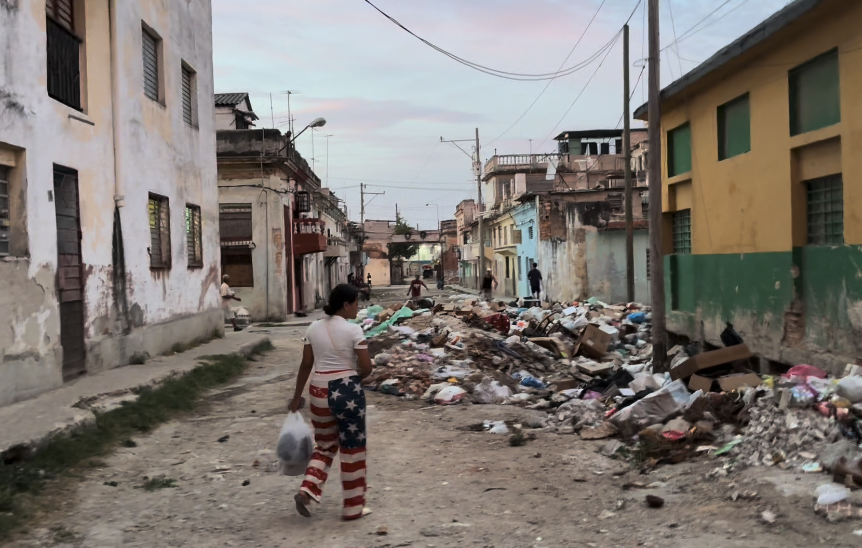
It’s not a sight one expects in the backstreets of Havana, but perhaps it’s not so surprising in what many consider the final, dying days of Castro’s Cuba.
A young woman is making her way home at twilight, trudging through the trash in pants printed with the American flag.
Anna-Maria, 23, hasn’t had running water for days and gets only about two hours of electricity at home most of the time.
Under the U.S. oil blockade this year, she has been struggling to get by without the basics. It’s a struggle to cook each day without a working fridge or stove.
The trash is piling up on her street because the garbage trucks have stopped running. She has to walk to work because the buses have stopped.
“It’s a really hard situation, we’re suffering a lot right now,” Anna-Maria tells Newsweek. Like all the interviewees in this piece, her name has been withheld for safety reasons.
But she doesn’t blame the American blockade – she blames her government – even as Donald Trump has tightened the screws on Cuba’s regime this year.
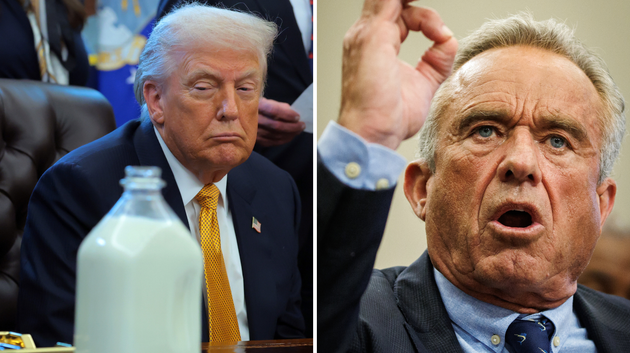
The U.S president has repeatedly threatened a “friendly or not so friendly” takeover, telling a crowd in Florida last week the U.S. would take Cuba “almost immediately” after the Iran war.
But Anna Maria isn’t alarmed by the prospects of U.S. intervention. If it meant an improvement to daily conditions, she would want it “to happen now, immediately”.
“We are suffering a lot right now.”
Fidel Castro once told a journalist, when asked about the perennial threat of U.S. invasion: “Any man or woman in Cuba prefers death to living under the boot of the United States.”
But young people like Anna-Maria have no desire to defend the current system that the Cuban Revolution has evolved into.
Her experience has been one where the state has consistently failed to provide the basics. The U.S. blockade has worsened things, but the highly-centralized, state-controlled economy had been stagnant for years, riddled with mismanagement and corruption critics say.
She sells clothes at a market, hoping to become one of the 10,000 private businesses that have sprung up in recent years following liberalizing reforms.
But to do well in the state-run economy, you need to be close to the Communist Party, she says.
“Communist socialism will never be effective because they are thieves and they steal so much,” she said, referring to alleged government corruption.
“They don’t allow Cubans to do their own thing, get their own ideas. But Cubans are very intelligent and hardworking. And by not letting us express ourselves, that’s why we are in this misery.”
The Cuban government has long argued that it has been held back by the weight of the U.S. trade embargo, that the country’s well-regarded medical and educational systems have been achieved despite punitive measures imposed by the world’s largest economy.
The U.S. has maintained the embargo essentially ever since Castro and his guerrillas swept the U.S.-backed military dictator Fulgencio Batista from power.
Washington was actually among the first to recognize the new leaders on the island 90 miles from Florida but when the rebels seized back private land, nationalizing refineries and sugar cane fields owned by U.S. companies, President John F. Kennedy banned Americans from selling to or buying from the country.
The embargo—running for 67 years now and considered the longest in modern history—has been tightened and loosened in the 14 U.S. presidencies since.
But President Donald Trump in his second term has applied a “maximum pressure” version, aimed at choking the life out of Cuba’s economy.
His fuel blockade against Cuba—which he justifies as a national security measure—has been twofold.
In seizing Venezuela’s president in January and taking over the country’s oil exports, Washington cut Cuba off from its main foreign supplier of cheap oil and a critical ally.
Trump openly mused that without Venezuelan oil, Cuba would be “ready to fall”. Then the following week he ordered tariffs on any countries that would supply oil to Havana.
That has worked to deter former suppliers like Mexico and there have been reports of the blockade going even further; of U.S. naval vessels turning away tankers and hunting down Cuban vessels venturing out for oil.
One Russian tanker was allowed through in late March, as the U.N. warned the island was facing a growing humanitarian crisis. Trump made it out to be a gesture of goodwill.
“We don’t mind having somebody get a boatload, because they need—they have to survive,” he said.
Cuban government officials say the U.S.’s economic warfare results in collective punishment for ordinary Cubans.
They also point out the huge battle they face in the information war on what’s happening; the millions approved by Congress each year on what they say is U.S. propaganda and what Washington says is aid.
The point of the blockade has always been thus: to make people suffer so much that they give up believing in the Cuban communist system, one official told Newsweek. To combat that you need “education, mobilization, trying to solve people’s problems,” they said.
But authorities can’t even keep the lights on at the moment.
Yeli is an 18-year-old first-year medical student who speaks excellent English, a result of her public schooling in Havana. She hates the system.
We’re sitting in her neighbor’s peeling house in the dark, just meters from festering garbage at the end of her street.
“They say socialism is such a great thing, that it made such great changes. They say you have free school, you have free medical care,” she told Newsweek.
“But when you go to the schools, you don’t have light, the teachers can’t teach.”
“Broken chairs, broken tables, there is no material, no books,” her boyfriend Alejandro, 18, says. “You have to wait for a classmate to finish with his book to borrow it from him.”
Yeli, just starting out in her career, describes what her in-person training is like. At the clinic she attends once a week, the cupboards are empty. Doctors pay out of their own pocket for whatever medicines they can scrounge and basics like paracetamol and allergy medication are sought after substances on the black market.
“It’s very sad. I just sit there and say to the patient, sorry I don’t have anything to give you. I don’t know what to give you because I don’t have meds. It’s free healthcare but at what cost?”
One doctor told Newsweek she has to give patients oranges instead as “treatment” in some cases.
Cuba is renowned for its homegrown pharmaceutical industry – it developed its own COVID vaccines during the pandemic – but drugmakers in the country are failing to import in key ingredients under the blockade, or they lack the fuel to distribute across the island what has been produced.
At least 2 million Cubans, or around a fifth of the population, have left the country in the past five years, a brain drain of young talent nurtured through the Cuban public system.
Alejandro has been saving pesos wherever he can so he can escape to the U.S., maybe next year.
He’s due for military conscription but refuses to go—he has a medical condition and besides, he thinks it’s pointless.
Their neighbour, Nurse Camila, misses her daughter who left for the U.S. four years ago after the pandemic shuttered Cuba’s tourism-reliant economy.
“The only reason we’re alive is because of the families living outside the country,” she says referring to the remittances she receives from her daughter and brother in the States.
She thinks she wouldn’t be able to eat otherwise. The energy crisis has led to food shortages and price inflation. At one government store Newsweek entered in April, a 500g bag of rice was being sold for $2.50. The median monthly wage in Cuba stands at around $16.
The “libreta,” the booklet of rice, beans, sugar, oil and other staples distributed by the government has also been disrupted by the fuel crisis.
A decade ago, people regularly got meat and vegetables delivered, even a case of beer on their birthdays. These days they are lucky to get a bag of beans every two weeks, Alejandro says.
Cubans are supposed to be celebrating the 100th anniversary of Castro’s birth this year. His portrait and those of fellow revolutionary Che Guevara still adorn walls in bars, clinics and classrooms around the capital.
“When Fidel [Castro] was here this didn’t happen. Fidel had good direction,” says Nurse Camila. “But now nothing is worth it since Fidel left.”
But Nurse Camila is ambivalent about a U.S. takeover, seeing it as a good thing if it leads to change. “I want development,” she says.
At May Day parades last week, former president and last living revolutionary Raúl Castro, now 94, was presented with a book of more than 600,000 signatures of locals, pledging to defend the homeland.
But most of those signatures were coerced; Cubans can risk losing their government job or having police show up at their door accusing them anti-revolutionary spirit if they don’t turn out.
The government continues to repress and punish almost all forms of dissent and public criticism, especially amid the economic crisis, human rights groups note.
More than 2,000 prisoners were released last month, a move interpreted by watchers as a conciliatory gesture to the U.S. amid negotiations. But while Newsweek was in Havana, there were reports too of locals being placed under house arrest.
Washington has made it clear it’s interested in regime change— indicating it wants the current president Miguel Díaz-Canel to step down. The opinion held by many Cuba watchers is that Trump is looking for an internal regime figure with whom Washington can work to reinstall U.S. influence in Havana.
Díaz-Canel has rejected the pressure, and in his first interview with U.S. media in three years, told Newsweek last month in the presidential palace in Havana that if the U.S. were to launch an attack, his country was prepared to fight back.
For Cubans attuned to the fundamental issue at stake— the island’s continued resistance to an empire —there is anger at the U.S.’ economic bullying, even as they acknowledge internal faults.
Government officials pose the question – why can’t the U.S. just leave them alone?
“Yes we have a different political system and we have our own problems but the U.S. should respect that, just like it does the systems in China and Russia,” one official told Newsweek in Havana.
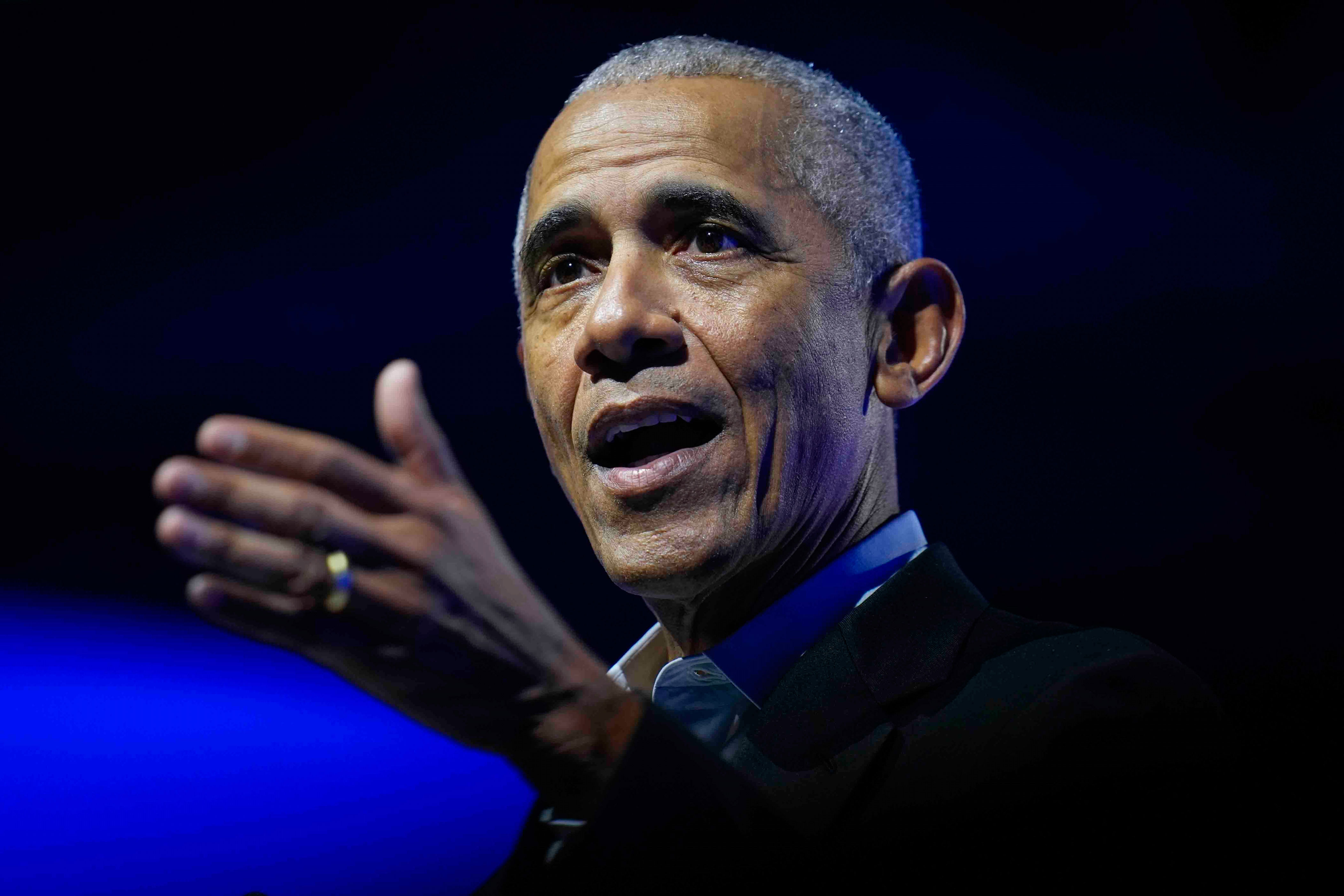
The Cuban government also stresses that it’s not just this year’s U.S. blockade that has led to the dire conditions but rather the cumulative effect of censures in place since 2018, when Trump ripped up the ties of rapprochement carefully established by the Obama administration with Raúl Castro.
Trump reimposed travel and finance restrictions on Cuba, which continued under the Biden administration, and designated the country as a state sponsor of terrorism. That, coupled with the pandemic 18 months later, obliterated the gains Cuba had been making.
“During the Obama years, Cuba got so much better, but when Trump came that’s what has made the last few years so bad. The blockade has been the hardest,” says Yeli’s grandfather, a former colonel in the Cuban army who fought in Angola.
He beckoned Newsweek over after overhearing his granddaughter’s comments.
“Young people don’t understand what a U.S. intervention would look like,” he said. “They don’t know what they’re saying.”
But many are too disillusioned to care about what happened in the past. They’re suffering now, and they just want a better life.
“We’ll survive because we’ve always survived,” says Yeli, the medical student.
“But ever since we were like children, we grew up seeing this situation. And we have in mind to get out of this country as soon as possible.”
Related Articles