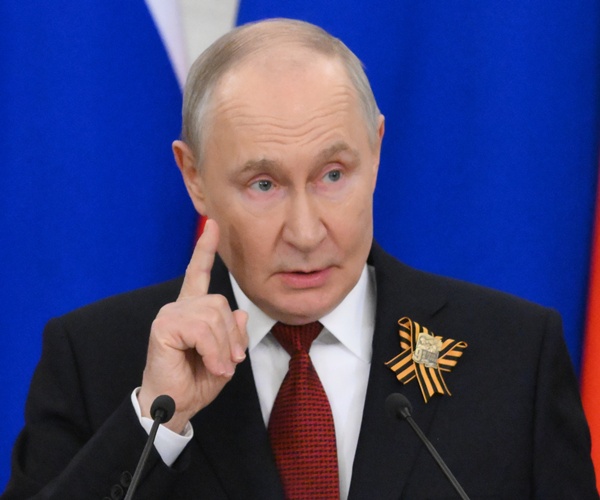
MOSCOW — Russian President Vladimir Putin said Saturday that the United States, Israel and Iran had agreed to transfer enriched nuclear material from Iran to Russia, but that the arrangement ultimately collapsed after Washington reversed its position and demanded the material be sent only to the United States.
Speaking during a lengthy post–Victory Day press conference at the Kremlin following military commemorations in Moscow, Putin described the earlier negotiations as a missed opportunity to reduce tensions in the Persian Gulf and revive confidence in diplomacy surrounding Iran’s nuclear program.
Addressing questions about the current standoff between Iran and the United States, Putin revealed details of the recent talks on the plutonium.
“We didn’t just propose it; we already did it once, in 2015,” Putin said.
“Iran trusts us completely… and it has good reason to trust us, because, firstly, we’ve never violated any agreements.”
He added that Russia had previously accepted nuclear material transfers connected to the international agreement over Iran’s atomic activities.
“And initially, and this is sort of a secret, everyone agreed—representatives of the United States agreed, Iran agreed, Israel agreed,” Putin told the press about more recent negotiations.
According to Putin, the deal unraveled when “the United States hardened its position and demanded that the uranium be transported only to the United States.”
He said that shift prompted Iran to change its own stance and refuse to move the material abroad.
Putin recalled that former Iranian official Ali Larijani later informed Moscow that Tehran no longer supported exporting the enriched uranium.
Instead, Iran proposed “creating a joint venture, but on Iranian territory, and diluting the uranium together there.”
The Russian president said Moscow remained open to compromise, telling Iran: “Go ahead, we’re not against it. The main thing is that this defuses the situation.”
But Putin added that he believed “neither the United States nor Israel” would accept the revised arrangement, leading negotiations into what he called “a dead end.”
But a source in the Netanyahu government told Newsmax that Israel still supports the idea of transferring Iran’s plutonium to Russia, subject to provisions for inspections.
Putin argued that Russia’s proposal would have provided transparency and international oversight through the International Atomic Energy Agency.
He emphasized that any transferred nuclear material would be fully monitored.
“Everyone would see what it is, how much of it, and where it is,” Putin said. “Secondly, it would all be placed under IAEA control.”
He also stressed that the dilution and handling of the uranium would remain under international supervision, saying “the work of liquefying this uranium would also be organized under IAEA control and would be transparent and safe.”
Putin defended Iran against allegations that it was pursuing nuclear weapons, stating that “the IAEA has never said that there’s evidence that Iran is pursuing nuclear weapons,” while also referencing religious decrees from Iranian leadership against such weapons programs.
Throughout the remarks, Putin portrayed Russia as a neutral intermediary seeking to lower tensions in the Persian Gulf rather than gain geopolitical leverage.
“We simply want to make some small contribution, if it suits everyone, to defusing the situation,” he said.
Despite the breakdown in negotiations, Putin insisted that “compromises are possible” and said Moscow would support “any solution that will break this deadlock and make it possible to move toward a peaceful resolution.”
Putin’s remarks came as tensions remain high across the Persian Gulf region amid ongoing disputes over Iran’s nuclear activities and broader instability in the Middle East.
Putin warned that any escalation would leave “everyone” worse off and said there were “no longer any interested parties in continuing this standoff.”
The Kremlin press conference followed Russia’s annual Victory Day celebrations, which this year were scaled back because of security concerns connected to the war in Ukraine.
© 2026 Newsmax. All rights reserved.