
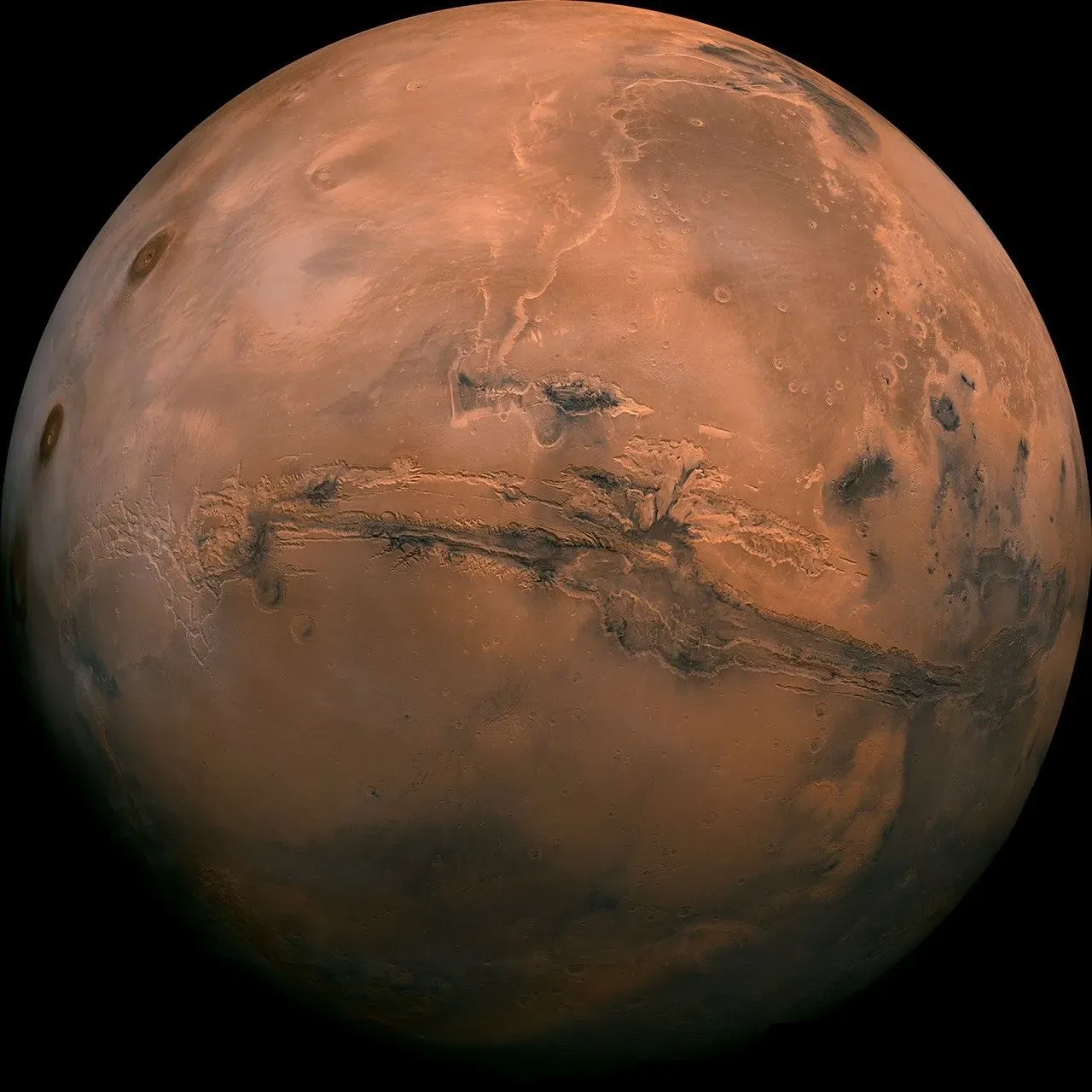
Under the best circumstances, a trip from Earth to Mars and back would take a spacecraft three years to complete.
And that's during a very specific orbital alignment that occurs once every two years or so as the two planets travel around the sun.
But new research has unveiled a possible shortcut to Mars that would drastically reduce the time it would take to reach the red planet. Taking a cue from the orbital trajectories of asteroids, a researcher discovered what he claims is a viable shortcut to and from Mars that would span less than a year.
Start the day smarter. Get all the news you need in your inbox each morning.
The finding comes as NASA is in the midst of returning astronauts to the moon under the space agency's Artemis program, which has the larger objective in the years ahead of sending the first humans to Mars.
Here's what to know about the newly-found possible shorter trajectory to Mars, and what it could mean ahead of future missions to Earth's planetary neighbor.
How long does it take to reach Mars?
On average, Mars is 140 million miles from Earth.
But because the distance between Earth and Mars is constantly changing based on their orbits, the best time for spacecraft – with or without a crew – to venture to the red planet comes once every 26 months. During that window when the two planets are closest together on the same side of the sun, traveling to Mars takes anywhere from seven to 10 months.
For future missions with astronauts who would, of course, want to return to Earth, they'd have to wait for another return window, stretching a crewed mission to nearly three years, according to NASA.
Astronomer finds shortcut from Earth to Mars
But what if we could cut the time it takes for that round trip in half?
Using the early orbital data of asteroids, Marcelo de Oliveira Souza, a cosmologist at the State University of Northern Rio de Janeiro, said he was able to find a way to shave off a significant amount of time for the interplanetary journey.
Souza followed the early predicted path of a near-Earth asteroid that crossed the orbit of both Earth and Mars to make his findings, which were published in the journal Acta Astronautica.
By following the initial predicted route of near-Earth asteroid 2001 CA21 around the sun, Souza concluded that a human-made spacecraft could follow a similar trajectory on a much more direct path to Mars.
Souza also analyzed potential launch windows based on Mars and Earth's orbits to determine that 2031 may offer the best opportunity for a shorter trip. In that year, the study identified two possible profiles for a round trip to the red planet, with total durations of about 153 and 226 days.
It's important to note, though, that either option would require a spacecraft to travel at speeds well beyond current capabilities of both rockets and landings systems, Souza wrote.
Discovery comes as NASA eyes 1st human Mars missions
While Souza's concept is largely theoretical, the researcher posited that it could still prove useful for space agencies charting voyages to Mars based on the planet's movements in relation to Earth.
NASA in particular has its sights set on sending the first humans to Mars in the next few years. A key objective of the agency's Artemis lunar campaign is to use a series of human moon landings to inform how crewed travel deeper into space – including to Mars – could be accomplished.
First, though, NASA plans in 2028 to launch the first nuclear-powered spacecraft to Mars in what could be a pivotal test of a technology that could also be a power source for human surface operations. The Space Reactor-1 vehicle would reach Mars in 2030 and deploy three helicopters similar to the retired Ingenuity aircraft that would survey for potential human landing sites and use radar to identify sources of underground water.
Such fission nuclear-powered technology used in the spacecraft could be vital on Mars where dust storms known to block the sun for weeks at a time would make solar power unreliable.
Eric Lagatta is the Space Connect reporter for the USA TODAY Network. Reach him at elagatta@usatodayco.com
This article originally appeared on USA TODAY: A researcher may have found a shortcut to Mars as NASA eyes red planet