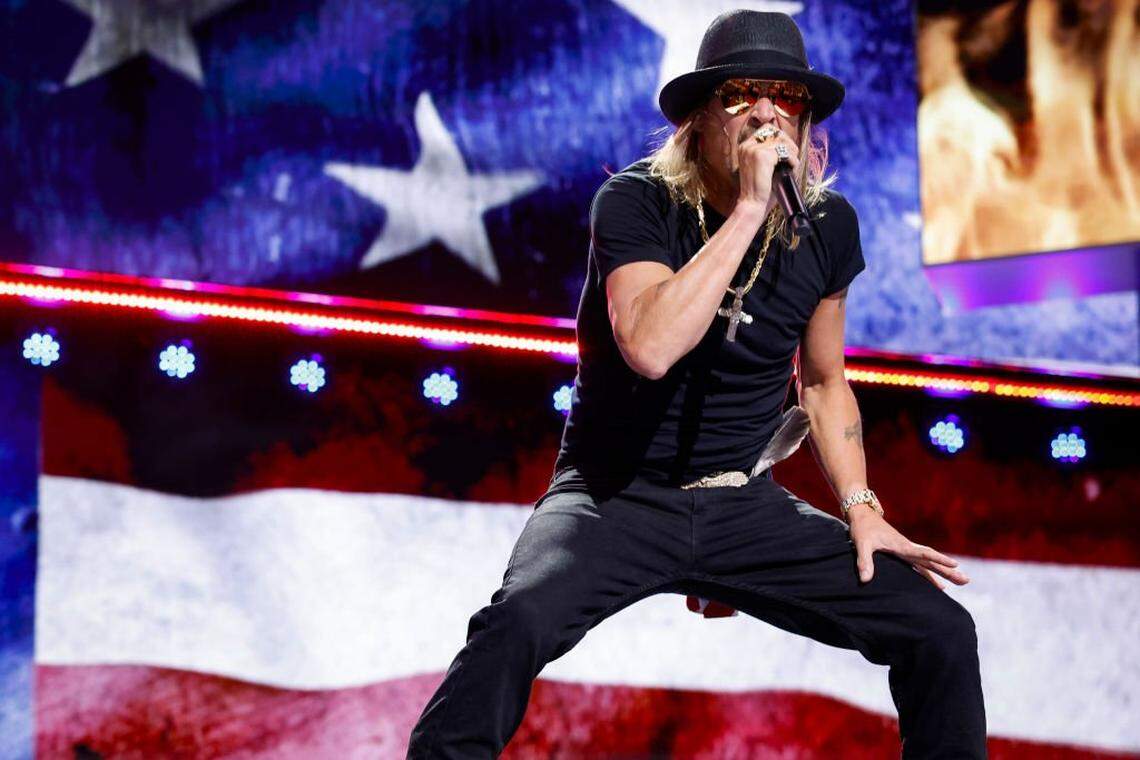
Kid Rock concerts contain multitudes.
And on Saturday night at Truliant Amphitheater, those multitudes included: giant American flags; an AI-generated re-creation of Abraham Lincoln signing the Emancipation Proclamation; a U.S. Department of War promo featuring President Trump proclaiming his military is “defending America like it’s never been defended before”; Civil War-style cannons loaded with real pyrotechnics; the headliner scratching records one-handed while simultaneously lighting a cigar and pouring Jim Beam; a 10-year-old girl in the front row being gifted a saxophone by Mr. Rock, followed immediately by a video gag that featured a topless woman and male genitalia; and a virtually never-ending parade of middle fingers.
It was all deeply ridiculous.
The Charlotte stop on his ‘Freedom 250 Tour | The Road to Nashville’ also was, somewhat annoyingly for skeptics, an extremely effective concert experience.
That is to say this: The 55-year-old showman (née Robert James Ritchie) still knows exactly how to overwhelm an amphitheater.
But even before Kid Rock hit the stage on Saturday night, the crowd - the median age of which appeared to be somewhere around “still owns CDs” - was already marinating in a carefully assembled stew of red-white-and-blue iconography that made even the countrier country concerts at Truliant seem restrained.
American-flag clothing, both inspired by and literally made-of, was everywhere. Even more impressively, it seemed like 1 out of 100 shirts had the F-word on it. Which might not sound especially notable until you realize there were roughly 15,000 people on hand.
The opening acts leaned hard into that anything-goes atmosphere.
Them Dirty Roses kicked things off with Southern-rock swagger before gradually mutating into something closer to full-on hard rock.
Then Brantley Gilbert arrived in a sleeveless “Intimidator” shirt flanked by flames, on the heels of a video montage wildly overstuffed with military imagery and speeches from JFK, MLK and Ronald Reagan.
Gilbert - who seven years ago headlined this venue himself - smoked a cigar and dipped tobacco simultaneously for much of his set, which luxuriated in country-music-concert tropes. He shouted, “We got any rednecks out here tonight?” in the early going (and got loud cheers). He thanked “the boys and girls overseas” later on (and got even louder cheers). He somehow managed to make his biggest highlight a genuinely strong performance of “Dirt Road Anthem,” the Jason Aldean hit he co-wrote with Colt Ford.
But he also slipped snippets of Limp Bizkit and Linkin Park songs into a medley - a reminder that the entire evening would function less like a traditional country concert and more like a giant American nostalgia blender set permanently to “puree.”
It was the perfect set-up for Kid Rock, who started his own pureeing from the get-go.
At 8:53 p.m., giant flags filled the video screens while his acoustic version of “Proud to Be an American” played over the speakers, the crowd singing along loudly. “Don’t Stop Believin’” followed, fans bobbing their heads as spilled Coors Lite seeped down the sloped seated sections.
Then came another even-more-overstuffed video montage, this one featuring AI-created animations and videos of everything from the Civil War and the suffrage movement to Jesse Owens, Muhammad Ali, Neil Armstrong, the “Miracle On Ice,” and Trump pumping his fist after last year’s assassination attempt.
Finally, a prerecorded Pete Hegseth clip appeared in which the Defense Secretary offered Kid Rock a ride to the show in a Department of War helicopter.
And somehow all of this was merely the appetizer - for an even more outrageous spectacle.
Things really got started when Kid Rock emerged atop the highest tier of the stage in a glitter-striped black tracksuit with “Made In Detroit” sequined across the back, gold chain hanging from his chest, abs flashing every time he pumped his fist.
Cannons exploded. Fireworks burst from platforms decorated with bald eagles that had stars and stripes on their spread wings.
But what was most striking wasn’t the politics or even the spectacle. It was the sheer physical commitment.
Not even 20 minutes into the show - despite the cool edge in the spring-night air - he was already sweating so profusely his shirt looked like it had survived a maritime disaster.
Yet the man kept rockin’.
For nearly two hours, Kid Rock barely stopped moving. He hopped, skipped, jumped, kicked, danced, waved towels, flipped his mic in the air, strummed guitars, blew a sax, scratched records, banged a tambourine and a drum kit, played and then climbed atop a white grand piano, and conducted his band like a man trying to summon a thunderstorm.
Musically, the set could feel less like a coherent concert than a jukebox possessed by the ghost of a 2003 Daytona Beach spring-break trip. Country bled into rap-rock, which bled into blues, which bled into Southern rock, which bled into his DJ theatrics. In addition to his standards, Kid Rock and company ripped through bits of ZZ Top, Stevie Wonder, The Rolling Stones, Ted Nugent, and Kenny Rogers and Dolly Parton, basically refusing to settle into a genre before you could accuse him of settling into a particular one.
Against all reasonable expectations, it worked.
That’s because beneath all the fireworks and provocation, Kid Rock remains an unusually gifted ringmaster. He understands pacing. He understands crowd psychology. He understands when to lean into absurdity and when to pivot by, say, crooning with surprising tenderness.
His introspective 1998 power ballad “Only God Knows Why” transformed into something almost revival-like. 2001 country-rock ballad “Picture,” performed with a young backup singer doing the Sheryl Crow parts, became a legitimately strong vocal showcase. During the feel-good anthem “All Summer Long,” a big hit for him in 2008, thousands of people seemed awash in a wave of nostalgia.
As for politics? They perhaps proved less dominant than outsiders might expect.
Yes, Trump imagery received loud cheers. Yes, patriotism saturated the production. But the loudest reactions frequently came not during political moments, but during the giant communal singalongs: “Cowboy.” “All Summer Long.” “Bawitdaba.” The emotional engine of the show wasn’t outrage. It was nostalgia.
During the early part of his set, Kid Rock proudly announced that the two awards he treasures most are the Detroit NAACP’s Great Expectations Award and the Waffle House “Legend Award,” bestowed upon him for being the redneck-friendly restaurant chain’s most-played artist of the decade.
Honestly, nothing else could have explained him better. Because Kid Rock has always existed in contradiction.
He’s a Detroit rapper turned Southern-rock patriot. A wealthy celebrity masquerading as dive-bar outlaw. A politically polarizing figure whose concerts ultimately function less as ideological gatherings than giant parties where everyone wants to feel loud together for a few hours.
Kid Rock may never again dominate pop culture the way he once did. But by the time he said his goodbyes and disappeared beneath the stage at 10:48 p.m. Saturday - after ringing a giant Freedom Bell while 1998 rap-metal anthem “Bawitdaba” detonated around him in a haze of smoke, sweat and gunpowder smell - one thing had become impossible to deny:
He still knows how to make all those multitudes roar in unison.