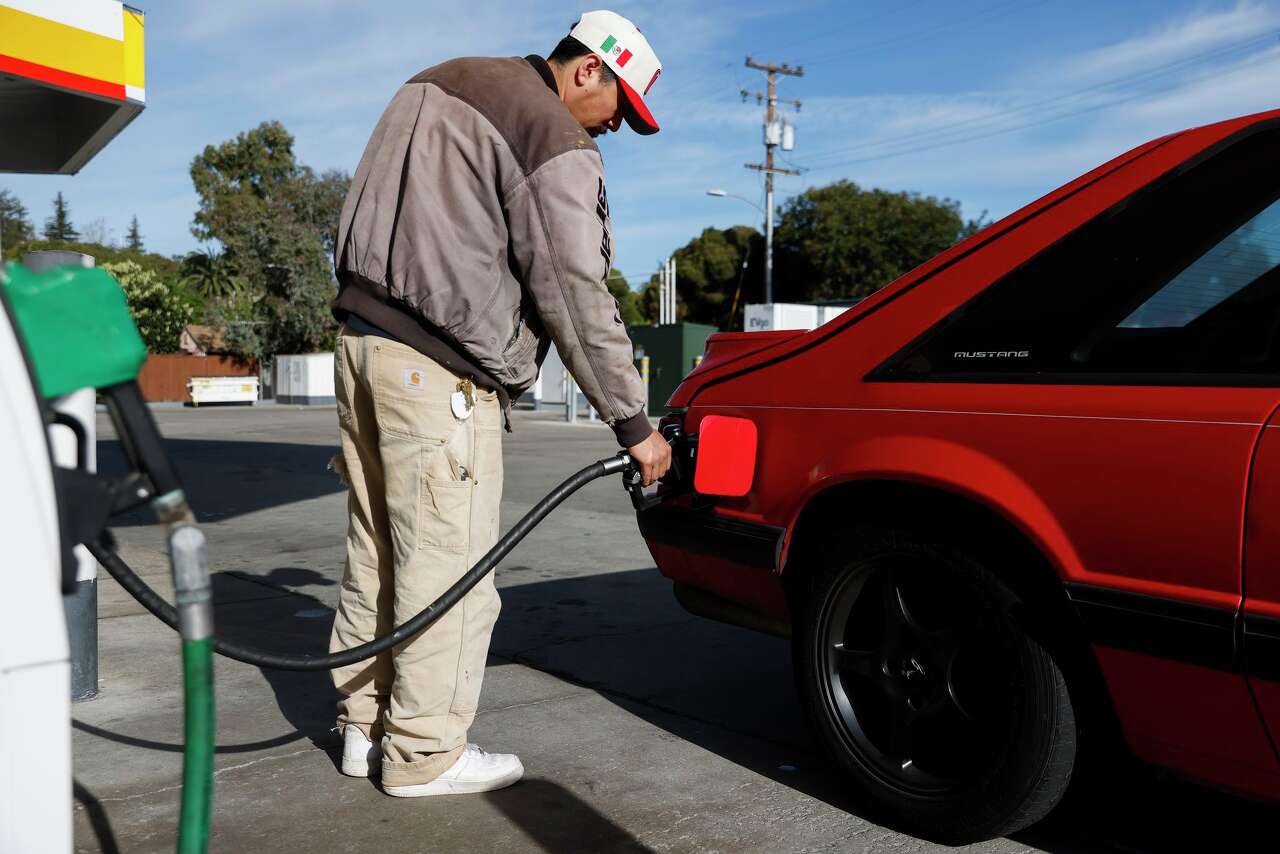
Gas prices in California have never been higher - on average, nearly $6 a gallon this week. We're not experiencing the extreme shortages, nationwide gas station queues and panic buying seen in the 1970s - yet. But with no end to the war with Iran in sight, who knows how bad things will get.
In response, most of the state's gubernatorial candidates, Republican and Democrat, are talking about ways to bring prices down.
Matt Mahan has said he wants a temporary cessation of the state gas tax. Tom Steyer has proposed a "windfall profit tax" on oil companies to give direct rebate money to Californians. Since at least 2018, Katie Porter has proposed moving away from the tax, replacing it with general fund revenues to fund infrastructure. Republican Steve Hilton, who believes that "California Democrats have prioritized ‘climate' ideology over affordability," promises to deliver gas to consumers at $3 a gallon.
California's gas tax is among the nation's highest at over 60 cents per gallon. Many argue it is a regressive tax, one that only exacerbates high gas prices and hits those who can least afford it.
Many urbanists like me have long supported the gas tax to make drivers pay for the true cost of driving. But gasoline taxes are used to fund highway capacity expansion, which undermines the environmental benefits that come from disincentivization.
It's become increasingly clear that the tax has outlived its usefulness.
Suspending and/or eventually getting rid of it would provide immediate financial relief to consumers. But as Frank Jimenez from the nonpartisan California Legislative Analysts' Office told me, the gas tax is one of the major funding sources for the state, about $8 billion annually. "To the extent you suspend or reduce it temporarily, that's $8 billion that the state would have to make up for it somewhere."
Originally, the gas tax was designed as a user fee to build out and maintain the federal highway system. But it wasn't indexed to increases in fuel efficiency or to inflation until the enactment of Senate Bill 1 in 2017 - and the disrepair in our roads shows it.
People who have vehicles with internal combustion engines pay for it, and people who have electric vehicles don't. This certainly complicates things for future electrification. Roads will still need repairs, so the state can't just eliminate the tax without replacing the revenue it generates.
So, what to do?
Transportation is the biggest source of greenhouse gas emissions in California, mostly from private cars and trucks. To meet climate goals, we can't just make gas really cheap because it incentivizes burning fossil fuels. Meanwhile, the number of passenger miles driven has more than doubled in the U.S. since 1975, while drivers are paying less (indexed for inflation) into the system that maintains the roads they use. It's past time to find other methods to fund all the things the gas tax currently does.
One idea is to start taxing cars based on size.
I've long found it perplexing that the size of cars - and houses, for that matter - has increased dramatically even as family sizes have decreased. The average home was 1,500 square feet in 1970; in 2024, it was 2,400 square feet. The average family size was 3.6 in 1970; now, it's 3.15. Yet the average SUV seats 5 to 7 passengers.
Most people don't need a vehicle that large - but they buy them anyway. People don't factor in how much it costs to heat and cool a giant house. And they don't factor in what it costs to operate and maintain a big car.
SUVs are the fastest-growing vehicle type registered in California. They are also really heavy and tall. Addressing the attending consequences is long overdue.
In 2023, the California Legislature initiated a study of how larger and heavier vehicles impact pedestrians and other non-drivers on roads and the state's infrastructure. The aim was not to replace the gas tax, though an exploration of a fee was on the table. The resulting report showed a correlation between growing vehicle size and weight and an increase in road user injuries and fatalities. Larger and heavier vehicles transfer more energy in collisions and impact pedestrians and other road users with greater force, though the report declined to identify a causal relationship to vehicle size and pedestrian safety, despite many others having done so. The report also concluded that growing passenger vehicle weight has a negligible impact on roadway degradation. Ultimately, it did not recommend a passenger vehicle weight fee.
Fourteen other states, though, including Florida and New York, are using weight fees to offset infrastructure damage, enhance safety, and manage environmental impact. In 2022, Washington, D.C., passed a $500 annual registration fee for vehicles over 6,000 pounds, compared to $72 for lighter cars.
The hope is that, over time, the tax could start to act like a price signal nudging buyers toward lighter vehicles.
I am hopeful this conversation can one day help shift the Federal Motor Vehicle Safety Standards, which focus on improving the safety of vehicle occupants, to consider the people outside the vehicle; the share of pedestrian crashes involving an SUV is growing faster than all other vehicle types. Many other nations require vehicle testing for pedestrian collision outcomes; the Biden administration was poised to do so as well, but that effort was stalled.
Another gas tax alternative is the road user charge. This is a mileage-based fee charged to drivers: the more you drive, the more you pay for highway and road repairs. The less you drive, the less you pay.
If you buy a car and rarely drive it, your impact on things like carbon emissions, road damage, and pedestrian safety is much smaller. It is a more efficient way of linking impact to paying for that impact, i.e., wear and tear you cause to funding roads. (You can calculate what your fee might be at www.caroadcharge.com.) Jimenez, from the Legislative Analyst's Office, said he believes that road charges have a lot going for them in terms of addressing concerns around declining fuel tax revenues.
But only if they're designed carefully.
They need to address the privacy component of reporting mileage. And equity adjustments would need to be made for rural drivers, low-income commuters and those with few transportation alternatives who should not be punished because they have to drive greater distances.
California has already piloted a road user charge to determine if it could be a fair and sustainable way to replace the gas tax. In 2021, the state Senate passed SB339, which ordered a study of the results; a report to the Legislature is due in December.
By then, we will have elected a new governor who will have to add this to his or her very long to-do list.
Allison Arieff is a columnist and editorial writer for the Opinion section.
Related Reading
S.F.'s Sunset Dunes park is thriving a year in, but its future could be in doubt
New multifamily housing in S.F. is mostly ugly. Here's how we get better designs
Subscribe
There’s more to San Francisco with the Chronicle. Subscribe today for just 25¢.Read this story on sfchronicle.com