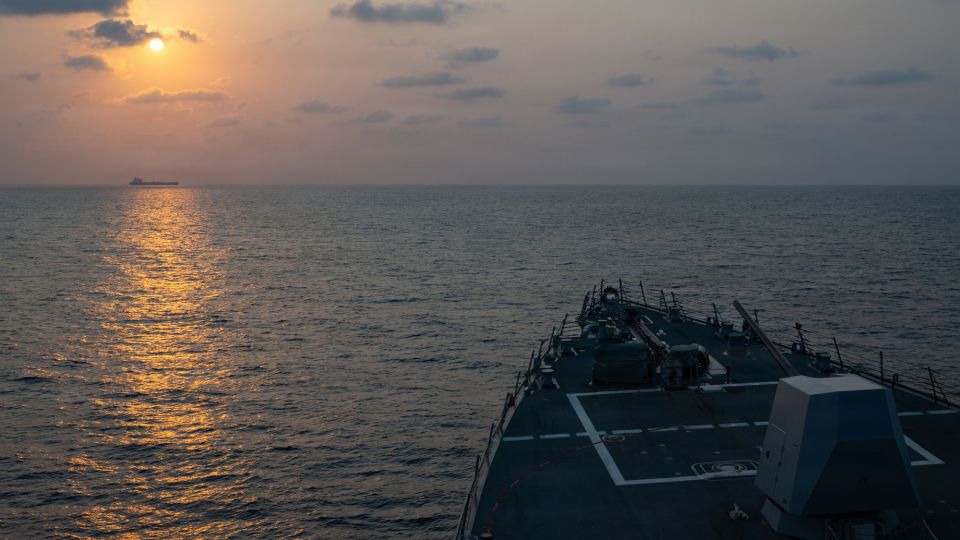
President Donald Trump’s maritime blockade is the latest attempt to test a thus far unproven theory of the Iran war — that superior US might will inevitably break the Islamic Republic.
The strategy is based on a simple premise: The strangulation of Iran’s oil exports and the imports that sustain regular life there will trigger societal collapse. This will build unbearable pressure on the regime to bow to US demands to permanently renounce its nuclear program.
In Washington, this seems logical. Every nation, whether a radical theocracy or Western democracy, will crumble if it can’t assure access to the basics — food, energy and work. When US officials see soaring inflation, catastrophic job losses and shortages in Tehran, they conclude the two-week blockade is working.
“The blockade is genius, OK?” Trump said Wednesday. “Their economy is in real trouble. It’s a dead economy.” The president is so pleased with the plan that he’s steeled aides for it to last much longer, CNN reported.
One reason is that it’s a way of heaping pressure on Iran without risking US casualties with ground operations or resuming bombing that was relentless but inconclusive. Another is that it seeks to restore US leverage in economic warfare eroded when Iran set off a global crisis by closing the Strait of Hormuz.
The US economy is far mightier than Iran’s, so this should be no contest. Then again, a fearsome US-Israel air assault devastated Iran’s military, but wasn’t able to secure a strategic victory in the war.
Trump’s bullishness will confront two questions that will decide the fate of his latest strategy in a war that has often seemed to lack a rationale or endgame.
The first is how long Trump, his fellow Republicans and the American people can take the rising costs of the war, including $4-plus gasoline and a likely rise in inflation. Midterm election voters are already angry at high costs and Trump’s economy.
The second question is whether the plan is based on realistic intelligence about conditions in Iran and sound reasoning on how its leaders might react. There is, after all, a long and dubious tendency in Washington to apply American logic to Middle Eastern societies that don’t react as US presidents expect.
The president is betting that Iran’s leaders, in a radical Islamic theocracy with a record of inflicting extraordinary pain on its own people, will react purely on economic motives — as perhaps he might in their shoes.
A mounting crisis in Iran
There is growing evidence that Iran’s economy is in terrible trouble. The Wall Street Journal reported Wednesday that the war’s costs include a million unemployed; soaring food prices; and an internet shutdown that has stifled the online economy. Inflation is rampant and staples like red meat are unaffordable. Middle Eastern media reports warn of growing shortages and threats to food security.
Iran’s Oil Minister Mohsen Paknejad warned the public on Wednesday to cut consumption of energy. And government offices have been ordered to cut electricity use by 70% after 1 p.m.
CNN’s White House team reported that US officials are reading intelligence that predicts the Iranian economy can only survive for a few weeks, if not days, according to two sources. And Trump repeatedly claims Iran’s inability to export oil means it will have to halt production and risk huge damage to oil wells that could take years to fix.
Alex Vatanka, a senior fellow at the Middle East Institute, argued the blockade could wreak severe economic pain that could translate into uncontrollable political opposition.
But he added a critical caveat: This could take months.
“The first thing to remember is that we’ve never been here before; this is uncharted territory,” Vatanka said. “The blockade is nothing Iran’s ever experienced, not even during the Iran-Iraq war.”
Vatanka said he could foresee a time when millions of workers would potentially come onto the streets and demand relief. “That is where the regime will be tested in ways it hasn’t been tested before — it doesn’t mean it can’t prevail, relying on repression. … But it’s going to be a question of whether they can overcome the volume of anger.”
Vatanka warned, however, that the potential for economic collapse to spark political change would rely on a level of organization in anti-regime protests and regime defections that are yet to materialize in Iran.
Trump might not have time to wait for the counter-revolution. His approval ratings are at historic lows and Republicans fear losing the House and facing an uphill fight to cling onto the Senate in November. The longer the war goes on and Iran keeps the Strait of Hormuz closed, the greater the damage in the US.
Trump’s personal psychology may also play a role. He seems fixated on his legacy as he dreams of grand architectural works in his last 1,000 days in office. Nothing would be more shameful for a man who sees himself as one of life’s ultimate winners as being branded a loser in a war with Iran.
One day, Trump may not TACO.
How the blockade might fail
Yet even if Trump vows to go long, there’s always a chance that the blockade strategy is simply flawed.
If the killing of Iran’s Supreme Leader Ali Khamenei didn’t cause Iran to quit and weeks of relentless bombing didn’t break the resolve of its leaders, is there reason to think an economic crisis might?
The Islamic Republic’s persistence and stubbornness have become legendary.
Iran has labored under Western sanctions for decades. It endured a horrendous eight-year war with an estimated 1 million casualties against Iraq in the 1980s. Every time protesters threatened to reach a critical mass, the regime sent its thugs on the streets to massacre civilians to save the revolution.
The regime’s entire ethos in the 47 years since the Islamic Revolution has been resistance to the US “Great Satan.” It might choose societal collapse over caving into Trump.
Trita Parsi, executive vice president of the Quincy Institute for Responsible Statecraft, said that Trump’s team was the latest US administration to believe, wrongly, that a pressure campaign could force Iran to give in.
“There is that constant search for that silver bullet, that one point of pressure that causes the Iranians to either collapse, capitulate or just mend themselves to America’s wishes,” Parsi said. “And almost every time the US goes down that path, it ends up disappointing itself.”
Trump’s confidence also reflects another familiar Washington trend — a never-reconciled belief, especially prevalent among conservatives, that the Iranian economy and regime is perpetually about to collapse.
“They have to cry uncle, that’s all they have to do. Just say, ‘We give up, we give up,’” the president said in the Oval Office on Wednesday.
If Iran does so, Trump could break a futile cycle of history and finally end America’s near half-century duel with a bitter enemy.
If it fails, he will only have proved yet again that the Islamic Republic’s willingness to take punch after punch can neuter far greater American power.
For more CNN news and newsletters create an account at CNN.com