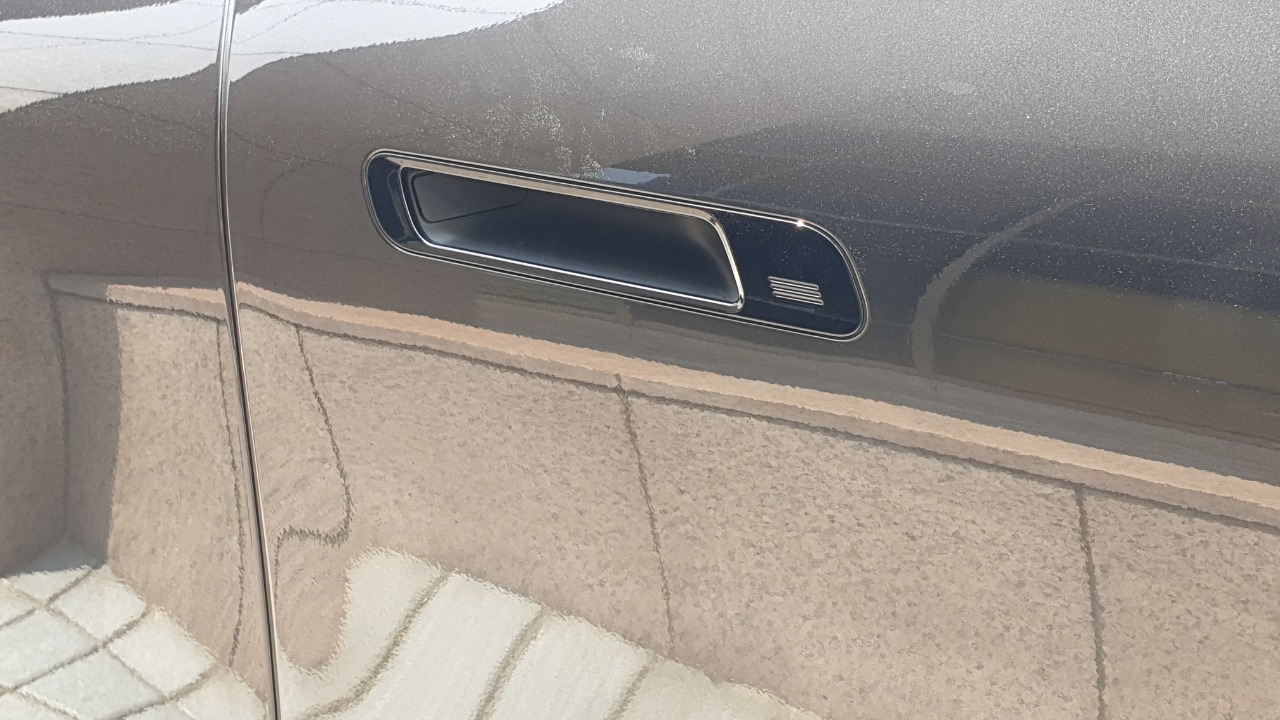
When BMW unveiled its Neue Klasse electric vehicles for the Chinese market earlier this year, one detail stood out to industry watchers: the door handles stick out. In an era when nearly every premium EV sports flush, retractable handles for the sake of aerodynamics and aesthetics, BMW went the other direction. Its China-only iX3 Long Wheelbase and the Chinese-spec i3 feature conventional, protruding handles you can grab and pull, backed by a mechanical failsafe that works even if the car loses all electrical power.
The reason is straightforward. China’s Ministry of Industry and Information Technology (MIIT) has finalized a regulation, set to take effect in 2027, that will ban hidden door handles on new vehicles and require every car door to include a mechanical release. BMW built its Chinese EVs to meet that standard well ahead of the deadline. But the regulation itself exists because of a problem that Tesla owners know all too well.
The safety failures behind the rule
In the United States, the National Highway Traffic Safety Administration opened a formal investigation in late 2025 covering roughly 174,000 Tesla Model Y vehicles over exterior door handle failures. The core concern: handles that fail to deploy or respond, leaving occupants unable to exit and bystanders unable to open doors from outside, particularly when the vehicle loses power or suffers an electrical fault.
The complaints are not abstract. An Associated Press report documented cases in which parents said their children were stuck in the rear seats of Tesla vehicles after exterior handles stopped working, forcing them to find workarounds to free their kids. For regulators on both sides of the Pacific, these incidents illustrate a fundamental risk: when cabin access depends entirely on electronics, a single point of failure can turn a parked car into a trap.
As of April 2026, NHTSA’s probe remains open. The agency has not issued a final determination on root cause or mandated a recall. Tesla has not publicly disclosed a comprehensive fix tied to the investigation. But the pattern of complaints was significant enough to prompt China’s MIIT to act preemptively through regulation rather than wait for its own string of incidents.
What BMW actually changed
Flush door handles became a signature of modern EV design for good reason. They reduce aerodynamic drag, contribute to a sleek silhouette, and signal that a vehicle belongs to the electric future rather than the combustion past. Tesla popularized the look, and competitors from Mercedes-Benz to Nio followed.
BMW’s China-market Neue Klasse models break from that trend deliberately. The protruding handles on the iX3 Long Wheelbase and the China-spec i3 are designed to be grasped and pulled in the familiar way drivers have opened car doors for decades. The system also includes redundancy: backup power and a mechanical override ensure the doors open manually regardless of the vehicle’s electrical state, according to technical coverage of the iX3 Long Wheelbase debut.
This is an engineering trade-off, not a step backward. BMW accepts a small aerodynamic penalty in exchange for guaranteed compliance with the 2027 standard and a clear safety margin. In the world’s largest auto market, where roughly 27 million vehicles were sold in 2025, that trade-off looks more like a competitive advantage than a concession.
The limits of what we know
No BMW executive has publicly stated that the handle redesign was a direct response to Tesla’s failures. The connection is logical given the regulatory context and timing, but it comes from automotive journalists and analysts rather than official BMW communications. BMW may well have adopted this approach purely to meet the Chinese regulation, regardless of what happened with the Model Y.
The full scope of the MIIT rule also has gaps in available English-language reporting. The broad requirements and the 2027 start date are confirmed, but details on exceptions or phase-in provisions for vehicles already in production have not been fully clarified. Automakers with existing flush-handle designs may face different compliance timelines depending on model year and production status.
Whether BMW plans to bring the physical handle design to Europe or North America remains an open question. The iX3 Long Wheelbase and China-spec i3 are built specifically for the Chinese market. Global Neue Klasse vehicles sold elsewhere may retain different handle configurations, potentially including partially recessed designs. Over time, though, the Chinese regulation could push BMW toward sharing more components globally rather than maintaining separate door systems for different regions.
What this means for Tesla and the wider industry
Tesla faces a clear compliance challenge. The company sells vehicles with flush handles in China today, and the 2027 deadline gives it roughly a year to redesign, retrofit, or negotiate its way into compliance. Whether that means new handle hardware, a reinterpretation of what qualifies as a “mechanical release,” or something else entirely will be one of the more consequential product decisions Tesla makes in the near term.
Other automakers face similar calculations. Companies that leaned into retractable or flush handles for aerodynamic and styling reasons must now weigh re-engineering costs against the risk of losing access to the Chinese market or facing safety scrutiny elsewhere. Some may adopt hybrid solutions that preserve a streamlined profile while adding clearly mechanical backup levers. Others may follow BMW’s lead and return to traditional hardware, at least in markets with explicit rules.
The broader signal is hard to miss. For years, automakers treated door handles as a design statement, a place to show how futuristic and frictionless their vehicles could be. China’s regulation reframes them as safety-critical hardware. BMW got there first. The rest of the industry is now on the clock.
More from Morning Overview
*This article was researched with the help of AI, with human editors creating the final content.