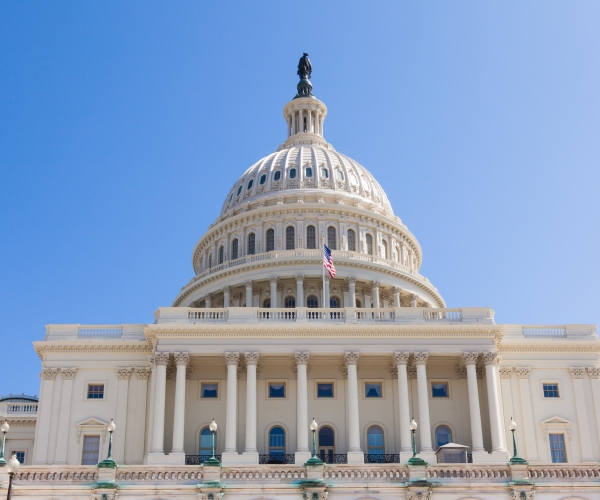
The Senate voted to adopt a budget resolution aimed at clearing the path to fund immigration agencies in an effort to end the two-month shutdown of the Department of Homeland Security (DHS.)
The measure advanced with a 50-48 call early Thursday, with all but two Republicans voting in favor of advancing the GOP plan that could see the eventual approval of around $70 billion in additional funding for Immigration and Customs Enforcement (ICE) and Border Patrol.
Republican Senators Rand Paul of Kentucky and Lisa Murkowski of Alaska notably joined all Democrats in voting against the measure.
Sen. Paul, who chairs the Senate Homeland Security and Governmental Affairs Committee, raised issue with the breakdown of the numbers, suggesting cuts be made elsewhere.
“Congress ought to fund border security, but we should be good stewards of the taxpayer dollars and fully pay for the $70 billion to secure our borders,” he told the Senate floor.
Paul instead suggested an amendment, proposing the elimination of $5 billion in refugee welfare, cutting more than $45 billion in foreign aid, slashing the National Science Foundation by nearly $4 billion, and reducing the Department of Education by 16%.
“These reductions would be made in just one fiscal year and would fully pay for border security,” he claimed.
Paul has previously broken with his party on fiscal policy matters.
In February 2025, he was the only Republican to oppose a resolution led by Sen. Lindsey Graham of South Carolina that would have allowed the Judiciary and Homeland Security committees to spend up to $175 billion to implement Trump’s border security agenda.
He also opposed Trump’s “Big Beautiful Bill,” which passed in the Senate last July with the tie-breaking vote of Vice President J.D. Vance.
His opposition and citing of concerns over “fiscal conservatism” drew criticism from Trump, who described Paul on Truth Social as “a sick wacko, who refuses to vote for our great Republican Party.”
Sen. Murkowski, a senior member of the Senate Appropriations Committee, did not immediately comment on her vote opposing Thursday's measure, but she has previously been a vocal critic of the Trump Administration’s handling of immigration enforcement.
“The tragedy and chaos the country is witnessing in Minneapolis is shocking,” she said in January after Alex Pretti, a U.S. citizen, was fatally shot by federal agents.
Murkowski insisted the killing should “raise serious questions within the Administration about the adequacy of immigration-enforcement training and the instructions officers are given on carrying out their mission.”
The Alaska Senator also joined Democrats in voting to rescind ICE funding earlier this year.
Like Rand, she has earned the wrath of Trump when breaking from party lines.
Meanwhile, following the vote in the early hours of Thursday morning, the legislation will now move to the House.
If the budget framework is adopted, it would allow congressional committees to begin drafting separate legislation outlining how the $70 billion would be spent, which Trump would then need to sign into law.
The funding is expected to run for three years, coinciding with the end of Trump’s presidency in January 2029.
“The vast majority of Republicans stuck together to do something Democrats are refusing to do: Fully fund the Border Patrol and ICE for three and a half years through the Trump presidency,” said Sen. Graham.
Senate Majority Leader John Thune stressed there is a “multistep process ahead of us," yet told reporters he's hopeful the House will move forward soon, as DHS officials warn that funding will dry up next month.
But Republicans and Democrats remain at odds about how best to move forward.
Senate Minority Leader Chuck Schumer criticized the budget resolution and said “nobody respects” ICE and Border Patrol.
“When America’s crying out for real relief on the skyrocketing cost of living, Republicans are spending another $140 billion on Trump’s private militia, on these two rogue agencies that have no restraint,” he argued.
Trump demanded an apology over the comment on Thursday, referring to it as “one of the most egregious, incorrect, unpatriotic, and dangerous statements” he had ever heard from a politician.
Funding for most of DHS lapsed in late January after Democrats refused to continue financing the agency in response to the Administration’s immigration crackdown in Minneapolis, which resulted in the fatal shootings of Pretti and fellow U.S. citizen Renee Good at the hands of federal agents.
The partial shutdown has become the longest in U.S. history, stretching on for more than 60 days and causing disruption across several agencies, including the Transportation Security Administration (TSA), where staffing shortages resulted in long lines at airports.
Democrats in the Senate alongside the Republicans agreed in March to fund DHS whilst leaving out funding for ICE and some parts of Border and Customs Patrol (BCP). However, House Republicans rejected the deal, saying they would not support any bill that did not fund immigration enforcement.
Trump moved to fund the agency via executive action, but if funding runs out again before the DHS is fully reopened, there are concerns travelers in the U.S. could see a return of long airport lines and significant delays.