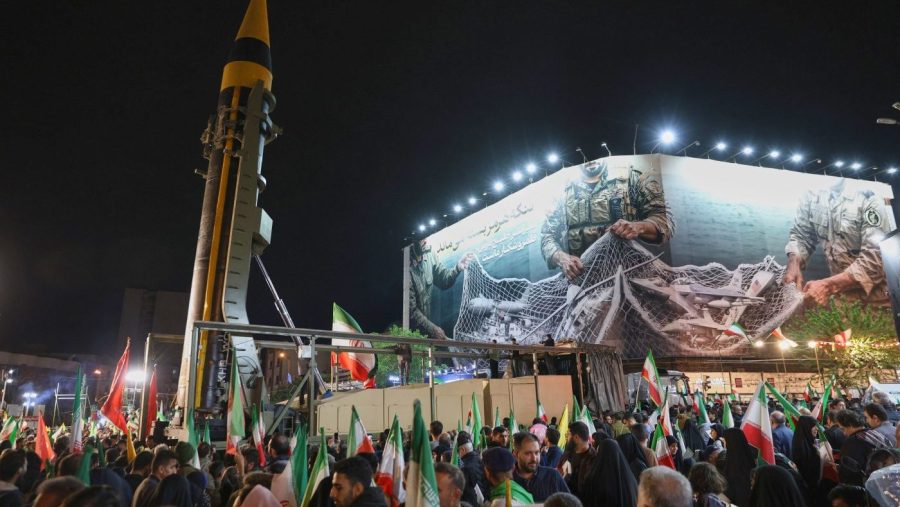
A giant banner hangs on the side of a building in Tehran’s central Enqelab Square declaring, “The Strait of Hormuz will remain closed; the entire Persian Gulf is our hunting ground.”
It’s a blaring reminder of Iran’s key point of leverage in its war against the United States and Israel; and it’s a signal of what analysts say is President Trump’s almost impossible task of restoring free access to one of the world’s most important waterways.
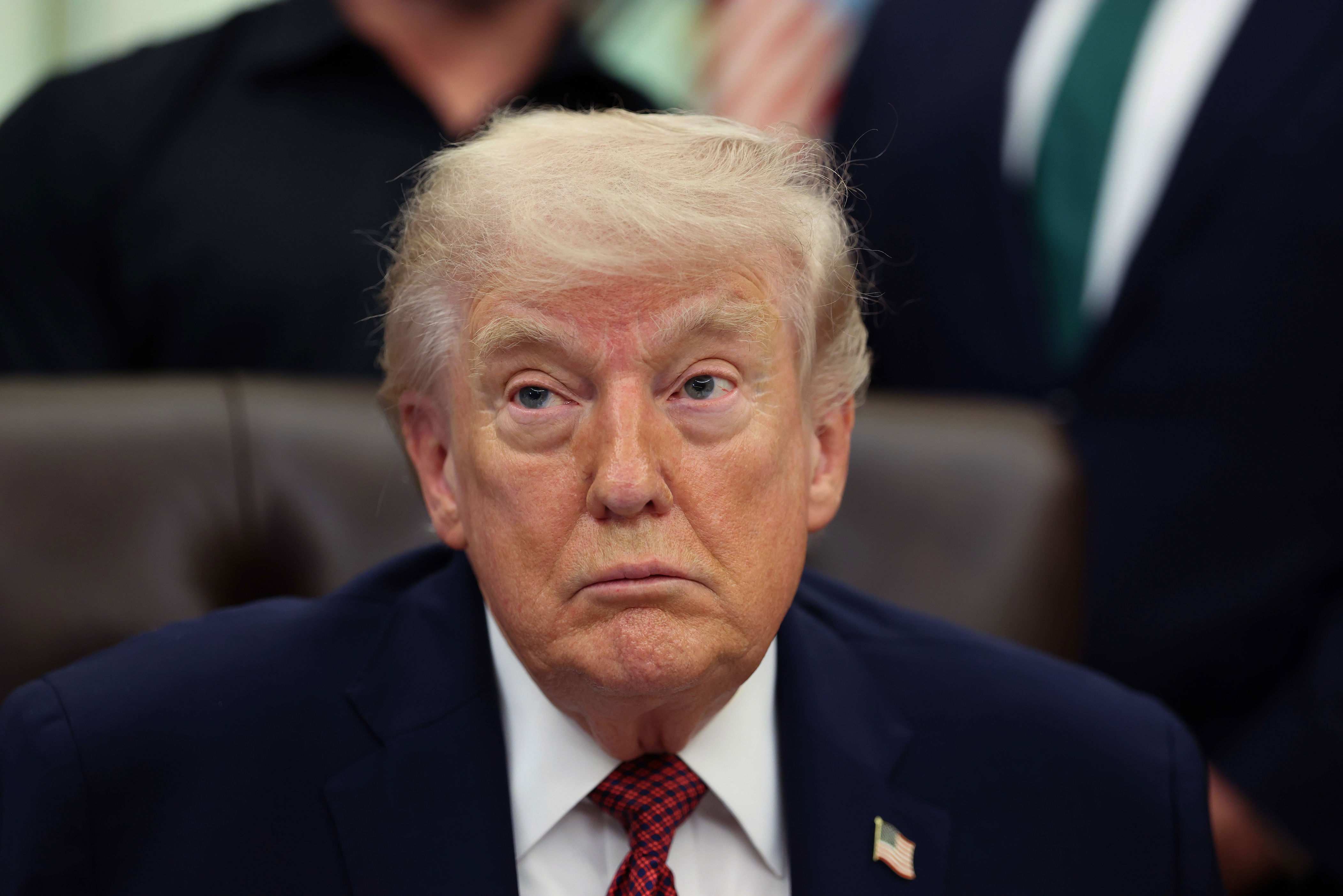
Trump announced Tuesday that he would delay renewed strikes on Iran until it came forward with a proposal for long-term peace, unilaterally extending a 14-day ceasefire indefinitely. However, he said the U.S. would maintain its naval blockade of all maritime traffic entering and exiting Iranian ports in the critical maritime trade route.
Alam Saleh, a senior lecturer in Iranian studies at the Australian National University, said the blockade is playing into Iran’s hands.
“This policy actually is not necessarily practical. It’s not helping much, and it never will convince Iran to withdraw or to give up, definitely not,” he said.
“If Iran stops others’ oil and if the United States stops Iran’s oil, that means the Strait is fully closed thanks to both the United States and Iran,” Saleh said. “And it’s something that makes Iranians happy. This is what they want. This was their strategy from the very beginning of this war, to keep the oil price high, to affect the global economy, to make this prolongation of the war quite costly for the United States.”
“So what President Trump is doing is helping Iran’s strategy to take place in a shorter time,” he added.
Leverage game
Almost as soon as joint U.S.-Israeli forces launched attacks on Iran more than 50 days ago, Iran’s military effectively closed the Strait of Hormuz, a 22-mile-wide corridor that typically facilitates about 20 percent of the world’s energy trade.
Once Iranian forces sent a few tankers up in flames, the rest stopped trying to pass through.
While Iran exerting control over the strait has long been forecast in U.S. war games, the effectiveness of its tactics seems to have caught the Trump administration off guard.
“Before Iran closed the Strait of Hormuz, the U.S. and Israel did not see a lot of risk in attacking Iran, launching a war against it, or bombing it, and now, Iran has demonstrated that it can basically take the global economy hostage if its enemies decide to launch a war,” said Jim Krane, a Persian Gulf energy expert at Rice University’s Baker Institute. “It gives Iran a pretty strong deterrent to try and ward off future U.S. attacks on it.”
Iran said it would reopen the strait for commercial ships following the temporary truce agreement between Lebanon and Israel. Then hours later, it reversed the decision, stating the strait would remain closed until the end of the U.S. blockade.
The Islamic Revolutionary Guard Corps (IRGC) navy warned in a statement last week that “approaching the Strait of Hormuz will be considered co-operation with the enemy, and the offending vessel will be targeted.”
The implications of the stalemate on global energy supplies are enormous. While the U.S. faces soaring gas prices, other countries face more severe consequences. The Philippines declared a state of national emergency in March due to dwindling energy supplies; a shortage of jet fuel in Europe has spurred refueling restrictions and canceled flights; and farmers across the world are facing a looming fertilizer shortage.
While the U.S. is inflicting major pain on Iran’s economy through its blockade, Saleh said the impact on China, which imports roughly 90 percent of Iran’s crude oil, could ultimately create problems with Trump’s efforts to strike a trade deal with Beijing.
“Yes, United States can stop oil tankers that goes to somewhere else, but to China? That is a different cup of tea,” Saleh said.
Firms that monitor the global shipping industry say more than two dozen Iranian-linked tankers have managed to skirt the U.S. blockade in its first week, indicating Iran’s energy economy has not been completely cut off.
Geography vs. military might
Trump and his military leaders often tout how badly Iran’s military was degraded during a month of battering by U.S. and Israeli missiles and bombs.
Still, Saleh said the world’s greatest military “cannot control over 3,000 kilometers of the sea, shipping and the routes, [and] hundreds of ships going and coming into the strait from different parts of the world.”
Nor can it control Iran’s coastline without sending in ground forces. Even then, Iran can launch its Shahed drones from any location in the country and strike a ship going through the strait, said Mark Nevitt, an associate professor of law at Emory University and a former professor at the United States Naval Academy.
“As long as they have the capacity to launch drone attacks, they can control the strait,” he said.
Sahar Razavi, the director of the Iranian and Middle Eastern Studies Center at Sacramento State University, echoed Nevitt’s sentiment, saying, “there’s really nothing the U.S. can do to totally remove Iran’s influence over the strait as long as Iran’s government remains.”
There’s also the threat of Iranian mines in the Strait of Hormuz. A U.S. Defense official told Congress that removing the existing mines could take six months, an operation that can only begin when the war is over, according to The Washington Post.
The U.S. has also mulled sending naval escorts to protect commercial ships moving through the strait, though so far it has decided it’s too risky with the war ongoing.
Allen Fromherz, director of the Middle East Studies Center at Georgia State University, said, “It’s sort of odd to see this idea that Iran and the United States could somehow be seen at all as equal in terms of their military or naval capacity.”
While Iran has scared commercial ships from crossing the strait, Fromherz noted it hasn’t launched attacks on U.S. ships imposing the blockade, which would likely trigger a harsh response from American forces.
Scrambling alliances
Both Iran and the U.S. are seeking to bolster alliances through their standoff in the Persian Gulf.
Trump has urged U.S. allies to make sure Iran doesn’t impose a tolling system on the strait, while also suggesting Washington and Tehran could jointly manage the waterway after the war.
Iran sees tolling as a potential way to replenish state revenue and undermine the U.S. dollar by insisting on payment in Chinese yuan or cryptocurrency, which would also insulate its economy from U.S. sanctions, said John Calabrese, a senior fellow at the Middle East Institute.
Facilitating the transit for friendly states through the strait, while delaying or denying access to others, could help Iran undermine U.S. efforts to isolate the regime, he added.
“Over time, such selective access could do more than erode sanctions, it could fragment the anti-Iran coalition and gradually normalize limited engagement with Tehran,” Calabrese said.
America’s traditional allies have expressed frustration with Trump for launching the war without any coordination and balked at his demands to get involved. France and the United Kingdom have led a global coalition of countries charting a plan for the strait once the war is over.
Razavi said Iran is “trying to use this to create a rift or a fracture between the United States and some of its allies,” adding, “and to be honest, they don’t have to work that hard to do that because the United States made it very clear from the get go that they were going forward with this war without the buy-in of their allies.”
Still, Calabrese warned against overstating Iran’s leverage.
“Iran has not yet achieved uncontested, permanent control of the Strait of Hormuz in a legal or strategic sense. What it has demonstrated, thus far, very effectively is the ability to deny, restrict, and condition access,” he said, adding Iran “has gained a powerful bargaining chip but not the ability to reshape the regional order on its own.”
And Tehran risks overplaying its hand. The more it relies on coercion, fees and harassment, “the greater the chance of a confrontation it cannot control,” Calabrese said.
Loosening Iran’s grip
The standoff in the strait has already triggered long-term planning on how to create alternate routes for the Middle East’s energy trade.
Krane, of the Baker Institute, said in order for countries to undermine Iran’s leverage, they need to build rail cargo and pipelines that bypass the Strait of Hormuz, so they can move oil outside the Persian Gulf to either the coast of the Red Sea or the Arabian Sea.
“And I think once they do that, Iran will lose that leverage that it now has,” he said.
But these alternate routes of export would take a number of years of development. And Iran could further ratchet up the stakes by working with its Houthi allies in Yemen to close off the Bab el-Mandeb Strait in the Red Sea, another key shipping lane.
Saudi Arabia, the United Arab Emirates and Iraq have alternate pipelines that are currently in operation, but Krane said they don’t have nearly the capacity of oil tankers. The Persian Gulf typically exports about 20 million barrels a day; the pipelines are able to carry about half of that at most.
And that’s just oil; alternate channels are far more limited for natural gas and other derivative exports like fertilizer.
In the short term, Saleh said the U.S. can try to break Iran’s leverage over the strait by targeting civilian infrastructure with renewed airstrikes, but that would likely be a war crime and lead to further Iranian retaliation, which would further roil the global economy.
“This war will not be solved legally, not even politically,” Saleh said. “And there is kind of an absence of trust, lots of difficulties and enmities between the two sides. The only thing that can solve this problem is a compromising, and both sides need to consider that seriously.”
Copyright 2026 Nexstar Media, Inc. All rights reserved. This material may not be published, broadcast, rewritten, or redistributed.For the latest news, weather, sports, and streaming video, head to The Hill.