Cars are becoming more expensive annually, meaning you're likely to spend more than you intended if you're in the market for a new vehicle. This is especially true for some popular models, with dealers selling them over MSRP. Some buyers who are simply looking for the cheapest new car that can fit their monthly budget, instead of considering the sticker price, might not think much about this, but those who want the best deal on a brand-new vehicle would likely object.
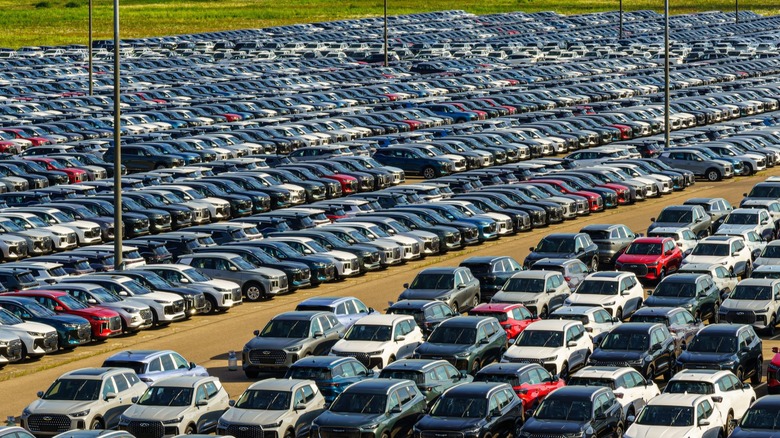
So, we're looking at a few car models that many dealers can't get off their lots quickly. These new cars have so little demand that it can take more than a year before they're sold. This means they tie up the dealer's capital and add storage costs. The longer an unsold vehicle stays in the lot, the greater the chance a buyer can get steep discounts or incentives just to move it.
Unless you've set your heart on a specific make and model, keep your eye out for these vehicles and you might just be able to get a good deal. Note that we're just considering these cars' market day supply (MDS), or how long they sit on dealers' lots. Before making a final decision, you should also check reliability and ownership costs to ensure the vehicle fits your budget and lifestyle.
Read more: 5 Of The Worst V6 Engines Ever Made
Mercedes-Benz Sprinter Crew Van
You might think of Mercedes-Benz as a luxury brand, but it's also known for making commercial vehicles like the Sprinter Crew Van. Although the base model seats five passengers, it boasts a massive 240 cu. ft. cargo capacity and a 3,825-lb. payload capacity. It can also tow up to 5,000 lbs., making it ideal for carrying a work crew and their equipment. And because it has a sliding door instead of the usual swing doors, you don't have to worry about tight-space access when you're loading and unloading both people and equipment.
This van is also available in other configurations, including a high-roof model and an extended wheelbase option, and starts at $53,830. But because its MDS is at 366 days, that means it can take over a year before the entire current inventory of these vans can be cleared. So, if you're a business owner looking to get a combined people and cargo carrier, or want something practical that you can take your family in while carrying everybody's stuff, a Sprinter Crew Van is worth considering for a deal.
The Sprinter is also available in Cargo and Passenger versions, as well as the all-electric eSprinter. However, these models aren't included in CarEdge's list of slowest-selling cars in the U.S., so you might have a harder time finding discounts on them.
Mitsubishi Outlander
The Mitsubishi Outlander isn't included in J.D. Power's best cheap SUVs, but its base starting price of $29,995 means that it was just edged out by the Hyundai Tucson's $29,200. Despite that, there are few buyers, as its MDS sits at 372 days. It's not a bad car per se, as we found in our review, making it a great option for someone who wants a simple, no-fuss larger vehicle.
For a starting price of less than $30,000, you get a three-row SUV that seats seven people, a 12.3-inch touchscreen infotainment system with wireless Apple CarPlay and Android Auto, and a premium eight-speaker sound system from Yamaha. However, once you tack on options like heated seats, all-wheel drive, a panoramic sunroof, automatic climate control, and more, the price can easily go above $40,000. At this point, you're probably better off considering other models like the Toyota Highlander Hybrid or the Kia Telluride.
It's probably for this reason why the Outlander isn't a good seller. Despite being marketed as an affordable SUV, the average selling price of existing inventory is $37,116. The best thing you can do is check this model at your nearby dealership and see what they're willing to offer you. From there, compare it with the sticker price of other available options that you're open to and see if the deal you're getting is good enough to compromise on what you're getting.
Jeep Wrangler 2-Door
The Wrangler has a cult following among off-road enthusiasts, despite the disappointment that many buyers get from the brand. Now, if you want to get into the Jeep lifestyle, one of the most affordable ways to do so is through the two-door version of the Wrangler. The base Sport trim has a starting price of $36,035 for the two-door, while the four-door costs just over $3,000 more. If we look at other versions of the Wrangler, the price difference between the two versions ranges between $2,000 and $4,000.
While the larger option is slightly more expensive, it also carries more passengers and cargo, making it a more versatile option for people who only want to keep a single car. If you're taking out a loan for your vehicle, you might not even feel the difference in the monthly cost. What's more interesting is that if you look at the lease options on the Jeep website, they show higher monthly costs for the two-door, with the Rubicon at $546 for 36 months versus $394 for the four-door.
Because it seems that the two-door Wrangler isn't moving as much in the market, there's a better chance that you can score a deal or get a good incentive on it. However, you should note that these SUVs are still quite popular, so you might have to do some haggling before you can get what you want.
Audi S E-Tron GT
Even if you have deeper pockets and can afford to spend a lot on a luxury car, it does not mean that you're going to pass up the chance to get a good deal. So, if you're looking for a luxurious electric sedan, consider the Audi S E-Tron GT.
This is the tamer version of the Audi RS E-Tron GT and is about $43,000 cheaper, with a starting price of $127,700. However, it's no slouch, with Audi boasting a 3.3-second zero-to-60 time and a top speed of 152 mph. This is slightly slower than the blazing 2.4-second and 155 mph of the RS, but most people do not need that kind of performance.
One of the things that's going against the Audi S E-Tron GT is that it uses the same platform as the Porsche Taycan while also being more expensive. The Taycan starts at a much lower $105,800 while also bringing the prestige of the Porsche name. It does have some advantages, though, like the slightly bigger trunk and being more comfortable for long drives (not that the Taycan is uncomfortable).
Still, if you're shopping for a premium EV sedan, you should look at available Audi S E-Tron GT offerings and compare them with what your Porsche dealer is willing to give you. Of course, you shouldn't just look at the base MSRP, as all the options tacked on to the vehicle can drive the Taycan's price much higher than the Audi's average selling price of $137,452.
Alfa Romeo Stelvio
The Alfa Romeo Stelvio is a mid-size luxury SUV with a starting price of $48,995. Unfortunately for Alfa Romeo, it's competing in a crowded market with excellent alternatives like the BMW X5 and Audi Q5.
Given that Alfa Romeo isn't as popular as the big three German brands, buyers might be flocking to these automakers instead when they're looking to spend some cash on their next SUV. Stellantis isn't known for making highly reliable cars, which may be why some buyers balk at the idea of getting a Stelvio as their only vehicle.
Nevertheless, if you can keep up with its maintenance schedule and you're looking for a secondary vehicle that would stand out from the crowd of Audis, BMWs, and Benzes, then this Italian luxury SUV might be a good option to consider. Its MDS sits at 421 days, so dealers might be itching to get this model going and may be willing to give you a great deal. You're not getting a dud of a vehicle, either, as the Stelvio has a relatively powerful 280 hp engine that can go from zero-to-60 in a respectable 5.5 seconds and deliver 306 lb.-ft. of torque.
Alfa Romeo Giulia
If you want a vehicle from an Italian brand but want something more practical and affordable than what you can get from the Prancing Horse, the Alfa Romeo Giulia will fit the bill. This compact executive car has been on the market for 11 years, but its timeless design — both exterior and interior — has stood up well through the years. Unfortunately, many still look past the Giulia when shopping for a luxury sedan, with this model having an MDS of 471 days.
The Giulia starts at $43,995, but after all the optional extras, CarEdge says that it has an average selling price of $53,513. For that amount, you're getting an engine that can output 280 hp and 306 lb.-ft. of torque — the same values found on the larger Stelvio, but in a lighter sedan body. Because of this, it has a zero-to-60 time of 5.1 seconds and a top speed of 149 mph. These are not supercar numbers, but they should be good enough to give you some excitement in your daily drive.
This luxury sedan isn't exactly a BMW 3 series or Mercedes-Benz C-class, but it still offers a striking design compared to these other models in the same price range. And given that it is a slow-selling vehicle, you have a better chance of getting a discount or incentive with the Giulia.
Aston Martin DBX
Aston Martin is a latecomer to the luxury SUV game, having launched the DBX only in 2020. This is some 18 years after Porsche Cayenne debuted in 2002, and it was also preceded by the Lamborghini Urus, which arrived in 2018. Although Ferrari Purosangue arrived later in 2022, it seems that Aston Martin's upscale clientele hasn't quite caught up with its SUV offering. That's because the DBX has an MDS of 522 days — meaning it will take about one and a half years to sell all existing inventory at the current rate of sales.
The current "entry-level" DBX707 costs an eye-watering $236,000, easily the most expensive vehicle on this list. Nevertheless, you're getting the refinement and performance one would expect from Aston Martin, while also getting a touch of practicality. And while many sports cars are typically reserved for the summer and warmer days, we reviewed the DBX707 during the winter, showing how versatile this performance SUV can be.
Price differences usually don't matter to buyers at this level, so getting a good discount on a DBX likely won't matter in the purchase decision. But if you have your heart set on this particular model, then your favorite car dealer could potentially get you a better deal if you ask for it.
Ford Mustang Mach-E
The Mustang Mach-E is Ford's best-selling Mustang, according to The Drive, moving about 51,000 units, some 6,000 vehicles more than the 45,000 examples of the traditional coupe. It's also the only pure EV left in the company's passenger vehicle lineup (except for the E-Transit, which is more of a commercial vehicle) after the F-150 Lightning ended production of its current generation in 2026.
But despite its popularity, it's surprising to discover that the latest Mach-E has an MDS of 548 days. It's unclear why this is, but we noted in our review of the electric SUV that it's expensive compared to the competition and offers a spartan interior. The Mach-E has a starting price of $37,795 for the base Select trim, with the most expensive trim going up to $57,690. By comparison, the Hyundai Ioniq 5 SE Standard starts at $35,000, with the top-of-the-line XRT starting at $46,275.
Still, if you prefer buying from an American car brand and don't fancy the Tesla Model Y, the Mustang Mach-E is a valid choice. And because it's not selling as fast as other alternatives, you might be able to haggle a better price for it at your dealer.
Audi SQ5
Audi released the third generation of the Q5, its compact luxury SUV, last year. This meant that its sporty counterpart, the SQ5, also received a refreshed look. Despite being the performance-oriented version of the mainstream Q5, we wished that the German carmaker made it a tiny bit angrier, although we can't complain about its 362 hp 3.0-liter turbo V6, which replaces the 2.0-liter four-cylinder engine on the vanilla SUV.
The Audi SQ5 has a starting price of $65,400, although its average price is $76,357 after all the fees, options, and extras added at the dealer. This might feel expensive but is about the same price range as its competitors, the BMW X3 M50 xDrive and Mercedes-Benz GLC Coupe.
On the surface, it might seem that car shoppers prefer these other brands, as it would take about 626 days for dealers to clear out this model, with 73 units sold in the last 45 days as of early April. However, we should note that this model is barely a year old, so it's possible that dealers are still trying to clear out the first batch of units from Audi. Still, if you're looking for a performance SUV, there's a better chance that a dealer is willing to give you the SQ5 at a more attractive price.
Toyota C-HR
The Toyota C-HR is a fully electric compact crossover, positioned below the bZ in terms of size. The Japanese carmaker revived the small SUV nameplate that the brand discontinued in 2022 because of poor sales, and it seems that it's following the same fate. The current C-HR has an MDS of 1,178 days — meaning it will take more than three years to clear out all inventory at the current rate. We hope that this is just because it's a newly launched model, having just been announced last February.
This tiny crossover is quite a fun vehicle to drive, and our team experienced this firsthand when we reviewed the 2026 C-HR. One downside mentioned was that it was expensive, starting at $37,000 for the base SE trim. By comparison, the larger 2026 Toyota bZ has a base MSRP of $34,900, meaning going one size up might make more sense for some buyers.
Given how new the 2026 Toyota C-HR is, it's unlikely that dealers would be willing to give you a sizeable discount. These numbers could be explained by Toyota ramping up manufacturing as it brought a new model to market, and that it's still waiting for buyer interest to catch up. Still, you can get a good deal on a new model like this, as long as you never say the wrong things when you're at the dealer.
Volkswagen ID.4
Volkswagen only sells two fully electric models in the U.S., the quirky ID. Buzz minivan and the more mainstream ID.4 SUV. Unfortunately, it seems that the ID.4 didn't capture buyers' attention, as it has a dismal 1,295-day MDS. Although it's a relatively affordable electric SUV, with a starting price of $45,095, it's a rather dull option that might've given those interested in getting one some second thoughts.
Because of this, VW is reportedly ending U.S. production of the ID.4 in Chattanooga, and it's possible that the carmaker will replace it with a pickup truck instead. This combination of high inventory levels and news of discontinuation could mean that dealers can't wait to get their inventory out the door. Because of that, you should be able to get some leeway when it comes to negotiations, allowing you to get a better number than the sticker price.
Polestar 4
Polestar is a luxury EV manufacturer, so it makes sense for its vehicles to sell more slowly when compared to mainstream models. When combined with the fact that the carmaker just started deliveries of the Polestar 4 in December 2025, this means that it has a high MDS of 1,468 days, meaning it will take dealers four years to clear the inventory at current sales levels. CarEdge reports that just 16 units were sold in the past month and a half, which is worse than the C-HR, which only launched earlier this year.
Still, we can partly explain these stats given that it's a luxury car, with the long-range single-motor trim starting at $57,800. Despite the high MDS and starting price, the Polestar 4 is actually a weird but great vehicle — for example, its rear window has been replaced by a camera.
Just like the C-HR, the slow sales of the Polestar 4 are likely because it has just launched recently and is still gearing up for demand as more people see the vehicle. So, you're unlikely to score a discount on this model even though it hasn't been selling as quickly as other EV SUVs.
How were these car models identified as slow sellers?
We identified these car models as some of the slowest sellers on the market based on the data collated by CarEdge as of April 6, 2026. It measures these metrics by computing the Market Day Supply, or MDS, which is the estimated number of days that it would take to sell all current inventory based on the reported number of cars sold per day in the past 45 days. So, the higher the MDS number, the longer it would take for dealers to sell all available units.
Note that, as with the Toyota C-HR and Polestar 4, a high MDS does not automatically mean that a model is a poor seller. You also must consider if the manufacturer is ramping up production for a new model and if sales have not yet had a chance to pick up. Still, MDS is one of the indicators that dealers use to see how quickly (or slowly) a model is selling, and you can leverage information like this to gain an advantage in your negotiations with the dealer for your next new car.
Want the latest in tech and auto trends? Subscribe to our free newsletter for the latest headlines, expert guides, and how-to tips, one email at a time. You can also add us as a preferred search source on Google.
Read the original article on SlashGear.