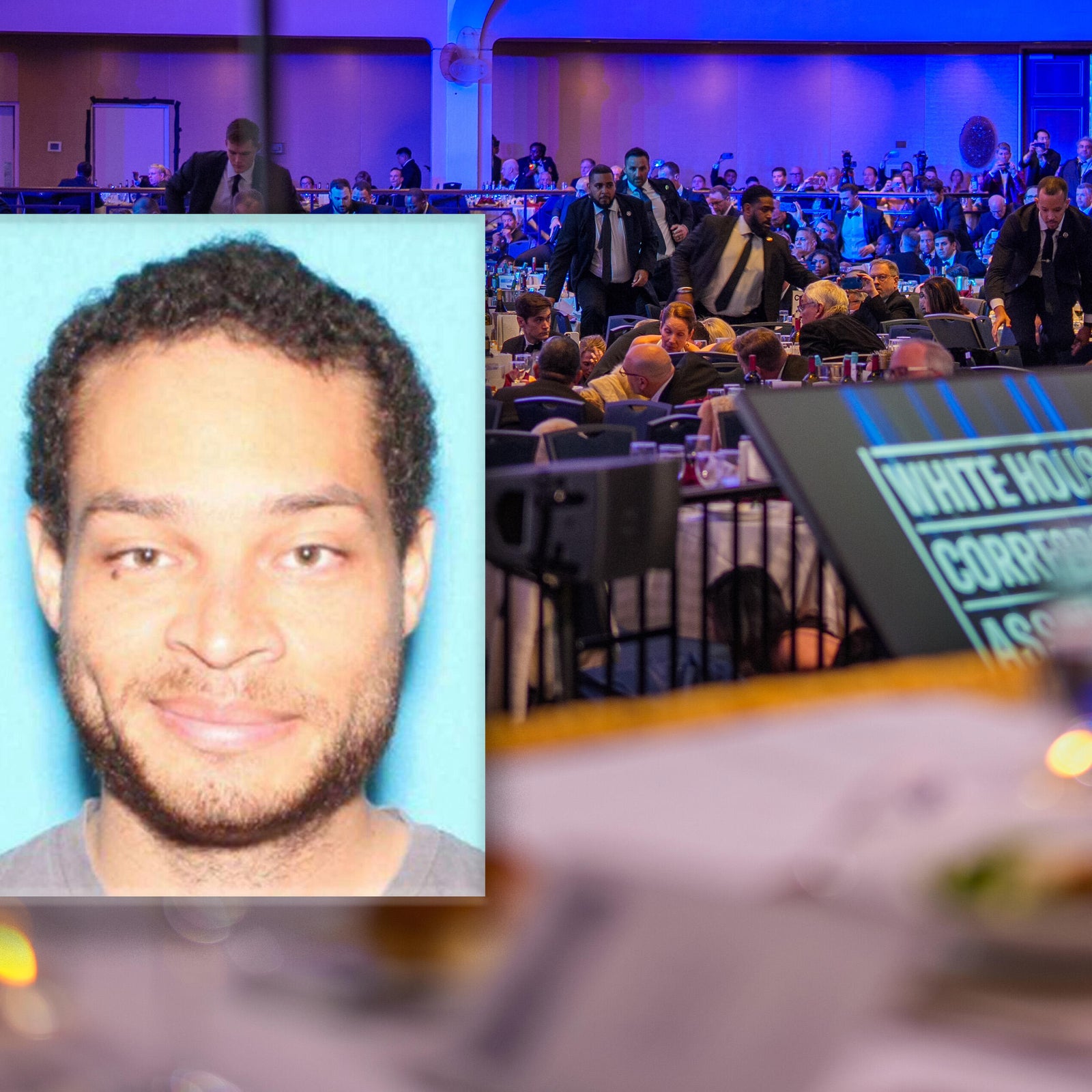
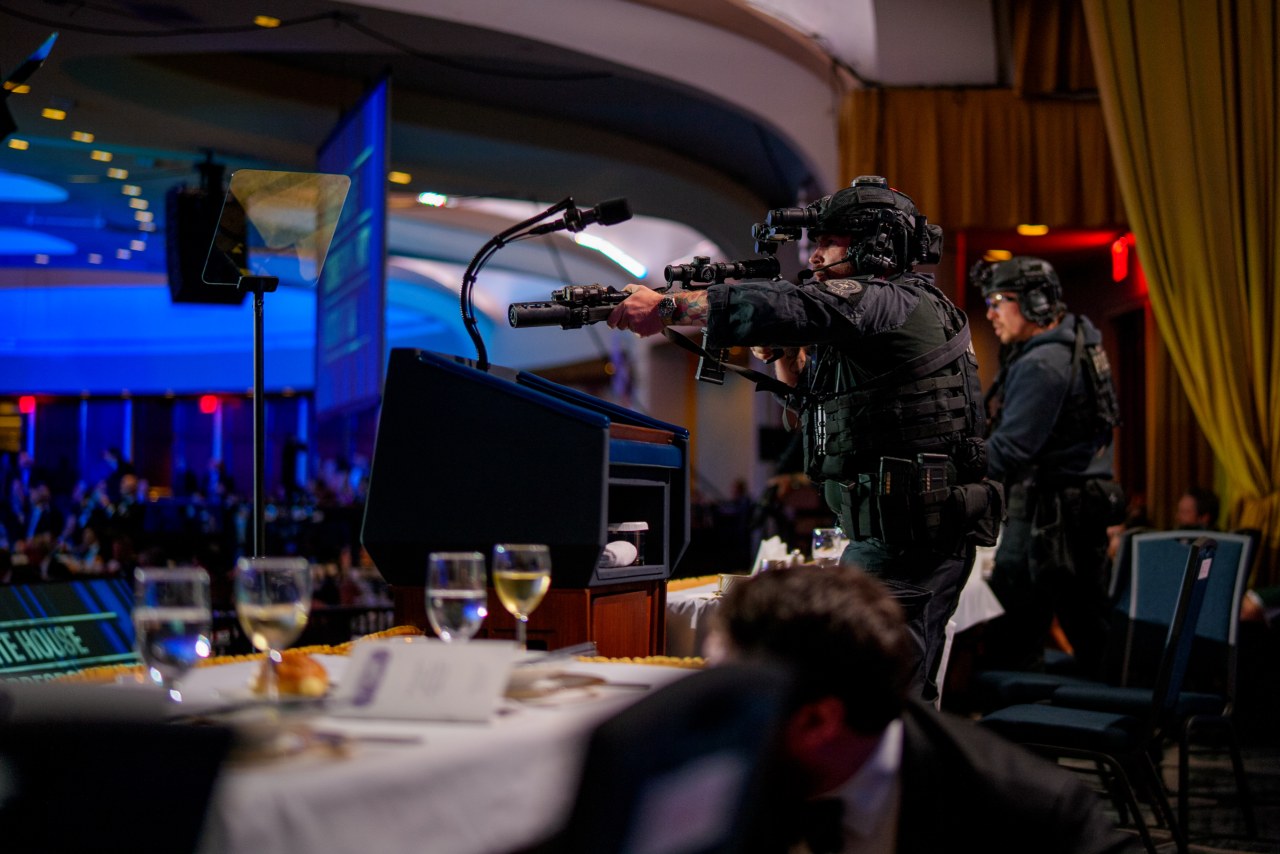
At the same hotel where then-President Ronald Reagan was shot 45 years ago, it was remarkably easy for a shooter to charge toward a ballroom where President Trump—along with his cabinet members and the reporters who cover his administration—were dining Saturday night.
The sprawling Washington Hilton, located about 1½ miles north of the White House, for decades has been home to the White House Correspondents’ Dinner because of its capacity to host a large crowd and the Secret Service’s familiarity with securing it. More than 2,500 people attended the event, including five of the top six officials in the presidential line of succession. Hundreds more gathered for parties that media outlets hosted on site before the main festivities began.
Despite a visible security perimeter and warnings of tight security, guests said they could enter the hotel through checkpoints on the surrounding streets by simply showing a dinner ticket or a copy of an invite to one of several predinner receptions. The tickets were reviewed by staff but weren’t scanned and there were no identification checks, attendees said.
“Upon entering nobody asked to visibly INSPECT my ticket nor asked for my photo identification. All one had to do was flash what appeared to be a ticket and they were fine with that,” said Kari Lake, a former Republican gubernatorial and Senate nominee in Arizona now serving as senior adviser for the U.S. Agency for Global Media, in a social-media post.
Guests were able to access the Hilton’s lobby and lower levels without going through security scans, and only passed through magnetometers before they entered the ballroom where the dinner was held. It was easier to get into the dinner than many big sports events and concert venues.
With 1,107 guest rooms and suites, 47 meeting rooms and four on-site dining venues, the facility in the heart of the nation’s capital can’t be fully sealed off for a high-security event.
One of those rooms was booked by the 31-year-old gunman, who checked in the day before the shooting, law-enforcement officials said, giving him an even deeper awareness of the Hilton’s contours.
“He didn’t beat the security plan the night of the dinner. He beat it the day he made the reservation,” said Jason Pack, a former FBI official. “They built that perimeter to stop an army. Turns out all he needed was a room key.”
Law-enforcement officials said the suspect, Cole Allen, of Torrance, Calif., traveled by train from Los Angeles to Chicago and then on to Washington. He said in a series of writings reviewed by The Wall Street Journal that he walked into the hotel with multiple weapons and “not a single person there considers the possibility that I could be a threat.”
Shortly before the shooting Saturday, Allen sent a manifesto to relatives, law-enforcement officials said.
“What the hell is the Secret Service doing?” Allen wrote. “Like, I expected security cameras at every bend, bugged hotel rooms, armed agents every 10 feet, metal detectors out the wazoo. What I got (who knows, maybe they’re pranking me!) is nothing,” Allen wrote. “The security at the event is all outside, focused on protestors and current arrivals, because apparently no one thought about what happens if someone checks in the day before.”
Saturday’s incident is sure to prompt a reassessment within the Secret Service of preparations for a site it has secured dozens of times in recent decades. But after attempts on Trump’s life in Butler, Pa., and in Florida at one of his golf courses, it also highlights how, in the heightened threat environment of today’s America, it is increasingly difficult to hold large political events that minimize the safety risks for those involved.
“The bigger question is are the traditional protocols put in place at venues such as the Hilton still adequate for this president and administration in today’s threat environment,” said Charles Marino, a former top Secret Service official. “Only the Secret Service can answer this.”
Secret Service spokesman Anthony Guglielmi said the agency’s security plans are made based on evolving intelligence.
“While the protective model for last night’s event proved effective, the key takeaway for future events is that enhancements should be expected at every level,” he said. “We are actively focused on identifying the trigger for this incident and fully understanding the factors that led to it.”
Secret Service officials could be seen at the hotel in the days leading up to the event conducting security sweeps that included asking staff questions and checking in areas including the kitchen, according to a person familiar with the matter. Security agents were posted around the hotel Saturday morning, this person said. Officials gave the dinner a lower security classification than they do for events of national or international significance, another person said, such as the presidential inauguration or the State of the Union address.
By Sunday morning officials were still trying to trace the gunman’s exact path from his hotel room toward the ballroom. Moments before the shooting, the gunman can be seen on surveillance footage running past a checkpoint and toward the ballroom. Investigators believe he fired his shotgun (he was also carrying a handgun), and that officers shot back, but are still awaiting the results of ballistics tests.
Investigators found a loaded, 10-round magazine, two knives, a laptop, hard drive, Metro receipt and a filtered mask inside Allen’s hotel room, people familiar with the probe said.
Inside the ballroom, the eerie fact that another president had been the target of an assassination attempt at this hotel decades ago hung in the air alongside the smell of gunpowder after the party screeched to a halt. “This is where Reagan was shot,” remarked Carlyle co-founder David Rubenstein, who described the challenge of securing the venue as “complicated.”
Though the shooting left attendees shaken and put a pall on what would have been an hourslong celebration of the First Amendment, some law-enforcement officials said the gunman’s failure was proof of the security plan’s effectiveness.
The gunman was stopped at an outer security ring and would have had to penetrate several additional defensive layers to get into the ballroom—and even more to get to the president, including the armed agents on his team, a person familiar with the planning said. Not all of those layers were visible to the public.
“We have to learn from what happened last night, and we will, but the first takeaway…is that the system worked,” said acting Attorney General Todd Blanche, who was also in attendance at the dinner. “We stopped the suspect.”
The White House Correspondents’ Association plans the event, said Fox News anchor and senior White House correspondent Jacqui Heinrich, the incoming president of the WHCA. There were “several meetings” between the White House, the Hilton and the correspondents’ association to review plans, Heinrich said.
Fox News parent Fox Corp. and Wall Street Journal parent News Corp share common ownership.
Hilton said in a statement that “the hotel was operating under stringent security protocols for the property as directed by the U.S. Secret Service, which led security for the event in coordination with a wide range of security teams.”
An array of law-enforcement agencies were involved in protecting the hotel itself, high-profile attendees and the surrounding area, including the district’s Metropolitan Police Department, the Secret Service and the Federal Bureau of Investigation, whose director, Kash Patel, attended the dinner. The hotel has its own private security, too.
The security details many CEOs and celebrities travel with weren’t permitted in the ballroom, but many of them had tickets to the dinner and were seated with attendees, according to people familiar with the matter. CNN’s security team was seated in the ballroom as a precaution to protect its attendees, according to its spokeswoman. After the shots were heard, the network’s head of security climbed over chairs to get to CEO Mark Thompson and chief White House correspondent and anchor Kaitlan Collins. Fox News also had a security detail at the Hilton. Some executives and politicians including CBS News Editor in Chief Bari Weiss and California Gov. Gavin Newsom traveled to events leading up to the dinner with their private security details.
Entry to the hotel was only partially curtailed Saturday. Barriers set up in front of the hotel blocked the driveway. Guests approaching the hotel that afternoon were generally asked to show a room key and ID and had their names checked against a printed list. The fitness center, which offers memberships to the general public and has a separate external entrance, was open during the dinner, though security agents were stationed at the internal entry where the gym connects to the rest of the hotel.
Some guests said security protocols paled in comparison to the security screenings that VIPs faced when they went to exclusive after-dinner parties on Saturday night.
Other dinner veterans said security appeared tighter than in years past. CNN’s Wolf Blitzer said the security presence felt greater than it had at any numerous correspondent’s dinners he had been to.
The hotel was designed with a special passage to safely move the president inside the hotel. When Reagan was shot just outside the venue in 1981, his limousine was reportedly parked at least several steps away, leaving him vulnerable.
Since then, a more tightly controlled entry through an augmented passageway at the terrace level has become a routine part of whisking the president inside. The president’s limousine drives through the passageway into a private entrance, people who know the facility said. He moves through a private elevator, and there’s a sitting area designed for him, including a bathroom, one of the people said. The president is delivered to the rear of the stage without the public seeing him.
“The president or protectee is never exposed to the outside,” said A.T. Smith, a retired Secret Service deputy director.
Trump, who attended the dinner this year for his first time as a sitting president, said he wants to hold it again within the next 30 days, which could set off a near-term scramble of how to bolster security while a longer review takes place.
Trump said the hotel “was not a particularly secure building,” adding the evening’s events underscored the need for the large ballroom he is planning to build at the White House.
Oz Pearlman, the celebrity mentalist who was set to perform at the dinner, said he is hoping for a redo—and to persuade Trump to participate in the act. During the early parts of Saturday’s events, his mind was focused on getting the president and first lady to warm up to him. He said he had no premonitions that things were about to go haywire.
“I assumed the security was tight,” he said, “and just like everybody else, I was shocked that this could happen.”
Header photography by Andrew Harnik/Getty Images; Andrew Leyden/Getty Images; Jonathan Ernst/Reuters; and Evan Vucci/Associated Press