
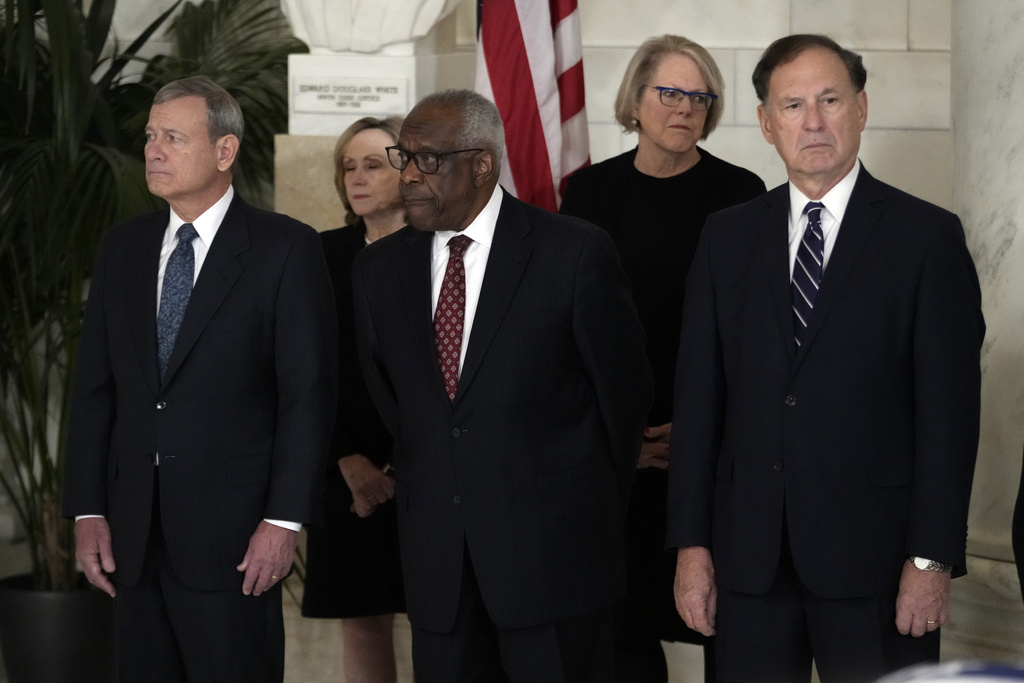
Democratic Representative Johnny Olszewski of Maryland is expected to propose a law on Monday that would establish 18-year term limits for Supreme Court justices and would mean the removal of Chief Justice John Roberts, Justice Clarence Thomas and Justice Samuel Alito if passed.
The constitutional amendment called the Reform of Bench Eligibility (ROBE) Act would also end Supreme Court lifetime appointments, apply to current justices and include provisions for a “fair and orderly transition” to the new system, according to a press release from Olszewski’s office.
The long-shot proposal comes as trust in the Supreme Court, which has a 6-3 conservative majority, remains at historic lows, according to polling. A survey conducted by the Public Religion Research Institute (PRRI) in 2025 showed that even two-thirds of Republicans (67 percent) supported the idea of term-limiting Supreme Court justices, along with 85 percent of Democrats and 76 percent of independents. However, the proposal is unlikely to move forward given the current political dynamics in Congress, as it will not be a priority for GOP lawmakers controlling both the House and the Senate.
Why Is Supreme Court Trust at Historic Lows?
A poll by NBC News released in March found that 22 percent of registered voters nationally said they have a “great deal” or “quite a bit” of confidence in the Supreme Court, 40 percent said they had “some” confidence and 38 percent said they had “very little” or “no” confidence. The poll surveyed 1,000 registered voters from February 27 to March 3 and has a margin of error of plus or minus 3.1 percentage points.
A Gallup poll released in October of last year found that 49 percent of Americans say they trust the Supreme Court either “a great deal” (16 percent) or “a fair amount” (33 percent).
“That level of trust is among the lowest in Gallup’s trend, essentially matching the low point of 47 percent from 2022,” Gallup said.
Analysts link the decline to a series of high‑profile rulings on abortion, voting rights, and presidential power, as well as ethics controversies involving justices’ finances and political ties—issues repeatedly cited by Olszewski in promoting the ROBE Act.
Meanwhile, a study published in the Harvard Journal of Law and Public Policy, found that Supreme Court tenure has expanded dramatically over the past century, with justices now serving far longer on average than at any previous point in U.S. history. The authors contend that what was once service measured in the teens has increasingly stretched into multiple decades, fundamentally changing the stakes of each appointment and magnifying the long‑term political impact of individual nominations.
What is the ROBE Act?
Olszewski’s office said the ROBE Act would create lower stakes around Supreme Court nominations, promote a more consistent appointment process and rebuild trust in the court.
“Faith in the Court depends on its legitimacy as a fair and independent institution,” Olszewski said. “Recent rulings that have thrown out decades of legal precedent, combined with ethically dubious behavior by sitting judges, are testing that faith. Justices should not be hobnobbing at White House dinners and flying on the private jets of friends who have business before the Court. By establishing term limits, we can reduce the political gamesmanship surrounding appointments, restore balance to the process, and strengthen the integrity of the Court.”
Olszewski’s office said modern tenure lengths are the longest in U.S. history and decisions on retirement from the bench have become more strategic, “often aligned with the political preferences of the sitting president.”
Which Justices Would be Affected by the ROBE Act?
Thomas is the longest-serving justice on the current court. He was appointed by President George H.W. Bush in 1991 and has served for over 34 years.
Alito and Roberts were both appointed by President George W. Bush and have served on the court for over 20 years.
The three are the only justices who have served over 18 years on the current court.
There has been speculation about Thomas and Alito, who are the current court’s oldest justices at 77 and 76, retiring. Thomas and Alito are not planning to retire this year, CBS News reported, citing sources close to each of the justices.
Trump said in an interview with Fox Business Network’s Maria Bartiromo last month that he is “prepared” to name another justice if one or more retire.
“It could be two, could be three, could be one. I don’t know—I’m prepared to do it,” he said.
There has been less speculation about Thomas’ retirement, The Hill reported.
Alito became ill at an event in Philadelphia in March and was treated for dehydration. He did not stay at the hospital overnight and returned to court the following Monday.
The expected release date of Alito’s new book has also led legal experts to speculate that he might have plans to retire this year. The book, So Ordered: An Originalist’s View of the Constitution, the Court, and Our Country, is scheduled to be released on October 6. The first day of arguments in the Supreme Court’s 2026-2027 term is set for October 5.
Elie Mystal, a legal analyst and justice correspondent for The Nation, said in a column: “It sure feels like Alito doesn’t plan on having a real job the Tuesday his book launches and instead thinks he’ll be free to run around the country promoting it.”
Georgetown University Law Center professor Steve Vladeck said in his newsletter, One First, that “the October publication date is a pretty big tell since one can’t exactly go on a book tour during the first argument session of the term.”
David Lat, a legal journalist, expressed a different view in a Bloomberg Law column.
“As for the Oct. 6 publication date, I’m assuming Alito and his publisher simply wanted to take advantage of the spike in media coverage of the court that the start of a new term brings,” he said. “Yes, this will curtail Alito’s ability to go on a book tour or do signings, but I’m guessing that’s a feature, not a bug, from the justice’s point of view.”
Potential Timeline of the ROBE Act
The legislation is unlikely to pass in the Republican-controlled House of Representatives and Senate.
A law proposing term limits for the Supreme Court introduced last year, titled the Supreme Court Term Limits and Regular Appointments Act of 2025, was referred to the House Committee on the Judiciary, but it did not advance further.
Sponsored by Democratic Representative Ro Khanna of California, the bill proposed staggered 18‑year terms for future Supreme Court justices and required presidents to nominate a new justice every two years, regardless of vacancies. Under the narrower plan, justices who reached the 18‑year mark would move into “senior” status, while the court’s active docket would be handled by the nine most junior justices. Crucially, the 2025 bill explicitly exempted sitting justices, allowing them to retain lifetime tenure.
That exemption marks a key difference from the newly proposed ROBE Act, which would apply term limits retroactively and force the immediate removal of several current justices.
As a constitutional amendment, it would also require approval by two‑thirds of both the House and Senate, followed by ratification from three‑quarters of U.S. states—a threshold analysts say is unlikely to be met in the current Congress.
If introduced this week, the proposal would first be referred to committee for hearings and markup. Even if it somehow cleared Congress, ratification would likely take years, making near‑term changes to the Supreme Court improbable.
Do you have a story that Newsweek should be covering? Do you have any questions about this story? Contact LiveNews@newsweek.com.
Related Articles