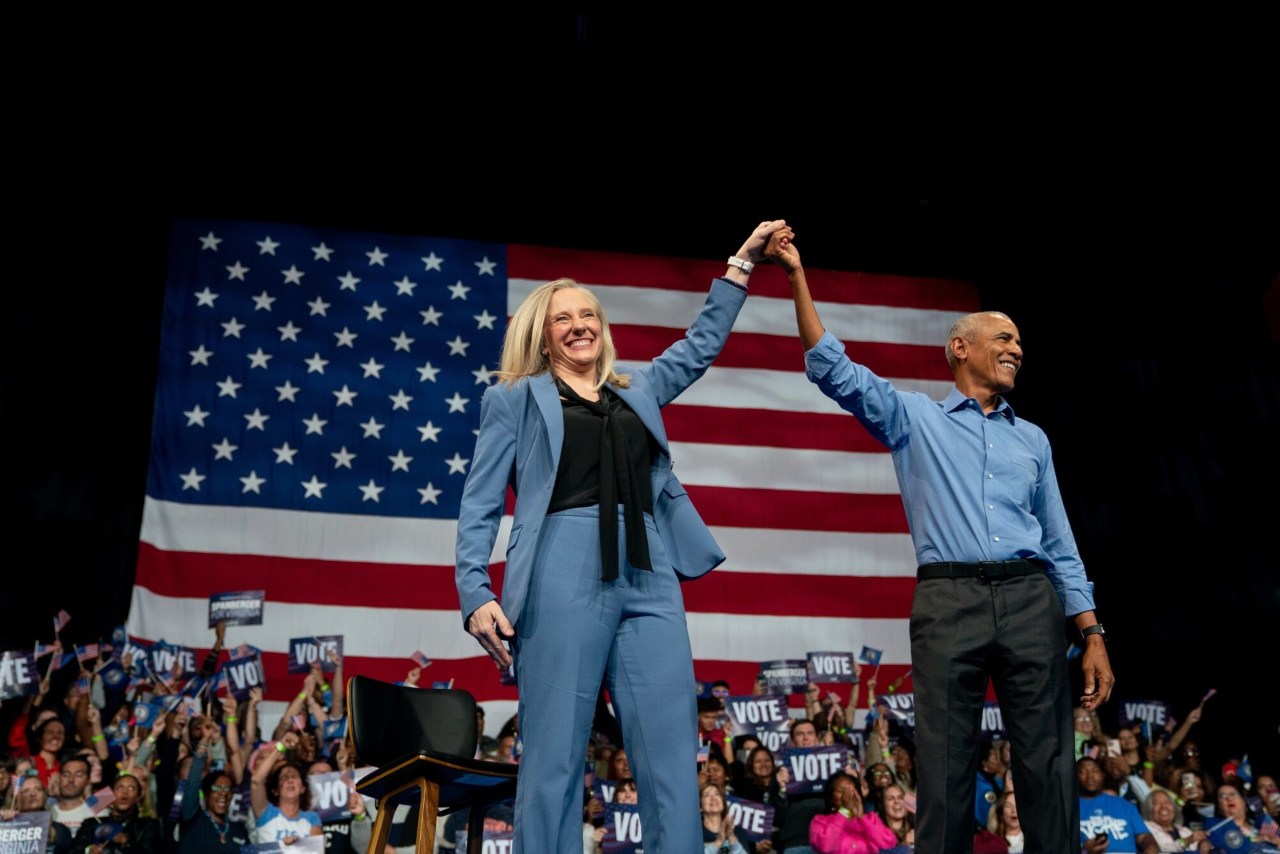
Backstage at a rally in the final days before Abigail Spanberger’s election to be governor of Virginia, Barack Obama approached Don Scott, the speaker of the state’s House of Delegates, and said he would also back a different political fight: Virginia’s redrawing of congressional maps to help boost Democrats’ chances in the midterm elections.
It was part of Obama’s extraordinary evolution on redistricting. The former president, who had long been critical of gerrymandering for partisan gain, didn’t just shift his stance to accommodate redrawing maps temporarily, but went all in on the effort. While campaigning for Spanberger in November, Obama was also lending his support to an unprecedented redistricting effort in California, which would ultimately lead to new maps drawn to eliminate up to five GOP congressional seats.
“He implied to me he’s going to be there. That’s all I needed,” Scott said in an interview following an election this past week in which Virginia voters narrowly approved a measure to redraw the state’s congressional map ahead of the midterms. “He put the battery in my back, let’s go.”
The new map, which is facing court challenges, has been drawn to change the state’s congressional delegation from six House Democrats and five Republicans to 10 Democrats and one Republican. It comes as both parties try to redraw congressional maps in their favor ahead of the 2026 midterm elections. President Trump kicked off the effort last year by urging Texas lawmakers to redraw their maps, but some Republicans now worry it has backfired as Democrats in other states have shown a willingness to counter.
“What they did last Tuesday is take Virginia from the least gerrymandered state to the most severely gerrymandered state in the nation,” said Jeff Ryer, chairman of the Virginia Republican Party. “The former president was against gerrymandering before he was for it. We were more than happy to point out his against position, which he relinquished.”
From redistricting to hardball negotiations on Capitol Hill that forced two government shutdowns and a continuing lapse in funding for the Department of Homeland Security, Democrats are increasingly letting go of taking the moral high ground against Trump and in favor of engaging in brass-knuckle politics.
“Democrats finally are standing up to defend ourselves,” Scott said. Republicans “thought we would do what we always do and have these sanctimonious, self-righteous conversations, virtue-signal and not do anything, and we didn’t do that this time. These are a new type of Democrats.”
He mentioned former first lady Michelle Obama’s famous saying, “When they go low, we go high,” but Scott said that “the rules of engagement have changed,” adding, “When they go low, you got to get your ass down and fight with them.”
First in California and then in Virginia, Obama has tried to balance using his voice judiciously, with an increasing need to use his platform to push back against Trump, people close to Obama said. The former president views Trump’s demands on GOP state legislatures to pursue unusual mid-decade redistricting as a blatant attack on democracy. (Democrats and Republicans have for years engaged in gerrymandering following the decennial census.) Obama views the Democratic response as appropriate in an emergency—as long as it is approved by voters and is temporary.
He became comfortable with that approach during last year’s Prop 50 redistricting effort in California, which Democrats won handily. California Gov. Gavin Newsom knew he could be successful if he could get Obama on board.
In conversations with the former president and his team, the California governor and his advisers stressed that the new map would be temporary and decided on by voters in an election, according to people familiar with the discussions. Obama became convinced that while independent redistricting remained his long-term goal, extraordinary measures were needed in extraordinary circumstances, those people said.
Polling conducted by Newsom’s advisers showed that Obama wasn’t just overwhelmingly popular among Democrats in the state, but also among independents, advisers said. Democrats poured $16 million behind ads featuring Obama’s endorsement of the ballot measure in the closing days. The measure passed overwhelmingly, giving the liberal state as many as five more seats to offset redistricting efforts launched by Trump in red states.
“We had to have a more robust response than an op-ed and doing some interviews and bemoaning what Republicans did in Texas,” said Eric Holder, a former attorney general under Obama who founded an organization that pushes for fair congressional maps and helped get the former president engaged in the elections. “The reality is we have to save our democracy now if we want to ultimately heal it.”
Democrats in Virginia tried to employ a similar strategy as California, and Obama was ready to jump into help that effort too.
But Virginia was always going to be more difficult, with people involved in organizing efforts muttering “this is not California” as they strategized, said a person familiar with the plans. Democrats had the tougher task of convincing the much more moderate electorate in Virginia, where voters in 2020 chose to create a bipartisan commission to draw the state’s maps. Roughly $7 million of the recent $60 million redistricting effort was for ads featuring the former president.
Republicans, meanwhile, were more prepared this time and aired their own ads with the former president’s previous comments opposing gerrymandering, confusing voters with dueling Obama ads. Republicans used old clips in which he said gerrymandering meant “our parties have moved further and further apart and it’s harder and harder to find common ground.” In the closing days, Democrats aired another ad with Obama that tried to clarify his position and urged people to vote in favor of the initiative.
“Given today’s noisy media environment, we are intentional about using the president’s voice for moments when he can drive impact,” said Eric Schultz, a senior adviser to Obama. “That’s why we make sure that we leverage his voice when and where he can meaningfully move the needle.”
Democrats ended up winning by just 3 percentage points. Republicans said the narrow margin was a good sign for them given that the state had just voted for a Democratic governor in November by more than 15 percentage points.
Hakeem Jeffries, the Democrats’ House leader, whose potential speakership rides on his party’s taking back the chamber, spent much of the past year organizing for the effort including meeting with state lawmakers and rallying voters all over the country, including in Virginia just before the recent election. Groups aligned with Jeffries invested more than $38 million into the Virginia effort, by far the largest donation on either side.
After Democrats won the measure, Jeffries declared: “Maximum warfare, everywhere, all the time.”
Write to Tarini Parti at tarini.parti@wsj.com and Eliza Collins at eliza.collins@wsj.com