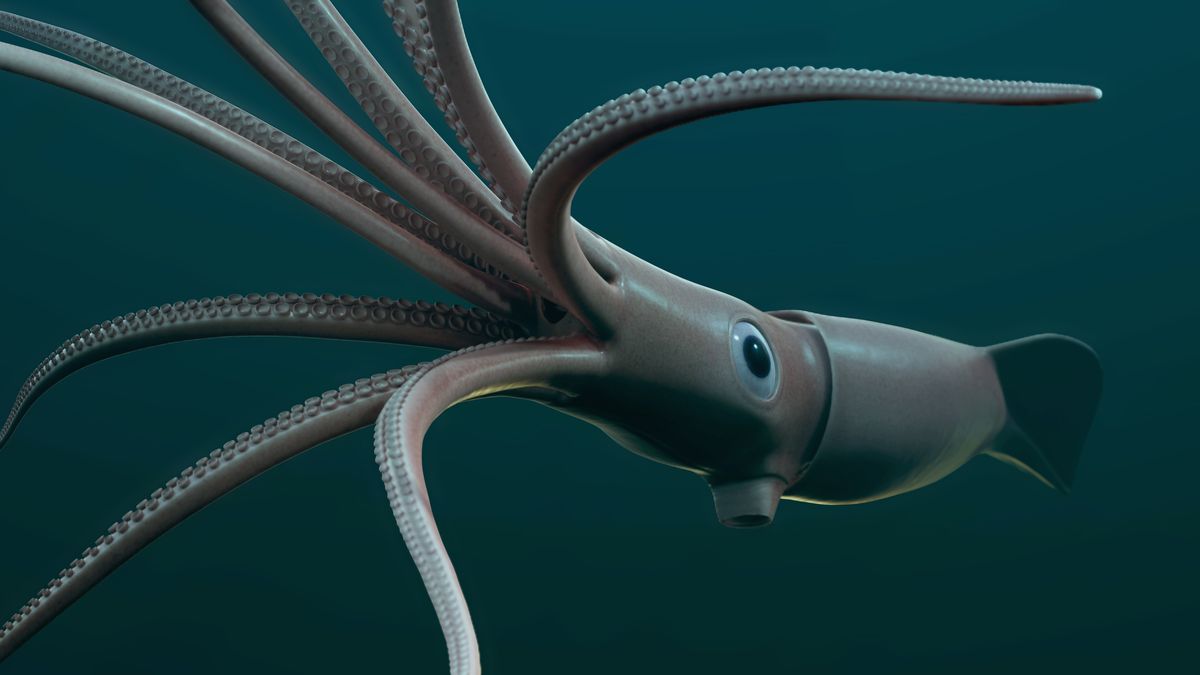
For the first time in decades, giant squids have been detected in the waters off Western Australia, lurking in the deep-sea canyons of the eastern Indian Ocean. However, these mysterious beasts remain as elusive as ever. The scientists didn't directly observe them, but instead identified their presence through environmental DNA (eDNA).
Giant squid (Architeuthis dux) can grow up to 13 meters, longer than a school bus, and have eyes up to 10 inches in diameter, perfectly adapted to see in the ocean's darkest depths. Despite their immense size, they are an extremely rare sight. Observations in the wild have been made, though most of what we know about them comes from deceased individuals washed ashore and the remains of their beaks found in the stomachs of sperm whales.
To learn more about the elusive species, scientists at Curtin University and the Western Australian Museum turned to eDNA, rogue bits of genetic material left by organisms in the natural environment. On board the Schmidt Ocean Institute’s ship, R/V Falkor, the team collected nearly 200 water samples from a variety of depths from Cape Range and Cloates, two submarine canyons about 1,200 kilometers (745 miles) north of Perth.
Genetic material of giant squid was detected in six separate samples from both the Cape Range and Cloates Canyons.
There have been only two prior records of giant squid off the coast of Western Australia, yet no confirmed sighting or specimen has emerged in over 25 years. Using these novel methods, the latest study suggests that they may be more common in this part of the ocean than previously thought.
“This is the first record of a giant squid detected off Western Australia’s coast using eDNA protocols and the northernmost record of A. dux in the eastern Indian Ocean,” Lisa Kirkendale, WA Museum Head of Aquatic Zoology and Curator of Molluscs, said in a statement.
But that wasn’t all. The researchers also identified samples of eDNA from 226 species across 11 major animal groups, including rare deepsea fish, cnidarians, echinoderms, squid, marine mammals, and more. Perhaps most significantly, they also found evidence of Pygmy sperm whale (Kogia breviceps) and Cuvier’s beaked whale (Ziphius cavirostris), two deep-diving whales that are known to hunt squid.
“Finding evidence of a giant squid really captures people’s imagination, but it’s just one part of a much bigger picture,” added Georgia Nester, who conducted the research as part of her PhD studies at Curtin University and is now at the Minderoo OceanOmics Centre at the University of Western Australia.
“We found a large number of species that don’t neatly match anything currently recorded, which doesn’t automatically mean they’re new to science, but it strongly suggests there is a vast amount of deepsea biodiversity we’re only just beginning to uncover.”
All of this was only made possible thanks to recent advancements in the field of eDNA, a tool that is transforming biology and conservation by providing a non-invasive way to detect rare or elusive species directly in their natural habitat.
“These canyons are incredibly rich ecosystems and, until now, they’ve been largely unexplored because of the difficulty of working at such extreme depths,” Nester added.
“With eDNA, a single water sample can tell us about hundreds of species at once. That means we can dramatically expand our understanding of deepwater environments in a way that simply hasn’t been possible before.”
The new study is published in the journal Environmental DNA.