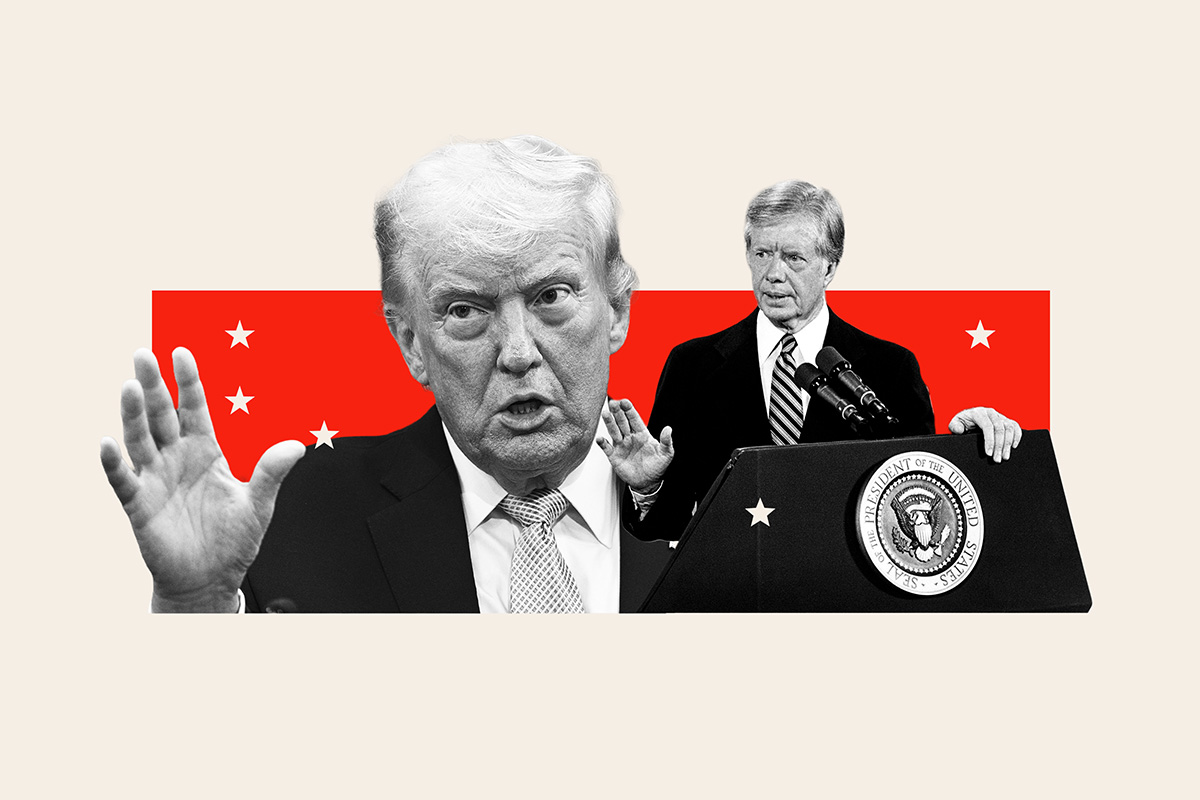
President Donald Trump has long invoked the late President Jimmy Carter as a cautionary tale.
In Trump’s telling, Carter embodied weakness at home and embarrassment abroad.
And though wildly different in their political beliefs and personal lives, recent polling data suggests Trump may now be dealing with a dynamic that has long been associated with Carter’s presidency: a widening split between how voters feel about him personally and how they think he is governing in office.
Trump has often mocked Carter’s legacy, citing him as the benchmark of a poor president while touting the successes of his own leadership—though he later claimed that Joe Biden was even worse.
“If you look back to Afghanistan or if you look back to the Jimmy Carter days, they were different days,” Trump said earlier this year. “We’re a respected country again.”
But more recently, the president has reportedly feared that his war in Iran could lead to comparisons with Carter.
The Wall Street Journal reported earlier this month, citing unnamed sources who spoke with the president, that Trump had dwelled on the 1979 Iran hostage crisis amid fears that his war in Iran could lead to a similar political disaster.
“If you look at what happened with Jimmy Carter…with the helicopters and the hostages, it cost them the election. What a mess,” the Journal quoted the president saying in March.
But now polls indicate that like Carter, more voters disapprove of the job he is doing as president, even if they do not hold an unfavorable view of him personally.
According to RealClearPolling’s average of polls, just 40.5 percent of Americans approve of the job Trump is doing as of April 22, while 57.7 percent disapprove, giving him a net approval rating of -17.2.
Meanwhile, RealClearPolling’s average of polls assessing Trump’s favorability shows 41.1 percent have a favorable view of Trump while 55.7 percent have an unfavorable view of him, giving him a net favorability rating of -14.6.
Since favorability measures how Americans feel about Trump personally and job approval measures how they think he is performing as president, it suggests there are voters who do not personally dislike the president, yet are critical of his presidency.
While the gap is modest, it’s a new dynamic for Trump.
His political success has long rested on the judgment of his performance being tied to personal support. The polling now indicates a small but potentially significant change in how some Americans evaluate Trump, with a growing share that appear willing to separate their personal feelings about him from their assessment of his presidency.
In Carter’s case, his presidency was marked by a documented split between personal perceptions of the man and of his performance as president. When he left office in 1981 after serving a single term, he was broadly seen as intelligent and caring, but he suffered from a perceived lack of leadership ability, according to an analysis of polls by CBS News.
Trump has touted a similar opinion. “He’s a nice man. He was a terrible president,” he said about Carter in 2019.
Grant Davis Reeher, a professor of political science at Syracuse University, noted that Trump and Carter led in different policy eras and faced different challenges with different leadership styles.
But what hurt Carter, he told Newsweek, “had to do with his negative overall orientation toward leadership. He had difficulty accepting that he had to persuade other political figures and the public of the rightness of his views and ideas. There was an arrogance, a finger-wagging there that turned Members of Congress and the public off.”
Reeher said Carter “ultimately became perceived as a weak leader, and the hostage crisis lingering on and on cemented that impression. So people lost confidence in him as time went on.”
While Trump’s strengths and weaknesses are different, Reeher said that in a presidency, if an impression becomes “deeply rooted, it is very hard to shake. I think Carter in his final year hit that place, and now Trump could be there too.”
He added: “People have seen the leadership style of Trump 2.0—there’s a consistent overall pattern in it, of the personal transactional base of it and the emphasis on loyalty, of the cycling change in rhetoric, of bluster, of crudeness, of policy aggressiveness with the capacity to back off if the public reacts strongly. That combined with the dissatisfaction with some of the policies themselves have anchored him underwater.”
Costas Panagopoulos, a professor of political science at Northeastern University, told Newsweek that job performance disapproval “may be more likely to be impactful, but personal ratings also matter because the two measures are not completely independent.”
Although the pattens can be reversed, Panagopoulos said it often happens only gradually and is unlikely to come in the months before November’s midterm elections.
Trump “still has time in his second term to change course, but these trends are often obstinate and could snowball further, causing his rating to continue to decline,” he said.
For now, one of Trump’s biggest political fears appears to be the polling reality he faces—and whether that gap closes or widens further could prove consequential for his final two years in office.
With Democrats fighting to regain control of Congress so they can thwart Trump’s agenda, the stakes for Trump—and his legacy—couldn’t be higher.
Related Articles