Maryland Democratic Gov. Wes Moore felt a sense of urgency last week to redraw his state’s congressional map and hand his party one more seat to help win this year’s bitter redistricting battle.
There was just one problem. His own party’s president of the state Senate, Bill Ferguson, has been standing in his way.
So the governor made his case in a private discussion with Ferguson, the lone Democratic leader holding up the party’s plans to approve midcycle redistricting, according to people familiar with the conversations. But Ferguson, who has argued that a new map would carry legal risks that could backfire, didn’t budge. Moore then excluded his fellow Democrat, facing the toughest primary challenge in his nearly 20-year career, from his list of dozens of endorsements.
The frantic push from Democrats to redraw maps in more states comes as two court rulings shatter the party’s optimism for beating Republicans in a gerrymandering battle that is upending the midterm landscape. Virginia’s state Supreme Court last week struck down a new map that would have given Democrats a chance of capturing four additional seats in its 11-seat delegation. That came after the Supreme Court’s decision to weaken the Voting Rights Act, giving Republicans an opportunity to redraw minority-focused congressional districts in Southern states. The court on Monday greenlighted Alabama’s efforts to change its maps.
Democratic leaders are now acknowledging there might be little they can do to keep up with the GOP’s redistricting efforts for the 2026 election. They are setting their sights on the next election and launching a plan to have maps redrawn in blue states like New York and Colorado. They are also looking to make gains in swing states, like Pennsylvania, if they can capture enough seats in state legislatures in November. Maryland remains a top target for Democrats, with some now debating an amendment to the state constitution instead of pushing the all-Democratic delegation map through the legislature.
“My philosophy is if Republicans are doing it, it’s malpractice for Democrats not to do it,” said Maryland state Sen. Arthur Ellis.
David Schuhlein, a spokesman for Ferguson, said that while the Senate leader remains opposed to Moore’s proposed map, he told the governor that he would be open to conversations about next steps with Senate leadership and the state attorney general. “He is as outraged as the governor about what is happening in the country and understands that the stakes are even higher,” he said.
Democrats in Oregon and Washington are also expected to consider new maps for 2028 if they can clinch quorum-proof majorities and supermajorities, respectively, needed to override procedural complications. The party is expecting to put up legal fights in states where Republicans are advancing broad changes. A new map passed under Florida Gov. Ron DeSantis is already facing legal challenges.
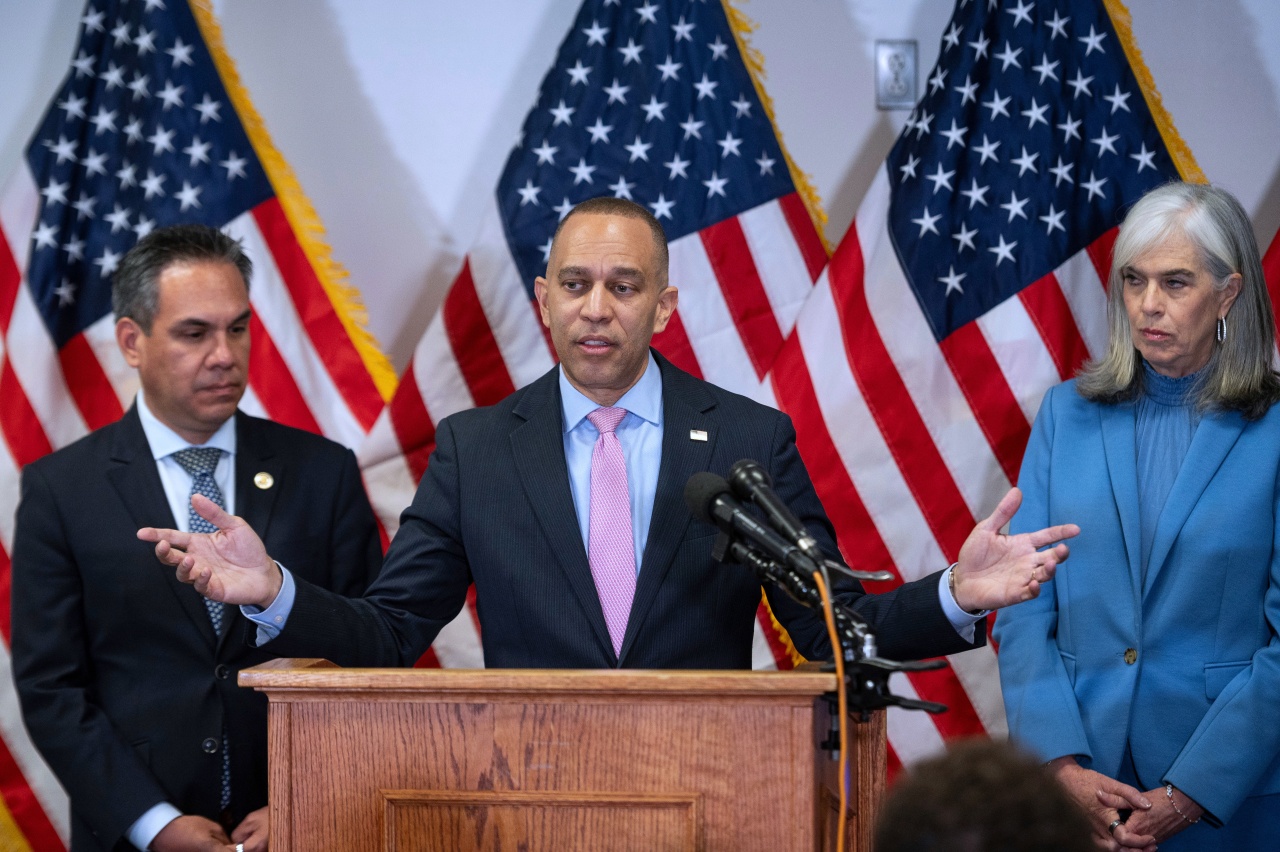
House Minority Leader Hakeem Jeffries, who has played a central role in the party’s midcycle redistricting efforts, has been in discussions with lawmakers in blue states for months, pushing them to take a more aggressive approach.
Jeffries said in a letter to House Democrats on Monday that Trump’s unpopularity would lead them to the majority, despite their recent losses in court. “Given the highly unfavorable political environment confronting House Republicans, the extremists will not meaningfully benefit from their scandalous gerrymandering scheme,” he said. He said Democrats would answer Republicans with a redistricting counteroffensive and announced a caucuswide briefing for later this week on the issue.
Rep. Joe Morelle (D., N.Y.), who will lead the briefing, met with New York Gov. Kathy Hochul last week, as lawmakers in his home state are expected to begin the process for changing the maps for the 2028 election. The early discussions point to Democrats picking up three to four additional seats in the 26-member delegation.
Democrats are still favored to win the majority in the House in November, with Trump’s approval ratings sagging in recent months amid a war in Iran and rising gas prices.
House Majority PAC, the super PAC aligned with Jeffries that spent $38 million on the Virginia effort, is gearing up to help push through changes in New York and other states for 2028. The group is already involved in a potential ballot initiative in Colorado to change maps for 2028 through an allied nonprofit, which has put $150,000 into the early efforts.
“We plan to pursue all paths necessary that will allow us to take back the House in November and hold the majority in 2028,” said CJ Warnke, spokesman for House Majority PAC.
Although Jeffries has pushed for Democratic-controlled states like Illinois to join in the effort, the party, which has a supermajority in the state, has faced pushback from its own lawmakers. Black elected officials in the state have expressed concern that redrawing maps would dilute Black representation. Illinois already held its 2026 primary, but state Democrats will be under pressure ahead of 2028 to reconsider.
Jeffries also hasn’t entirely given up on Virginia. In a private call with some Virginia Democrats over the weekend, the Democratic leader expressed anger at the court ruling and doubled down on efforts to flip two competitive House seats and a third seat that is more GOP-leaning, according to a person familiar with the call.
It included a brief discussion of a long-shot plan to replace all members of the state Supreme Court by lowering the mandatory retirement age for justices, the person said. The New York Times earlier reported on the call. The idea has since been publicly shot down by Democratic leaders in Virginia. The state’s attorney general filed an emergency appeal to the U.S. Supreme Court on Monday.
The complications in getting blue states to redraw their maps are in part rooted in efforts by those states to adopt anti-gerrymandering initiatives in the past decade. Even in Virginia, voters had to overturn a constitutional amendment that created a bipartisan commission to draw the state’s maps. Those measures were pushed by President Barack Obama and former Attorney General Eric Holder, who have shifted their stance since Trump’s emphasis on changing maps.
“We supported a number of those over time—I don’t regret those decisions,” said John Bisognano, president of the National Democratic Redistricting Committee, the group chaired by Holder and backed by Obama. “What has thrown the entire world upside down is Donald Trump’s decision to go scorched earth.”
Write to Tarini Parti at tarini.parti@wsj.com