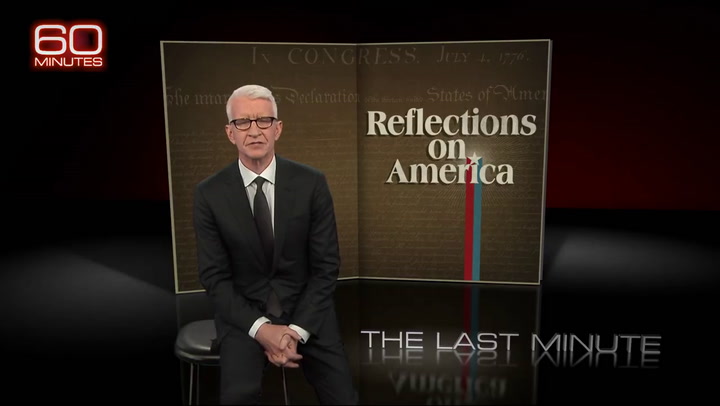
60 Minutes ended its Sunday night episode with a pointed message about American democracy.
During the show’s ‘The Last Minute’ segment,’ correspondent Anderson Cooper introduced historian Jill Lepore to discuss constitutional amendments.
Lepore, a professor of American history at Harvard and a staff writer for The New Yorker, discussed her view that the American legal system is founded on the philosophy of amendment.
“The idea that we can always make things better,” she explained, noting that state constitutions are regularly amended, typically via referendums conducted on election day.
“But I worry that at this point, we’ve all but forgotten that the federal Constitution can be amended, too,” she continued, adding that the Constitution has not been amended “in any meaningful way” since the 26th Amendment was introduced in 1971 to lower the voting age from 21 to 18.
Providing a brief history of written constitutions, which were invented 250 years ago with several state constitutions in New Hampshire, Virginia, and Pennsylvania, Lepore went on to respond to those who might argue that the U.S. Constitution does not need to be amended.
“You’d have to concede that the U.S. Constitution is being amended all the time,” Lepore told viewers. “Not by the people, but by the Supreme Court.”
“I think the 250th anniversary of the first constitutions in the United States—those state constitutions from 1776—is an excellent time to ask that question.”
In her 2025 book We the People, Lepore argued that the Constitution is a living document designed to be amended by each generation, in defiance of the constitutional originalism that now dominates the Supreme Court thanks to Justices Thomas, Gorsuch, Kavanaugh and Barrett. Of those “avowed originalists,” only Thomas was not appointed by President Donald Trump during his first term.
In a December interview, Lepore expressed concern that constitutional history no longer being taught in history departments has created problems for the U.S.
“Constitutional law is taught in law schools, which has a historical dimension in which constitutional law hopscotches from major Supreme Court decision to major Supreme Court decision,” Lepore explained on the Persuasion podcast.
“You then come to believe that the Constitution is what the Supreme Court says it is, and that there is no role for any other interlocutors in interpreting, understanding, or mending the Constitution. And that is a problem.”
Many of the Supreme Court’s landmark decisions have involved interpretations of the Constitution, some of which have been controversial.
In its 1857 Dred Scott decision, the Supreme Court concluded that rights afforded to U.S. citizens by the Constitution did not extend to people of African descent, and that Congress did not have the power to abolish slavery. It was only eight years later, after the conclusion of the Civil War, that the 13th Amendment would formally end slavery.
In Roe v. Wade, which was overturned by the Supreme Court in 2022, the court ruled that the 14th Amendment conferred on U.S. citizens a right to privacy, which included the right to seek an abortion.
Lepore’s Sunday night segment came at the tail end of a 60 Minutes episode that examined white supremacist groups and conspiracists who offer help to communities hit by natural disasters in order to launder their reputations and recruit new followers.
Other segments on Sunday night’s program included Cooper, who in February declined to renew his contract with CBS, reporting on the rare bird species that have flourished in “no-go areas” in Colombia amid decades of armed conflict, and a report on luxury perfume houses in the south of France.