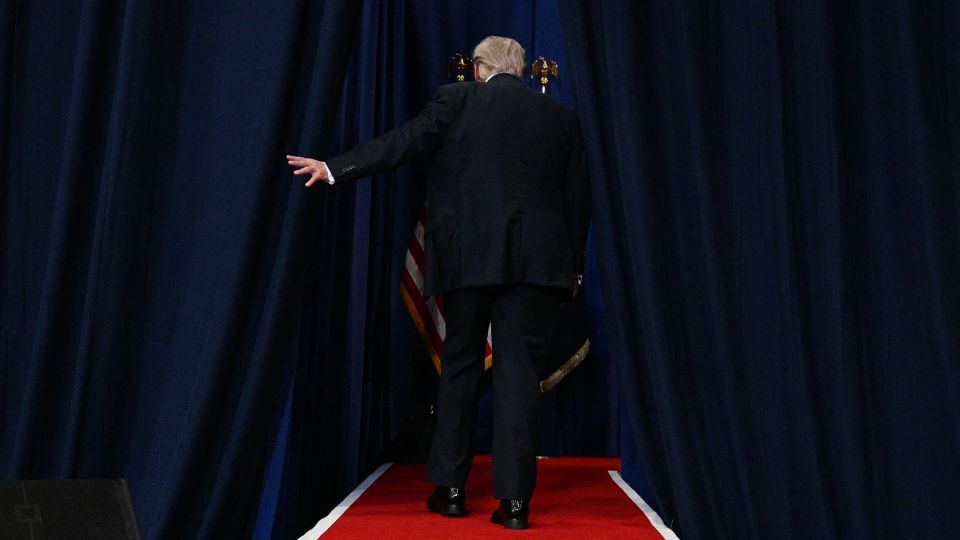
President Donald Trump’s tumbling approval ratings are raising the odds that the 2026 midterm elections will extend one of the most powerful trends in 21st-century American politics.
The president’s steady decline in popularity has increased the chances that Democrats in November could recapture the House of Representatives, and maybe the Senate too.
If Democrats flip either chamber, it will continue the extraordinary run of volatility that has seen control of the House, the Senate or the White House change hands between the parties in 11 of the 13 elections since 2000. By contrast, control of either congressional chamber or the White House flipped in just five of the final 13 elections of the 20th century and only seven of the last 20 stretching back to 1960.
Each time voters recoil against the party in power, political analysts usually focus on the immediate choices made by the president and his party in Congress. But the pattern of rapid reversals has become so entrenched that it appears driven less by tactical decisions than by deeper forces in the economy, society and the electorate that show no sign of abating.
“Five or six years from now, if we are having this conversation, it will probably be 14 out of 16 elections with people voting for change,” said Doug Sosnik, a former White House political adviser for Bill Clinton, who has tracked the trend.
Part of the explanation for this volatility is that whenever they do win power, both parties usually have only managed to scratch out small majorities. These smaller majorities leave them with little cushion for the midterm losses that have always been common for the president’s party.
“The midterm loss phenomenon is not new to the 21st century, but often the party in power absorbed the losses” and preserved its majority, said Brandice Canes-Wrone, a Stanford University political scientist and senior fellow at the conservative Hoover Institution. Now, she said, “the majorities are so tight” that even small reversals flip control.
A similar dynamic is evident in the White House’s revolving door. Each party has reliably locked down so much of the Electoral College that small shifts in the handful of swing states now decide elections.
But while narrow congressional and Electoral College margins can explain the frequent shifts in power, that raises another question: What explains the narrow margins?
Fewer swing voters, more income inequality
In their book “Identity Crisis,” UCLA political scientist Lynn Vavreck and co-authors John Sides and Michael Tesler, argued that the 2016 election culminated a long-term shift in the basic conflict between the parties from economic to cultural issues. Around polarizing questions including on immigration, racial diversity and LGBTQ rights, they wrote, Trump tilted the axis of political debate “to competing visions of American identity and inclusiveness.”
“For most of our lifetime, politics was contested over the New Deal issues —the size and role of government,” Vavreck said. “Those days are so gone. We are not (primarily) fighting over the tax rate anymore. In 2016, Trump raised these identity-inflected issues (and) now … we are fighting about who deserves to be an American.”
A political order grounded in such clashing visions of the nation’s identity, Vavreck and her colleagues argued, makes it harder for most voters to envision shifting their support from one party to the other. When “the differences between the parties in the early 1990s” centered on the role of government, more voters who leaned toward one party could imagine living in a country governed by the other “and not hate it,” she said.
“It wasn’t a personal and divisive existential crisis about what it means to be an American. So now that it is, it is harder for voters to make that crossover,” Vavreck said.
Amid these changes, political professionals largely agree that the combined share of the electorate immovably locked down for either party has grown through the 21st century to around 85% or even slightly more, reducing the number of swing voters. (In “Identity Crisis,” the authors memorably called this the “calcification” of American politics.)
Paradoxically though, the large number of voters firmly anchored in either party has increased the clout of the smaller group that is not. Swing voters tend to be the Americans who place less priority on the cultural and ideological firefights between the parties than on their own immediate economic circumstances — about which they have been persistently negative for years.
“That last 15% is dissatisfied, disengaged, not in the cultural wars, and are pretty much voting against whoever is in power,” said Sosnik. Those disaffected voters, as I’ve written, increasingly express their discontent not only by switching their vote, but also by whether they vote at all.
Micah Roberts, a Republican pollster who is part of a bipartisan team that surveys economic attitudes for CNBC, said voters who don’t strongly identify with either party “are consistently pessimistic.”
“There is not a year since 2017 when independents were positive about the current state of the economy,” Roberts said.
Economists and political strategists agree that many voters, especially those without a college degree, feel it has become far more difficult to get ahead than it was for their parents, as income inequality has widened since the 1970s. Josh Bivens and two colleagues at the left-leaning Economic Policy Institute recently calculated that the incomes of average families would be as much $30,000 higher today if workers at the very top had not claimed such a growing share of total national income since then.
“Rising income inequality is the main reason that affordability feels out of reach for too many U.S. families,” they wrote.
The slowdown in wage growth has frustrated working families for years and contributed to the 21st century’s endemic political instability, most analysts agree. But the sharp spike in inflation after Covid-19 raised these concerns to a crisis level. Instead of treading water, many families now feel they are slipping beneath it. Though other economic indicators such as the unemployment rate and stock market are positive, Roberts said, today “the only economic report that ordinary, everyday Americans pay attention to is the price on the gas station billboard or the price at the bottom of their grocery bill.”
Those frustrations boosted Trump in 2024 when Democrats were in the White House, but now that undiminished anxiety looms as the biggest 2026 threat for Republicans.
“We’re a quarter of the way through the 21st century and neither political party has figured out how to satisfy voters’ basics needs while we are playing on this new field,” Vavreck said. “This is where we are going to be probably for the rest of my lifetime.”
How presidential overreach feeds the pattern
Shifts in presidential strategy have also fed the persistent instability. With only occasional exceptions, the presidents since 2000 have centered their legislative agendas primarily on massive partisan bills (from Barack Obama’s Affordable Care Act to Trump’s One Big Beautiful Bill Act) that they typically pass through the special reconciliation process with little, if any, support from the other party.
“Both parties now use the reconciliation process when they have full control of government to jam through their agenda on a partisan basis,” said former Republican Rep. Charlie Dent, now executive director of the Aspen Institute’s congressional program. “It’s almost as if they’ve given up on trying to pass big bipartisan bills.”
Whatever the policy merits of these highly partisan bills, the political impact has been to trigger intense opposition from the other party. Neither recent Republican nor Democratic presidents have followed a more incremental strategy of seeking to broaden their support by starting their terms with limited, bipartisan legislative plans. Even when presidents have pursued bipartisan compromises — as Biden did on his big infrastructure and semiconductor manufacturing bill — they have found that their partisan moves overshadowed that outreach.
Canes-Wrone pointed to another reason why new presidents now stir immediate backlash: They are deemphasizing legislation at all in favor of advancing their agenda through aggressive executive action. “It is very easy when you are operating more unilaterally to overreach,” she said.
A cycle with no obvious way out
Cycles of such sustained instability have been rare in American politics. In the 20 years before the Civil War from 1840 to 1860, ten of eleven elections produced shifts in control. Many political analysts find even more similarities to the period from 1876 to 1896, which saw eight change elections over eleven.
Like today, that late 19th century stretch was defined by wrenching changes — the transition from an agricultural to industrial economy, fierce battles between management and labor, and rapid urbanization, all punctuated by a massive immigration wave. Then, as now, many voters saw the two parties as incapable of delivering economic and social stability amid the tumult.
What could break today’s cycle? Bivens, like Sosnik, believes that politics is unlikely to stop shaking until living standards for average families more steadily improve. The catch-22, Bivens says, is that implementing policies that might generate such broadly based gains will require one side to hold power for a longer stretch than now seems possible.
“In order to make the big policy change to get us out of the trap we’re in … it would require a sustained period of governance, which would require a lot of popular support, and popular support on a sustained basis is really hard when you haven’t solved the problem,” Bivens said. “How to solve that timing problem is a real conundrum.”
Canes-Wrone is more optimistic that a president who focused on incrementally building support with a moderate agenda intended to reassure and gradually solidify swing voters could construct a more lasting advantage. If a new president “didn’t overreach, then we are in a different world,” she said. “The question is whether once you are in office you can restrain yourself.”
Sean Wilentz, a Princeton University historian who specializes in 19th-century US politics, points toward a different possible endpoint. The eras of stability when one party established a lasting advantage over the other, he noted, have almost always come after a crisis that discredited the other side and allowed a new president to expand and solidify his coalition.
The period of turbulence before 1860 ended when Abraham Lincoln and Republicans led the Union to victory in the Civil War; the late 19th-century upheaval gave way to sustained Republican dominance after the panic of 1893 undercut the Democrats then controlling Washington. Similarly, Franklin D. Roosevelt’s vigorous response to the Depression powered 36 years of Democratic advantage in Washington. “Crises help make presidents one way or another,” Wilentz said.
The financial crisis of 2008, Wilentz believes, similarly offered Democrats a chance to reorder politics. But, he argued, the reluctance of first George W. Bush and then Obama to hold Wall Street and the wealthy fully accountable “blew up both parties” and ignited the free-floating populist backlash against “elites” and a “rigged system” that elevated the tea party, Trump and Bernie Sanders — and has unsettled both coalitions.
Now, Wilentz says, the political system may remain unstable until another crisis emerges that provides a future president another chance to build a more durable coalition. “Maybe that’s what we are waiting for — a shock like that,” Wilentz said. “If I was betting about the next 10 years, I wouldn’t bet against it.”
In the meantime, the safest bet is that voters will continue ricocheting between the parties, searching for answers neither seems able to provide.
For more CNN news and newsletters create an account at CNN.com