We may receive a commission on purchases made from links.
Amazon has been selling Amazon Fire tablets for nearly 15 years, with the first few generations being branded Kindle Fire. They're very affordable, entry-level devices that run Amazon's custom version of Android.
They're good for media consumption more than productivity work, even though Amazon has been selling the 2023 Fire Max 11 as the most powerful Fire ever, a tablet that targets work-related use, not just video streaming or web browsing as most other models do. But the Amazon Fire tablet line, as it exists in early-2026, may be a waste of time and money for the consumer.
You don't need an Amazon device to enjoy any Amazon-branded content tied to your Amazon account, especially Prime Video and Music perks. Anything a Fire tablet can do, a mid-range Android tablet or a used iPad can do better. Amazon Fire tablets have simply not kept up with the rest of the industry, with Amazon looking at keeping costs low for a device meant to direct users to Amazon's ecosystem. Meanwhile, the rest of the market has evolved significantly. Some of Apple's iPads run on the same powerful M-series chips as its MacBooks. Android vendors have also improved their offerings, with many Android tablets ready to offer high-end experiences like the iPad.
Read more: Thinking About Buying An Amazon Fire Stick? Here Are 5 Things You Need To Know
The hardware isn't even the biggest problem
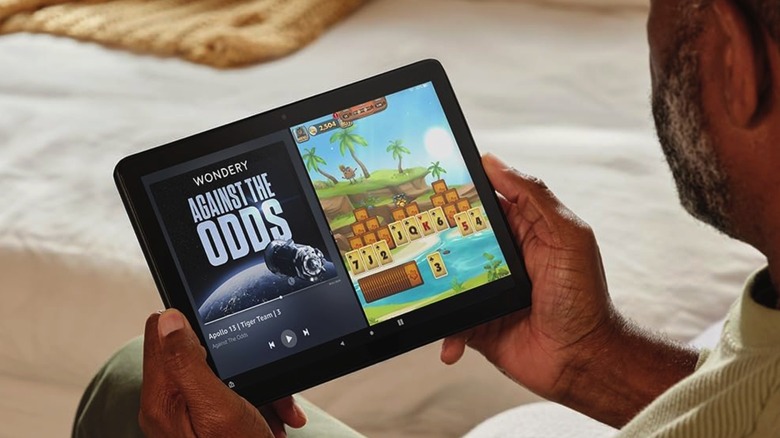
The Amazon Fire HD 8, priced at $99.99 on Amazon (the Lockscreen Ad-Supported version), features 3GB of RAM and 32GB of storage, with Amazon marketing it as "vibrant, fast, and responsive." Amazon also says the tablet is good for streaming video, reading ebooks, listening to music and podcasts, and playing games. Then there's the Alexa AI component, with the tablet offering access to Alexa Plus, Amazon's AI chatbot. At the high-end of the Fire tablet spectrum is the Amazon Fire Max 11, which Amazon says has been "engineered with precision, packed with power." Priced at $239 (with ads), the tablet features 4GB of RAM and 128GB of storage, but you'll only find refurbished versions. The $139.99 10.1-inch Amazon Fire HD 10 is the latest big-screen tablet you can buy new from Amazon. It features the same 3GB of RAM and 32GB of storage as the 8-inch version.
The main problem with Fire tablets may be the software experience. There's nothing wrong with using an entry-level or mid-range Android tablet for watching movies, reading books, playing games, and shopping online if that tablet has access to all the apps you love from the Google Play store. Amazon's Fire tablets don't run Google's version of Android, featuring an Amazon fork that has its own app store.
Tech-savvy users may be able to install the Google Play store, extending the Fire tablet's usability, but that's not something average users do. Also, Fire tablets may be slower than other alternatives, which can impact the experience. YouTuber Dammit Jeff has a good rundown on the current state of Amazon's version of Android and how it ruins Fire tablets (see the video above).
The bigger picture: Do we even need tablets?
A Reuters report last August said Amazon is working on a "big change" to its Fire tablet lineup meant to address criticism from consumers and developers. That project is known as Kittyhawk, and involves transitioning the Fire tablet to the open-source version of Android that's easier to use. The device running the Android OS consumers may want would be a higher-end offering, with prices going up to $400. Even if Amazon manages to address performance and usability concerns in the near future, there's a bigger picture to consider: the next paradigm of computing that may not have a place for tablets in it.
Smartphones are the go-to form factor for most of our computing tasks. A large-screen TV in the living room can run all the streaming apps and connect to all gaming consoles for home entertainment. Laptops feature touch screen displays and are much better for productivity, thanks to their powerful specs and built-in keyboards. It gets worse for tablets, as book-type foldable phones, including the Samsung Galaxy Z TriFold, the Pixel 10 Pro Fold, and the upcoming iPhone Fold, can replace them, though foldable devices have premium pricing.
Finally, there's the emergence of voice-controlled wearables that have AI chatbots at their core, like the Ray-Ban Meta smart glasses and upcoming Android XR glasses from Google and Samsung. OpenAI and Apple are working on wearable AI devices. Rather than looking at a screen to handle entertainment, controlling one's smart home, and shopping online, users may transition to AI pins and glasses that allow them to accomplish tasks without tapping a display.
Enjoyed this article? Sign up to BGR's free newsletter and add us as a preferred search source for the latest in tech and entertainment, plus tips and advice you'll actually use.
Read the original article on BGR.