I suspect many riders might not have heard of Propain, a German direct-to-consumer brand focused on off-road bikes. As with many DTC brands, such as Canyon and Ari, Propain offers exceptional value compared to larger brands for similar build options. But what might be most appealing to riders is the deep level of customization Propain offers during the purchasing process.
The brand's identity and product offerings are largely rooted in downhill bikes, and while the Hugene is a short-travel trail option with “just” 140/130mm of front/rear travel, it clearly draws on many styling, design, and build cues from the brand's longer-travel offerings.
How you feel about mountain bikes in this travel range will depend a lot on your past mountain biking experience and perspective. Riders coming from a Cross-Country(XC) racing background will likely see the Hugene as a heavy, big bike for big all-mountain days, where the point of the ride is descending. While Enduro and Downhill riders might see the Hugene as the bike they reach for when they want to spend more time pedaling rather than shuttling.
Neither perspective is wrong, but it will certainly color how you see the Hugene and whether or not it might be a good bike for you.
Frame Details
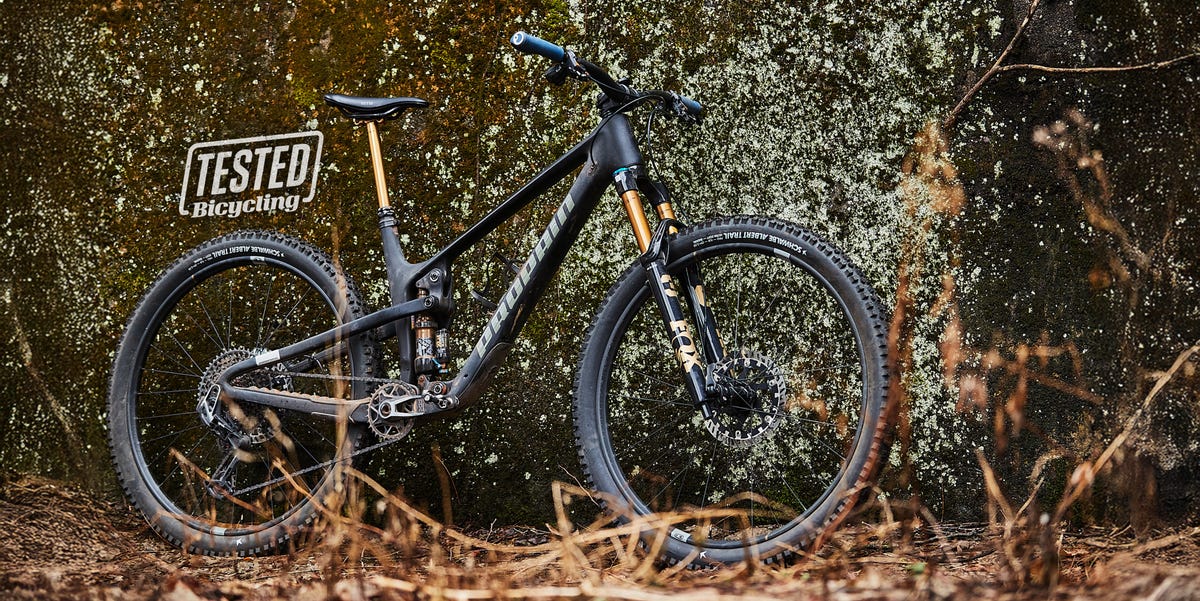
The Hugene uses a carbon frame, rear triangle, and a carbon upper linkage. The rear suspension looks to use a VPP-like layout with the shock oriented vertically. Propain calls it their PRO10 suspension design. A size medium frame is claimed to weigh 6.2 lbs, and my size large test bike came in at 32.3 lbs without pedals.
The frame itself features smart details, such as a protective plate on the bottom of the downtube and a very robust chainstay protector that does a great job of keeping the chain quiet on rough descents. There is a well-made internal storage hatch on the downtube that is well sealed. It uses a locking mechanism that is easy to use with one hand. The frame only has one bottle cage mount and no accessory mounts.
Cable routing can be done through ports on the side of the downtube or through the headset. Though, why would you want to make your life harder by putting a trail bike's cables through the upper headset bearing is beyond me. Still, it’s nice to have options.
Geometry
The Hugene is available in four sizes, from S to XL. Each size uses the same headtube angle of 64.8º with an effective seat angle of 77.5º. The basic premise of this type of modern trail bike geometry is to push the rider more forward in the seated position to help with climbing, while the slack headtube angle smoothes things out on the way back down when the seat is dropped out of the way.
Pricing and Builds
Propain offers riders many options for the Hugene's build. There are two stock build options, as well as a frame-only option for $2,750. The Signature 5 build is the more premium build and retails for $5,300, while the Signature 1 build is $4,000.
But customization is where Propain really shines, with custom builds starting at $3,700 and topping out at $9,100 after selecting every available premium option. The bike I tested is a custom option build that would retail for $7,664. Which feels like a really good value to me, considering the Fox Factory suspension/dropper post package, SRAM GX Transmission drivetrain, the very powerful Magura MT7 HC3 brakes, and the Crank Brothers carbon wheelset built to Industry Nine hubs.
Best of all, if none of those options suit your preferences or budget, other options are available, along with three frame colors and 22 logo color options.
Ride Impressions
Propain graciously let me spend almost a year riding the Hugene. Most of that time was spent riding rooty, rocky, and punchy East Coast trails in Pennsylvania, but towards the end of my testing, I also flew with the Hugene to Arizona to see how it would handle the steeper, more technical terrain in Sedona.
Truthfully, I’m glad that I did because the Hugene really came alive for me on the Sedona trails that really pushed my technical ability and nerve. That’s where I found the longer wheelbase, the more planted feeling, and the heft of the Hugene to be reassuring.
On my local, Pennsylvania trails, the Hugene felt overbuilt and heavy. The riding here is very punchy, with short uphill bursts of technical climbing that reward quick accelerations. With similarly short descents that didn’t quite let the Hugene really stretch its legs or show its capabilities. Instead, I mostly felt like I was overbiked.
Conversely, out West, where both the climbs and descents tend to be longer, the Hugene really shone. When it came time to pedal, I found the steep seat angle really helped me settle in to the climb without feeling like I was scrunched over the front of the bike. I found the position quite balanced, with both the front and rear wheels finding plenty of grip, even on the loose, dusty, and often rocky climbs in Sedona.
On the longer, steeper descents, the Hugene let me feel more in control, particularly on steeper sections, even when I was nearly putting my butt on the rear tire. If anything, how comfortable the bike felt made it easy to get a bit carried away and go overboard on how much the 140/130mm of suspension could handle. This is where I think the Hugene strikes a very fine balance, being an incredibly capable bike in the right hands. Almost too capable for how much suspension travel it has.
The only real downside of the Hugene for me was its weight. At 32.3lbs, it’s on the heavier end of the 140/130mm trail category, where many comparable bikes now dip under 30lbs depending on build. You feel that weight after a long day on the trail, especially if the day is ending with a climb. With trail bikes, the trade-off with weight usually comes with more suspension, which isn’t the case with the Hugene. Swapping to a lighter wheelset and tire combo on my test sample saved nearly two pounds and made a noticeable difference in how peppy the bike felt.
The Hugene’s weight won’t win any spreadsheet comparisons, but it also doesn’t tell the whole story. Much of that heft comes from a burly stock build and with Propain’s level of customization, that’s something riders can adjust.
What you’re really getting here is a highly capable, modern trail bike with downhill DNA and the ability to tailor it to your priorities. If you live somewhere with long, steep descents, or plan to travel to them, the Hugene makes a strong case as a do-it-all machine that favors stability and confidence while pushing right to the limit (and a little beyond) what a 140/130mm trail bike is capable of.