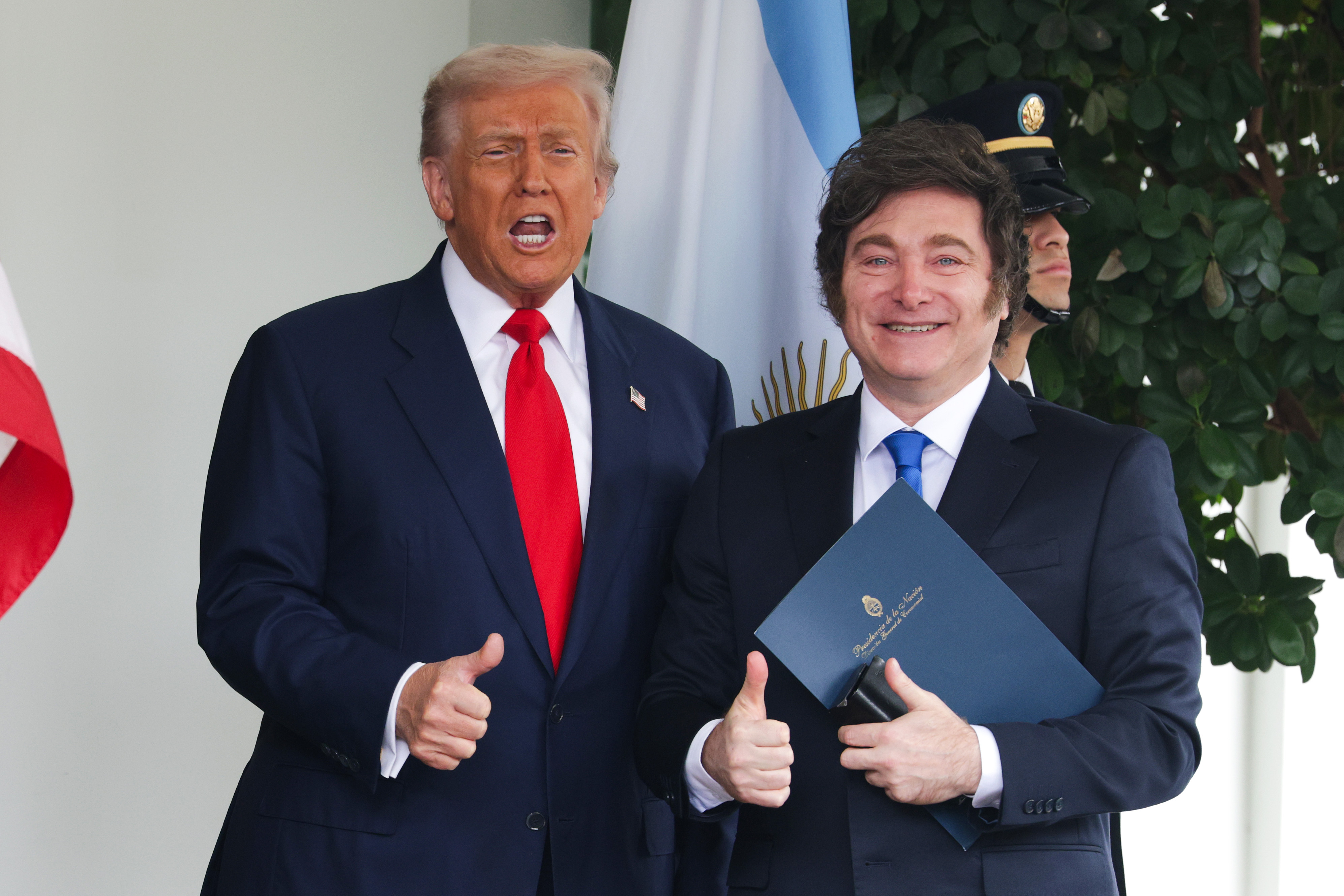
A leaked Pentagon email proposing to withdraw U.S. diplomatic support for Britain’s claim to the Falkland Islands has put Argentine President Javier Milei in an awkward position, exposing a sharp contradiction between Argentina’s domestic consensus on the islands and Milei’s demonstrated indifference to the dispute.
The internal Pentagon memo, first reported by Reuters and circulated among senior Defense Department officials Friday, proposed reassessing U.S. backing for European “imperial possessions,” including the Falklands, as retaliation against NATO allies who refused to support U.S. military operations during the Iran war.
Milei responded hours later by reaffirming Argentina’s territorial claim.
“We are doing everything humanly possible to return the Falklands to Argentina,” he said in an interview with the Argentine digital channel Neura. “Sovereignty is non-negotiable, but it must be handled judiciously, with brains.”
Unlike previous Argentine presidents, Milei has shown little interest in the Falklands dispute, preferring instead to cultivate ties to the United Kingdom rather than antagonize it over the claim. He has repeatedly said he will not abandon Argentina’s claim, yet he also told the BBC in 2024 that he accepts that the Falklands are currently “in the hands of the U.K.” and that there is “no instant solution” to changing that.
For experts consulted by Newsweek, the memo has left the Argentine president in a difficult position.
“Milei’s open admiration for [former British Prime Minister] Margaret Thatcher is even more noteworthy than his chainsaw or hairdo,” said Benjamin Gedan, senior fellow and director of the Latin America Program at The Stimson Center. “His general disinterest in the Falklands dispute wins him few friends at home, where agreement spans the political spectrum on Argentina’s territorial claims.”
The Falklands, a British Overseas Territory, are 300 miles off the coast of Argentina, which has claimed them since 1833. The islands were the subject of a 1982 war between Britain and Argentina that killed 255 British service members and about 650 Argentine soldiers.
Every Argentine government since the war has formally asserted the claim. Previous presidents have adopted hardline tactics, including threats against energy companies exploring for oil around the islands. Signs throughout Argentina display the distance to the Falklands.
Awkward Position
For an Argentine leader, U.S. support for Argentina’s claim would normally represent a monumental diplomatic victory. Argentina has spent decades pressing the U.S. to abandon its de facto neutrality on the issue at the Organization of American States and the United Nations.
“Normally, U.S. support for Argentina on the Falklands would be a monumental diplomatic win for an Argentine leader,” Gedan told Newsweek. “For Milei, however, hints of a shift in the U.S. posture are awkward, drawing attention to his preference for building strong ties to the United Kingdom rather than jeopardizing the relationship over this issue.”
The contradiction came into sharp focus during a recent session in the Chamber of Deputies. Libertarian lawmakers from Milei’s coalition attempted to pay tribute to the Falklands, but the moment exposed the government’s internal conflict over the issue. Deputy Juliana Santillan defended Milei by saying he “honors the Falklands in private.”
The response drew criticism from opposition lawmakers.
“It matters little what Javier Milei thinks in private,” said Myriam Bregman, a deputy from the opposition Socialist Workers’ Party. “When he expresses himself praising Thatcher, he does so as President of the Nation, and that represents an offense to our entire people.”
In another session in early April, Deputy Aldo Leiva Leiva, a national legislator from Chaco and a former combatant, spoke from his experience in the 1982 war and pointed directly at the head of state.
“It hurts a lot that the president of our nation expresses himself admiring the war criminal Margaret Thatcher,” he said before the chamber.
A 2024 survey found that 66 percent of Argentine adults believe the islands should become Argentine sovereign territory, with 21 percent supporting shared sovereignty. Eighty-nine percent of Argentine adults view their country’s claims to the Falklands as legitimate, and 83 percent would support negotiation on the issue.
Yet a 2013 referendum showed that islanders voted nearly unanimously—99.8 percent with 92 percent voter turnout—to remain a British overseas territory. Downing Street has consistently stressed that the islanders’ overwhelming vote underpins Britain’s stance on sovereignty and self-determination.
What U.K. and NATO Have Said
Citing an anonymous U.S. official, Reuters reported Friday that an internal Pentagon email proposed ways to hold allies accountable after the Iran war rift, including suspending Spain from NATO functions and reviewing U.S. backing of the U.K. claim to the Falklands to reduce what the Trump administration views as Europe’s “sense of entitlement.”
The United Kingdom immediately reaffirmed its position.
“We could not be clearer about the UK’s position on the Falkland Islands,” a spokesman for Prime Minister Keir Starmer’s government said. “Its longstanding and unchanged sovereignty rests with the UK and the island’s right to self-determination is paramount.”
British Member of Parliament Stephen Doughty echoed the stance on social media.
“The Falkland Islands are British,” he posted on X. “As I confirmed to Parliament earlier this week, our commitment to the self-determination, sovereignty and defence of the Falkland Islands and their people is resolute—and will always come first.”
Spain took a more measured approach. Prime Minister Pedro Sánchez refused to be drawn into a dispute with the United States over reports that the Pentagon is weighing whether to punish NATO members that fail to support American operations in the Iran war.
“We do not work with emails,” Sánchez told reporters at a European Union summit in Cyprus on Friday. “We work with official documents and positions taken, in this case, by the government of the United States.
“The position of the government of Spain is clear: absolute collaboration with the allies, but always within the framework of international legality.”
A NATO official told Newsweek that its “Founding Treaty does not foresee any provision for suspension of NATO membership.”
Pentagon press secretary Kingsley Wilson declined to comment on “internal deliberations” but told Reuters: “The War Department will ensure that the President has credible options to ensure that our allies are no longer a paper tiger and instead do their part.”
Trump’s Tensions With NATO: The Context
Trump has long tied his criticism of NATO to burden-sharing and allies’ defense contributions. Amid the Iran war, he called NATO “useless” after allies declined to provide military support or grant access to bases and airspace.
Beyond the Middle East, European leaders have been unsettled by Trump’s rhetoric that Greenland should become part of the United States and the island’s prime minister urged residents to be ready amid talk of annexation and questions over alliance obligations.
Any move to revisit the U.S. position on the Falklands, long administered by Britain but claimed by Argentina, would mark an escalation amid already-strained ties.
Related Articles