Iran is digging out its underground missile bases during the ceasefire with the US and Israel, satellite imagery suggests.
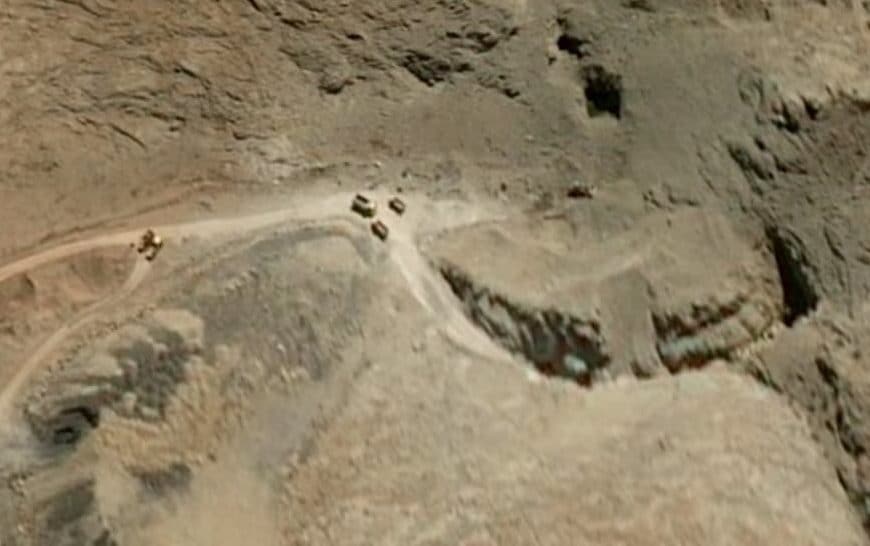
Heavy machinery has been seen clearing debris from blocked tunnels, scooping up rubble and loading it into nearby trucks.
Those entrances were deliberately targeted in earlier strikes by the US and Israel, as part of a strategy aimed at trapping missile launchers underground.
One satellite image taken on April 10 shows a front-end loader on a mound of debris that was sealing a tunnel entrance, with several dumper trucks waiting nearby at a missile base near Khomeyn, Iran.
A second image taken on the same day also showed construction equipment working at a site in Tabriz.
By blocking exit routes, the strikes sought to prevent launchers from deploying, firing or returning to reload.
However, US intelligence assessments indicate that around half of Iran’s missile launchers remain intact.
Earlier this month, the Pentagon said it had struck 11,000 targets in Iran within the first five weeks of war, while the Israel Defence Forces reported that three quarters of Iran’s missile launchers had been destroyed by March 7.
Last week, Gen Dan Caine, chairman of the US joint chiefs of staff, said the strikes had shattered Iran’s defence industrial base.
He said the US had dropped more than 13,000 munitions, striking missile and drone storage sites, naval assets and the country’s defence industry “to ensure that Iran cannot reconstitute the ability to project power outside their borders.”
Pete Hegseth, the US defence secretary, told reporters that Iran’s missile programme was “functionally destroyed”, with launchers and missiles “depleted and decimated and almost completely ineffective”.
But some American officials already expressed concern that Iran would use the break in fighting to rebuild some of its missile arsenal.
They have also warned that Tehran could seek to acquire comparable systems from Russia to bolster its capabilities against its neighbours.
“The Iranians have shown a remarkable ability to innovate and reconstitute their forces quickly,” Kenneth Pollack, a former CIA analyst now at the Middle East Institute, told the Washington Post.
“They are a much more formidable opponent than most Middle East militaries other than the Israelis.”
Many of these systems are believed to be buried within the underground network, rendered temporarily unusable rather than destroyed.
Analysts say Iran’s efforts to reopen the sites are both predictable and integral to its military doctrine.
Sam Lair, of the James Martin Center for Nonproliferation Studies, told CNN: “[A ceasefire] requires you to accept that your adversary is going to reconstitute some of their military capacity that you just spent a bunch of time and effort and money destroying.”
The so-called “missile cities” were designed with this in mind, to absorb an initial wave of strikes, restore functionality and resume operations, Mr Lair added.
“This aligns with the overall concept of operations for the missile city, which was, you eat the first attack, dig yourself out and then launch again,” he said.
Meanwhile, Donald Trump said on Tuesday the war with Iran was “close to over” as he hinted at a resumption of talks with Iran.
In a preview clip of an interview with Fox News, the US president was asked whether the war was finished. “I think it’s close to over, yeah,” he replied.
Separately, Mr Trump said negotiations between US and Iranian officials could resume in Pakistan in the next two days.
“I think you’re going to be watching an amazing two days ahead,” Mr Trump told ABC News, adding he did not think it would be necessary to extend a two-week ceasefire that ends on April 22.