
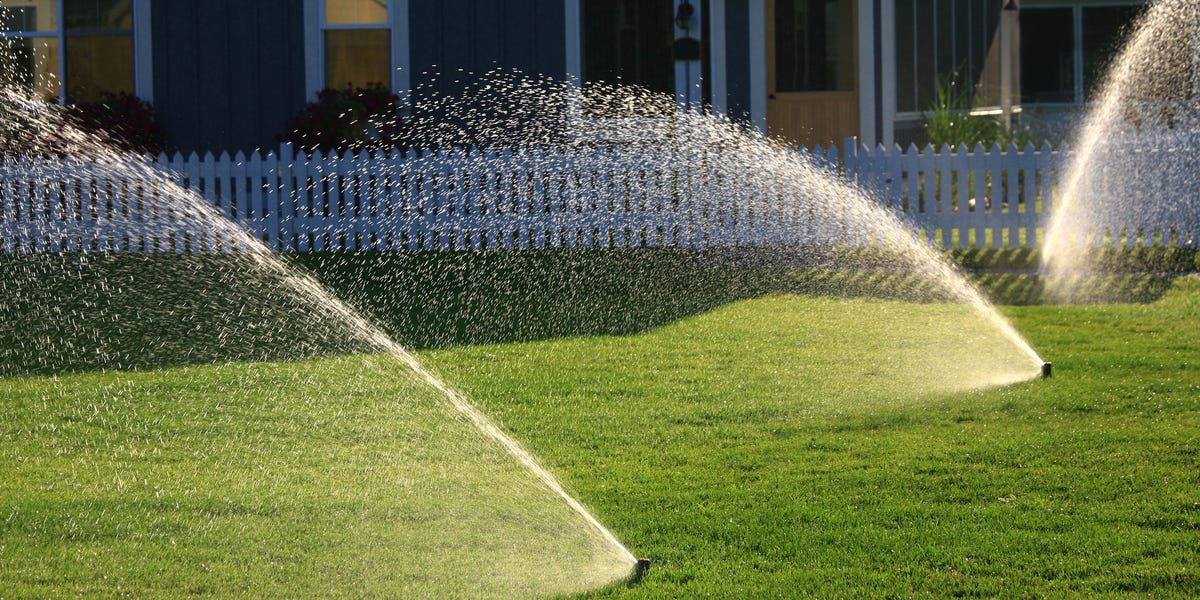
A thriving lawn doesn’t happen by accident. It takes thoughtful landscaping, proper seeding, regular fertilizing, and a reliable mowing schedule. Even so, summer can undo that hard work fast if your grass isn’t getting enough water to stay green and hydrated.
While rainfall is the simplest and most natural way to water your lawn, the challenge, of course, is that weather is unpredictable, and many regions across the U.S. are naturally hot and dry. That’s why so many homeowners rely on regular watering to keep their grass looking lush throughout the season.
So, what’s the best time of day to water your lawn, and how often should you do it? The answer depends on several factors, including your local climate, soil conditions, and the type of grass you grow. However, experts largely agree on the basics, and the general guidance is fairly simple. Before you invest in an irrigation system and turn on your sprinklers, see what the professionals suggest.
When Is the Best Time to Water a Lawn?
Give your grass an early start, and it’ll thank you with a healthier glow. Take it from the experts: "Early morning is the best time to water," explains Dr. Gary R. Bachman of Michigan State University in his writings on the subject. "The air is cooler, and the soil can absorb water before the heat of the day."
Try to water before 10 a.m. if possible. "Watering during the middle of the day is not very efficient, as some of the water evaporates before it can do any good," he notes. This is particularly useful in areas with municipal watering restrictions where conservation is of the utmost importance.
Is it Better to Water Your Lawn in the Morning or at Night?
Because evaporation in the heat of the day is one of the main reasons experts recommend morning watering, it’s natural to wonder whether evening is a good alternative. The lawn care experts at Scotts advise, "If you must water in the evening, try between 4 and 6 p.m. which should give the grass blades time to dry before nightfall." However they warn, "The later you water, the greater chance of disease becoming prevalent in your lawn." So, morning is still the best choice.
How Often Should You Water Your Lawn?
"Many common recommendations suggest applying one to one and a half inches of water per week," Dr. Bachman recommends. "This doesn't mean spread across seven days, but rather in one or two irrigations per week. Slow and steady wins the race." Keep in mind that cool-season grasses usually require more water than warm-season grasses. Also, pay attention to the weather. You'll have to water less (or perhaps not at all) on rainy weeks. Ideally, the top six to eight inches of soil should be wet.
How Do You Know When to Water Your Lawn?
"I have learned that observation and experience are needed for keeping your landscape plants alive during a long, hot and dry summer," notes Dr. Bachman. "Too much water encourages root rot problems; too little water leaves plants wilted and lifeless." Dry, yellow patches or an overall dull green color are two clear signs that your lawn needs hydrating.
If you're doubting your powers of sight observation, try this trick from Scotts: "Check your lawn by walking on it. If your footprints don't disappear quickly, it's because the grass blades don't have the needed moisture to spring back." Of course, the Scotts experts also advises that you don't always have to water your lawn! "Established and properly cared-for lawns can survive weeks without water by going dormant (when the lawn turns brown), then recover once the rain returns."
What Is the Best Way to Water Your Lawn?
Beyond when and how much to water your lawn, there are some best practices. First, sprinklers are best for consistency and efficiency. Choose a system based on the size and shape and position them so they don't water your sidewalk or driveway. If you're willing to invest, you might want to consider an in-ground sprinkler system with smart technology that you can control from your phone.
Also, if your region is prone to drought or had water restrictions, consider feeding your lawn with nutrients that’s specifically designed to combat heat. That way, even if you can't water your lawn as much as you'd like, your grass is still protected from the elements, including bugs.