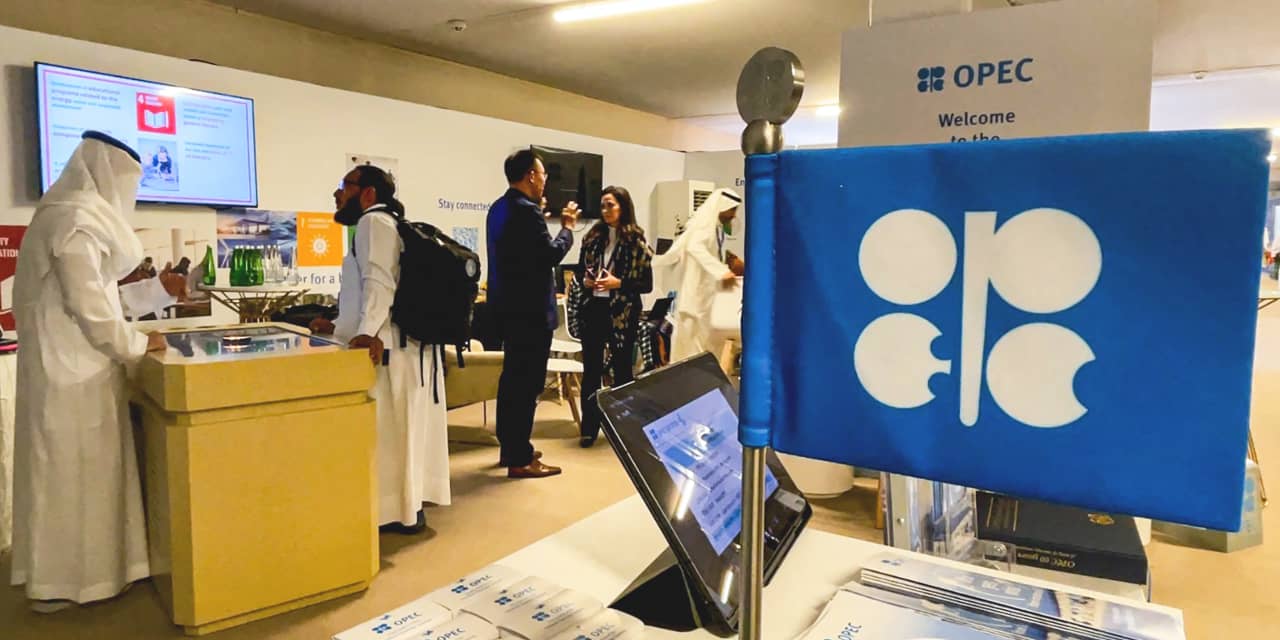
The United Arab Emirates said Tuesday it plans to increase energy production as part of its exit from the Organization of the Petroleum Exporting Countries on May 1.
More supply should, in theory, mean lower global oil prices down the road. Yet much still hinges on the trajectory of the Iran war, global crude supplies and control over the crucial Strait of Hormuz in the Persian Gulf.
“You want to be long oil now,” said Steve Hanke, a professor of applied economics at Johns Hopkins University, pointing to oil prices that are back near where they were when the U.S. and Iran on April 8 agreed to a cease-fire.
Global Brent prices were up more than 5% this week on Tuesday, near $104.55 a barrel, according to FactSet. They were near $109 on April 7.
“The story now is we are drawing down inventories at a very rapid rate,” Hanke said. “They’ll ultimately need to be replaced.” That means the world will likely see very strong prices by the end of the month, he said, adding that even if the Strait of Hormuz opens up again, there’s still a four- to six-week gap between the time a tanker leaves the Gulf and when it arrives at its destination.
More broadly, Hanke, who was a member of the U.A.E.’s Financial Advisory Council from 2008 to 2014, said the Iran war exposed a new reality — that Gulf oil reserves look less secure than they were before the conflict. That means producers in the region will want to exploit their oil resources while they still have them.
“You don’t want to be constrained by OPEC,” Hanke said. While the U.A.E. has been at odds with OPEC over the production issue in recent years, the Iran conflict was likely the “straw that broke the camel’s back,” he said.
The move was explained by the U.A.E. Energy Ministry as an “evolution of sector policies to enhance flexibility in responding to market dynamics, while continuing to contribute to market stability in a thoughtful and responsible manner.”
The U.A.E. isn’t the first member to leave OPEC — Qatar did so in 2019 — and some, like Ecuador, have returned after leaving. But the decision to exit at this crucial juncture for the oil market will have major repercussions.
U.A.E. oil production in February of this year was at 3.64 million barrels per day, out of total OPEC production of 29.82 million barrels per day, according to the International Energy Agency’s April oil report. That means the U.A.E. accounted for about 12% of OPEC’s output in February. Production in the Gulf has been cut since the Iran war began.
By increasing production on its own terms, rather than being strictly limited by membership in a body with many competing interests, the U.A.E. will have much greater flexibility.
The decision to exit OPEC now likely points to concerns that the Strait of Hormuz problem isn’t going away anytime soon, said Steven Blitz, chief U.S. economist at GlobalData, TS Lombard. “Nobody wants to be constrained on production, because they all need revenue.”
Whenever the Iran war ends, the seven emirates comprising the U.A.E. will have significant refunding commitments to rebuild the damage to their economies caused by the closure of the Strait of Hormuz. The more output there is, the greater the pressure there will be on prices to fall.
“I think it shows the cartel doesn’t have same influence with Venezuela now a de facto U.S. puppet and that the U.S. is now the global swing producer. U.A.E. will benefit from being able to align itself closer with the U.S. now,” said Ashley Kelty, an energy analyst at Panmure Liberum.
It also comes after the U.S. and the U.A.E. discussed the possibility of a swap line being extended to the Gulf state.
“The end of OPEC began a long time ago,” said Blitz. “This is finally the recognition of the end.”
Myra P. Saefong contributed.