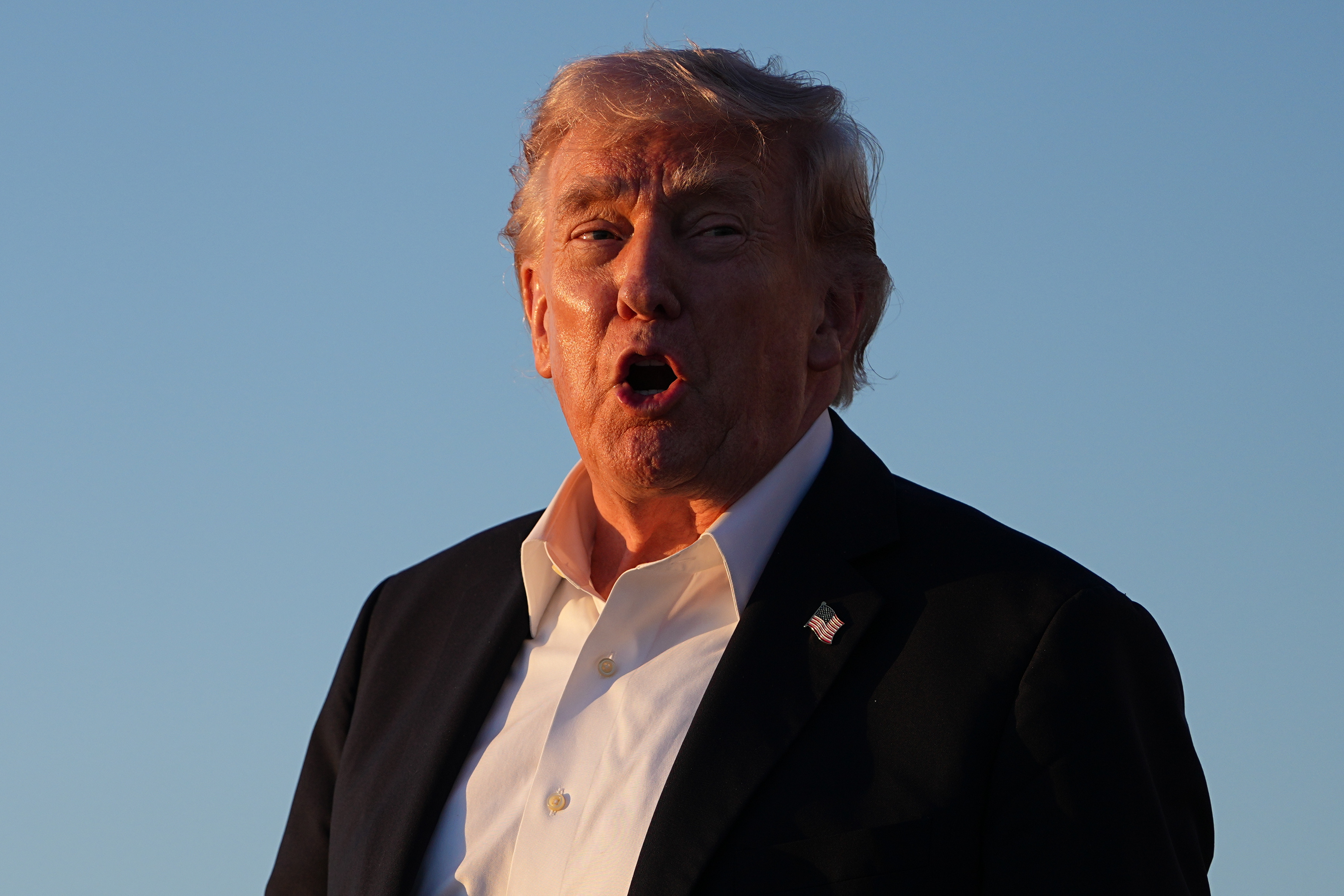
President Donald Trump warned that Iran could be “blown off the face of the Earth” as Iranian forces fired on U.S. ships in the Strait of Hormuz. He made the remarks to Fox News on Monday afternoon after Iran launched missile and drone attacks on U.S. forces and commercial vessels but failed to hit any targets, said U.S. Central Command (CENTCOM).
The attacks marked the most serious challenge so far to the fragile ceasefire reached between Washington and Tehran last month, as the United States expands operations to reopen the critical shipping lane.
On Sunday, Trump revealed “Project Freedom,” an initiative to safely guide ships through the strait starting Monday. Dislodging Iran’s grip on the strait could ease global economic anxiety and strip Tehran of a key pressure point. But any such move risks reigniting the full‑scale conflict that began when the U.S. and Israel attacked Iran on Feb. 28, prompting Tehran to shut the waterway.
The president posted earlier Monday on Truth Social, “Iran has taken some shots at unrelated Nations with respect to the Ship Movement, PROJECT FREEDOM, including a South Korean Cargo Ship. Perhaps it’s time for South Korea to come and join the mission! We’ve shot down seven small Boats or, as they like to call them, ‘fast’ Boats. It’s all they have left. Other than the South Korean Ship, there has been, at this moment, no damage going through the Strait.”
Trump continued, “Secretary of War Pete Hegseth and Chairman of the Joint Chiefs of Staff, Dan Caine, will have a News Conference tomorrow morning.”
US Says Destroyers and Cargo Ships Crossed Strait of Hormuz
Two American-flagged merchant ships have gone through the Strait of Hormuz on the first day of Project Freedom,” the U.S. military said.
CENTCOM said Monday that the ships “successfully transited” and are now “safely headed on their journey.” It also said U.S. Navy guided-missile destroyers were operating in the Arabian Gulf after “transiting” the waterway in support of Project Freedom, despite Iranian warnings.
But Iran’s Islamic Revolutionary Guard Corps dismissed the U.S. claim as “baseless and completely false” in a statement shared by the semi-official Fars News Agency, adding “no commercial vessels or oil tankers have passed through the Strait of Hormuz in recent hours.”
The head of Iran’s central command Major General Ali Abdollahi said the strait is “under the control” of Tehran. He said Iran would attack “any foreign armed force” in the Strait of Hormuz, “especially the aggressive U.S. Army,” in a statement to Iranian state broadcaster IRIB.
The head of the Iranian parliament’s National Security Commission, Ebrahim Azizi, also warned that “interference” would be “considered a violation of the ceasefire.”
“The Strait of Hormuz and the Persian Gulf would not be managed by Trump’s delusional posts,” Azizi said in an X post. “No one would believe Blame Game scenarios!”
Iran said on Monday morning that it had hit a U.S. warship with two missiles, but CENTCOM denied this, saying: “No U.S. Navy ships have been struck. U.S. forces are supporting Project Freedom and enforcing the naval blockade on Iranian ports.”
Meanwhile the United Arab Emirates said it was attacked on Monday for the first time since a ceasefire began last month, apparently in response to Project Freedom. Its defense ministry reported that various missiles and drones from Iran had been intercepted, but one attack caused a fire at the Fujairah oil port, which lies beyond the strait.
Trump’s Project Freedom Plan
Trump announced the U.S. naval mission Sunday in a lengthy Truth Social post, framing Operation Freedom as a humanitarian gesture in response to requests from countries with no direct stake in the war.
“Countries from all over the World, almost all of which are not involved in the Middle Eastern dispute going on so visibly, and violently, for all to see, have asked the United States if we could help free up their Ships, which are locked up in the Strait of Hormuz, on something which they have absolutely nothing to do with—They are merely neutral and innocent bystanders!” he wrote.
Trump framed the move as a goodwill gesture to all parties—including Iran. “I am fully aware that my Representatives are having very positive discussions with the Country of Iran, and that these discussions could lead to something very positive for all,” Trump wrote. “The Ship movement is merely meant to free up people, companies, and Countries that have done absolutely nothing wrong—They are victims of circumstance. This is a Humanitarian gesture on behalf of the United States, Middle Eastern Countries but, in particular, the Country of Iran.”
Trump cited deteriorating conditions on board many of the trapped vessels. “Many of these Ships are running low on food, and everything else necessary for large-scale crews to stay on board in a healthy and sanitary manner,” he wrote. “I think it would go a long way in showing Goodwill on behalf of all of those who have been fighting so strenuously over the last number of months.”
He also issued a clear warning that any interference would draw a forceful response. “If, in any way, this Humanitarian process is interfered with, that interference will, unfortunately, have to be dealt with forcefully,” the president wrote.
CENTCOM provided the first detailed picture of the operation’s scale on Sunday, revealing that the package includes guided-missile destroyers, more than 100 land and sea-based aircraft, multidomain unmanned platforms, and 15,000 service members. The deployment will continue alongside the existing U.S. naval blockade of Iranian ports, which has been in place since April 13.
U.S. Admiral Brad Cooper, the head CENTCOM, told reporters on Monday that his forces were encouraging vessels to transit the strait despite Iranian threats.
“Over the last 12 hours, we’ve reached out to dozens of ships and shipping companies to encourage traffic flow through the strait,” he said. “This news has been quite enthusiastically received, and we’re already beginning to see movement.”
Project Freedom, he noted, isn’t focused on escorting ships in the traditional sense. Instead, it’s a multi-layered defensive scheme that includes ships, aircraft, and electronic warfare.
“If you’re escorting a ship, you’re playing kind of one on one,” he said. “I think we have a much better defensive arrangement in this process. We have a much broader defensive package than you would have ever if you were just escorting.”
US Advice to Ships Navigating Strait of Hormuz
The U.S. “enhanced security area” in the Strait of Hormuz, which is just over 20 miles wide at its narrowest point, is directing commercial vessels closer to the Omani coast off the country’s Musandam Peninsula.
Oman and Iran previously agreed to a traffic separation scheme for inbound and outbound traffic in the strait, standard routes adopted by the U.N.’s International Maritime Organization in 1968 for maritime safety.
Sailing in or near the internationally recognized sea lanes “should be considered extremely hazardous due to the presence of mines that have not been fully surveyed and mitigated,” according to an advisory by U.S. Naval Forces Central Command, distributed by the U.S.-run Joint Maritime Information Center.
On April 9, two days into the ceasefire, Iran’s military announced alternative routes through the strait. It warned that the actual traffic zone had been mined and declared it a “hazardous area.”
The Iranian traffic lanes direct inbound ships to the waters north of its Larak Island, while outbound vessels are told to use the deeper waters south of the island—but both are within Iran’s territorial sea.
Tehran has selectively allowed merchant ships through the strait without attack and in certain cases has reportedly collected a fee for utilizing its designated corridor.
The U.S. Treasury Department said last month that any vessel found to have paid the Iranian “toll” also risked U.S. sanctions.
Related Articles