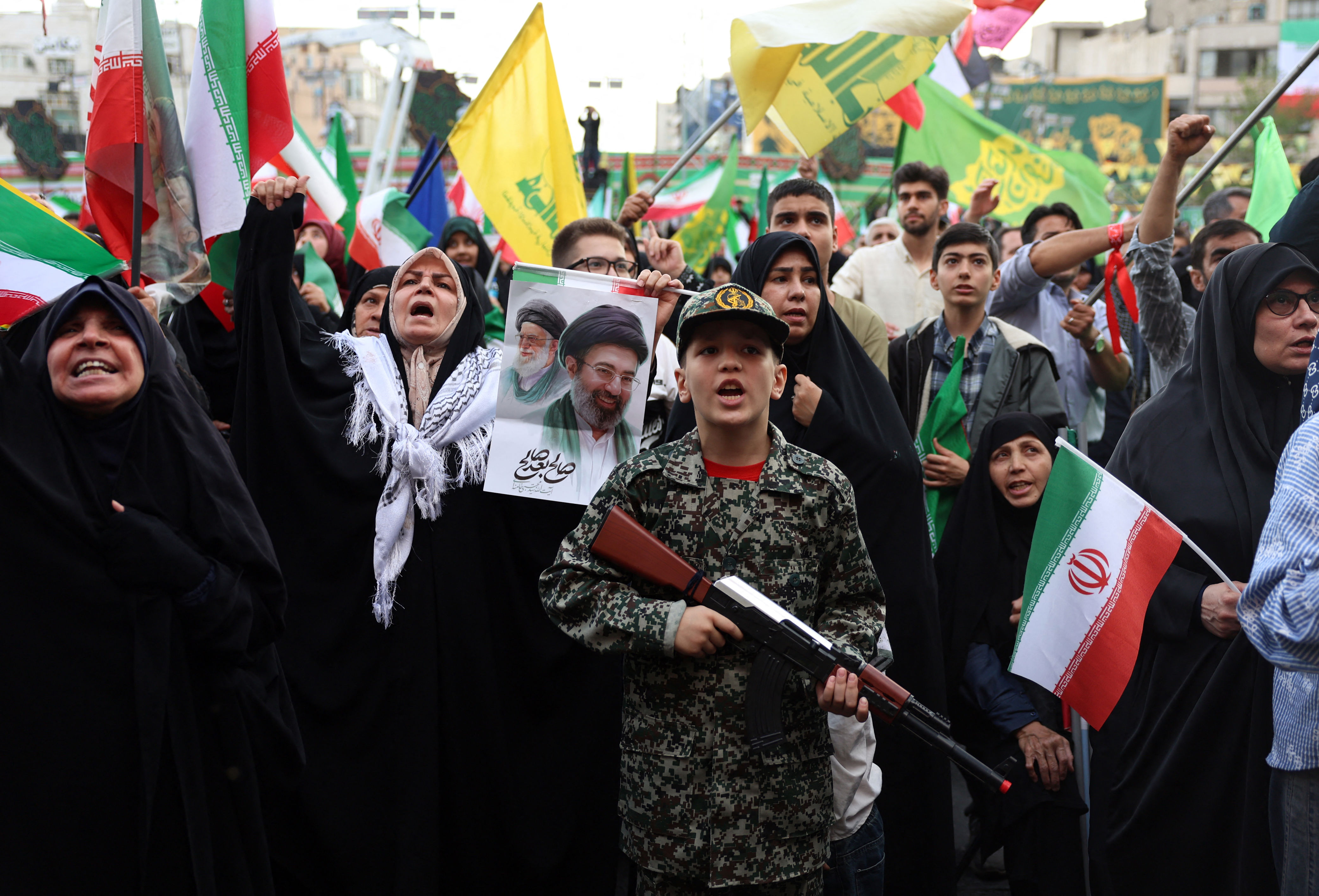
Iran has warned of regionwide retaliation to U.S. strikes following reports that Washington was considering a “final blow” against the Islamic Republic.
According to reports, the U.S. military presented President Donald Trump with new options against Iran as negotiations to free up the Strait of Hormuz, which Tehran holds captive, have stalled.
Joint U.S. and Israeli strikes on Iran began on February 28. On April 8, a ceasefire was announced through Pakistani mediation, but talks days later in Islamabad failed to yield a breakthrough agreement. As the fragile ceasefire Trump declared remains in place, Iran’s Aerospace Force Commander Majid Mousavi said any further U.S. attack on Iran would prompt “long and painful strikes” on American regional positions.
“We’ve seen what happened to your regional bases,” he said on Thursday, according to local media. “We will see the same thing happen to your warships.”
Mahmoud Nabavian, a member of parliament’s national security and foreign policy committee, said on Friday that Arab rulers in the region would also be at risk if the U.S. launched strikes.
“None of the kings of the Arab countries or their palaces in the region will remain safe, and they will all be sent to hell,” he said, according to independent outlet Iran International, in a warning to countries not to allow military bases to be used against the Islamic Republic.
A prominent cleric, Mohammad Saeedi, also cast doubt on the U.S.’s ability to ensure the security of its assets in the region, saying on Friday, “America cannot even guarantee the security of its own bases.” He added that U.S. deployment contributed to insecurity rather than stability.
Bryan Clark, a senior fellow at the Hudson Institute, told Newsweek: “The goal of a short and powerful wave of strikes would be to demonstrate U.S. military capabilities before the U.S. agrees to a compromise with the Iranian government.”
Newsweek has contacted the White House and the Pentagon for comment outside office hours.
US Options Reportedly Under Consideration
U.S. CENTCOM Commander Admiral Brad Cooper and Chairman of the Joint Chiefs of Staff General Dan Caine have briefed Trump on options that include a “short and powerful” wave of strikes on Iranian infrastructure, Axios reported, citing unnamed sources.
Fox News reported that assessed targets included Iran’s “remaining military assets, leadership and infrastructure.” Another plan focused on taking over part of the Strait of Hormuz to reopen it to commercial shipping in a move that could involve ground forces.
Iran International also reported that options presented to Trump was the deployment of U.S. ground forces to small islands around the Strait of Hormuz. Another involved sending special forces into the Isfahan area to remove Iran’s highly enriched uranium, which the Trump administration says can be used to develop into a nuclear weapon. Tehran says its nuclear program is for peaceful purposes.
Clark said the Trump administration has insisted it could take control of the strait, but any ground troops on islands such as Qeshm or Abu Musa would be exposed and at high risk for an Iranian drone or missile attack.
But this may not yield any benefit because Islamic Revolutionary Guard Corps (IRGC) could still launch attacks on shipping from the Iranian coast.
“The troops may simply allow for slightly faster counterattacks. Troops deployed to Isfahan would be less exposed than those on islands in the strait but would quickly come under attack by Iranian ground troops,” Clark said. “Excavating the site to retrieve the uranium would take weeks, during which the IRGC and Iranian army could attack U.S. forces.”
Vuk Vuksanovic, an associate at the London School of Economics think tank, LSE IDEAS, told Newsweek that any attempt to take either part of the Hormuz Strait or go after the Iranian enriched uranium would make American forces targets.
This would be especially so if the U.S. lands on one of the islands near the strait, which could be targeted from the mainland with drones and missiles.
“Iran still has the advantage of geography that favors the defender,” he said. “Special forces incursion aimed at seizing Iranian uranium stockpiles would be an enormously dangerous operation, as the Iranians are likely to have stored the uranium in deeply fortified facilities, especially after the U.S. 2025 strikes on Iran’s nuclear facilities.”
While the U.S. could decide to continue targeting the Iranian infrastructure and any military targets it can credibly pinpoint, Vuksanovic added that the conflict “has taught us that Iranians will not budge as they perceive this conflict as an existential one, and their pain threshold is higher than that of the U.S.”
Dark Eagle Hypersonic Missile
Fox News also reported that the Pentagon was considering deploying advanced weapons systems, including a new hypersonic missile known as “Dark Eagle.” The outlet said the system can hit targets up to 2,000 miles away, potentially taking out Iran’s remaining ballistic missile launchers.
The system known as the Long-Range Hypersonic Weapon, has not yet been declared fully operational but could mark the first time the U.S. has deployed a hypersonic weapon in a live conflict, Army Recognition reported.
According to Bloomberg, CENTCOM submitted a formal request for the deployment, although no final decision has been made.
Iranian forces have relocated their ballistic missile launchers beyond the reach of the 300-mile range Precision Strike Missile, sparking CENTCOM’s request, Bloomberg reported, citing an unnamed person with knowledge of the matter.
The missile uses a hypersonic glide vehicle that travels at more than five times the speed of sound—while maneuvering mid-flight, making it difficult to intercept.
Fox News also reported that U.S. B-1B Lancer bombers, which can have up to 5,000 pounds of hypersonics, have been stepped up in the Middle East.
Iranian Supreme Leader Mojtaba Khamenei said on Thursday that Tehran would keep control over shipping through the Strait of Hormuz and maintain its nuclear and missile capabilities.
In its latest analysis, the Institute for the Study of War said the regime in Tehran was unlikely to make any meaningful concessions in its next proposal to the United States.
The think tank also said on Thursday that Iran was trying to sow divisions between the Gulf states and the U.S. to push the Gulf countries to expel American forces from their territories.
Update 5/1/26, 10:36 a.m. ET: This article was updated with additional information.
Related Articles