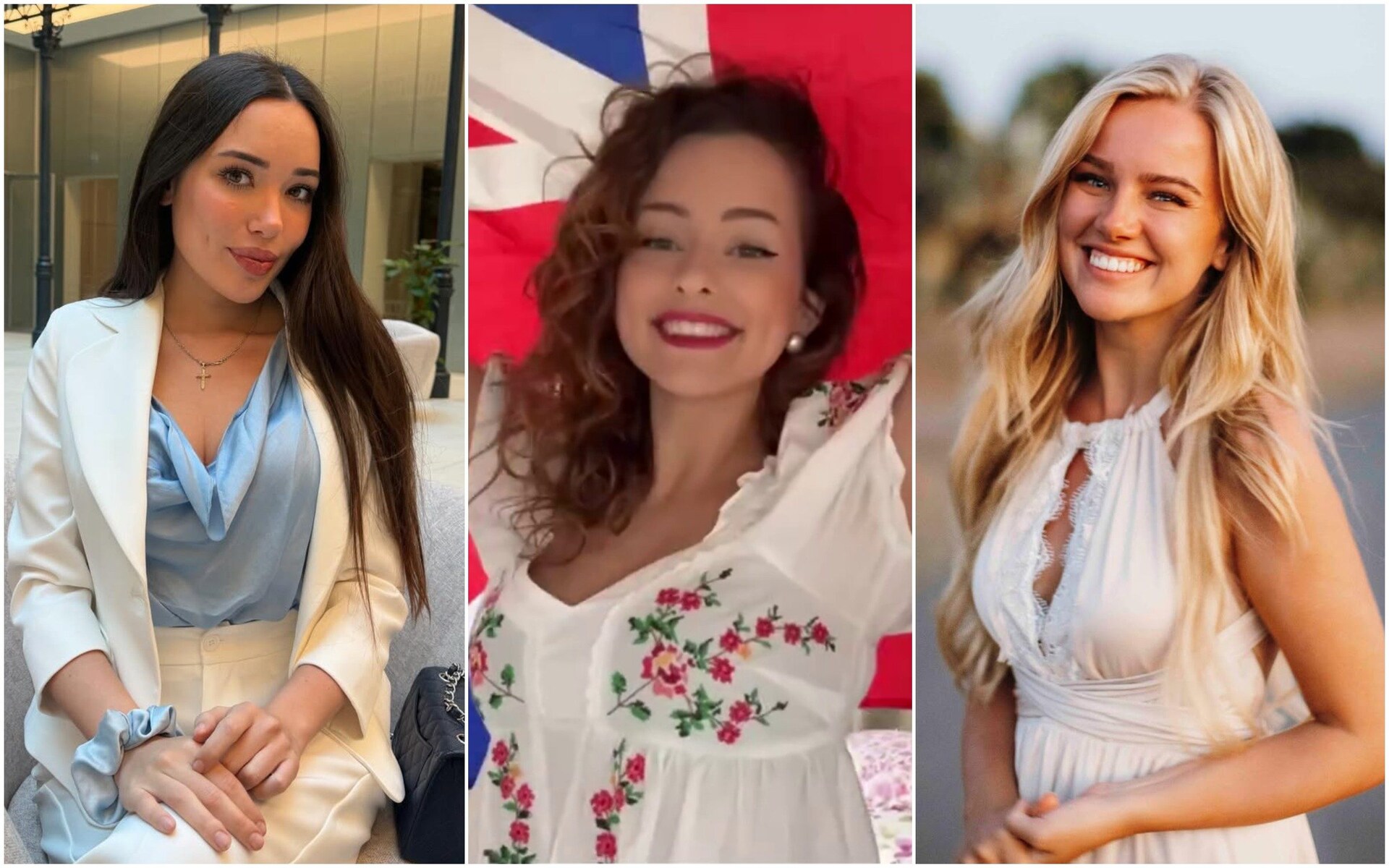
Not so long ago, the stock image of someone from the far-Right was easily summoned: they’d be male, obviously, and very probably bald, with steel-toe boots and questionable tattoos. Times, however, have moved on: this week, it was reported that the Government had banned seven “far-Right agitators” from entering the country to attend a Tommy Robinson rally on Saturday. Three are strikingly telegenic young women.
Among the verboten ones is Ada Lluch, an impeccably coiffed 26-year-old Catalan activist who has defended the Franco regime and had told the most recent “Unite the Kingdom” rally last September that western democracies have been “completely invaded”. Valentina Gomez, an influencer from the US, has also been barred, having told last year’s rally that “rapist Muslims” were “taking over” the country (she’s said she’ll still try to come on Saturday, though – via small boat). And Eva Vlaardingerbroek, a Dutch political activist and commentator, has been forbidden too, having lamented “the rape, replacement and murder of our people” in London last autumn.
The face of the far-Right, it seems, is changing – and it’s becoming a good deal prettier. Part of the shift is due to a growing number of young people flooding into politics – many of whom are profoundly disaffected with mainstream parties – and bringing with them a native understanding of the importance of a good Instagram filter. At the same time, there seems to be a rising awareness across the movement that improving its “look” is vital to broadening its appeal, which in recent years has come to rely heavily on a network of highly prominent social media influencers.
Of course, it suits the far-Right very well to have beautiful young women zhuzhing its image. Their looks, as much as their messaging, promise to draw in more men and open up new audiences altogether in the form of young women who, while once more wary of indulging in politics of this nature, are now turning towards it amid widespread disillusionment with modern life.
But for many of the individuals involved, there are also considerable rewards to be reaped: fame, the wealth that can flow from success online, perceived “clout” within the community and the satisfaction that can come from speaking out about a subject they care about.
The making of a far-Right influencer
The “agitators” recently banned from Britain are foreign-born, but Britain has a growing number of home-grown far-Right or ultra-conservative influencers who are using social media with considerable expertise to communicate their ideology. Among them is Saskia Teague, a 24-year-old with more than 100,000 followers on Instagram, whose most recent post is in praise of her “Anglo-Saxon hair”, which she duly tosses for the viewer’s delectation.
Teague has mesmerising eyes and princessy white skin; like many influencers of her kind, she mixes approachable, attractive selfies (sample caption: “happy happy happy”) with more politically charged content, calling, for instance, for “England for the English”, the return of “shame”, and the mass deportation of illegal migrants. In one recent post on her X timeline, she says: “Ethnonationalism is the only true form of nationalism. British identity cannot be acquired. It is blood, soil and a birthright.” Teague has also said: “Islam must be banned and Pakistanis must be removed from the country.”
Last year, Teague expressed her delight on X at the release of Robinson from prison, having been jailed for contempt of court. “To think I once thought this man was a ‘far-Right thug’… couldn’t be further from the truth,” she wrote. However, she appears to have turned against him since then over his support for Israel. When Robinson attacked “anti-Zionist” conspiracy theories about Jeffrey Epstein, she said: “Tommy Robinson is beyond the point of no return. Epstein was an evil Jewish supremacist.”
Asked whether she accepts the label far-Right, she says: “I’m not afraid of labels – I wouldn’t set out to be like ‘hello my name is Saskia, I’m far-Right,’ but if people want to put that on me they can make their own minds up.”
She says she became particularly interested in politics as a 14-year-old at a “Left-wing” grammar school in the south-west of England, where teachers would do “pro-EU assemblies and were pro-Jeremy Corbyn”. She began posting about politics on social media during the pandemic – she was both anti-lockdown and anti-Black Lives Matter – and immediately paid a social price: her school friends all shunned her.
Some point to Teague and her like as examples of young women who are being manipulated by the men who have traditionally driven the far-Right movement, for their own benefit.
But she forcefully rejects such an idea. “I’m not being used,” she says. Indeed, Teague is evidently proud to be part of a growing number of attractive young women setting out far-Right positions online, many of whom combine their political messaging with more neutral content – about dating, baking, money and so on. She says: “We’re now seeing people that you’d have associated with beauty or lifestyle content promoting traditional values. They’re brave to be putting their face to something that could get them in trouble. I think it’s a great thing for the movement, for young, attractive women to be coming on board.”
Unsurprisingly, Teague is exercised by the Government’s decision to ban others on the far-Right from entering the country – citing Vlaardingerbroek, the Dutch influencer, in particular. “In this country, foreign rapists are allowed in but phenomenal women like her aren’t, and I think that’s completely absurd,” she says.
The far-Right’s ‘makeover’
Among Teague’s peers is the glamorous Black influencer who goes by the name “Based and Bougie”; one recent video shows her toying with her hair on a beautiful London street (so far, so familiar) – but the clip is overlaid with the caption: “Why don’t the Left force bacon on Muslims the way they force LGBTQ on Christians?”
Part of the reason for the new emphasis on appearance, according to Alex MacKinnon, a researcher at the anti-fascist organisation Hope Not Hate, is a broader “glamorisation” that has taken place within the far-Right over the past few years. “This didn’t start with women,” she says. “This started, actually, with far-Right men trying to shed that kind of violent thug image.” At many far-Right marches now, she adds, speakers turn up in suits and deliver speeches in the manner of “eccentric politicians. …Where previously you’d have had football hooligans hurling things, now they want to present a more family-friendly outlook”.
Tommy Robinson himself is now no stranger to a tie. Another example of the far-Right “glowing up” is the young British ethno-nationalist Hugh Anthony, who argues against interracial marriage and advocates for “remigration” (for all Jews in Britain, as well as migrants). He often “sports a pinstripe suit and signature moustache”, MacKinnon notes.
The new emphasis on how the movement looks, as well as what it is calling for, is rooted, MacKinnon believes, in a quest for credibility. It reinforces the idea, she says, that the far-Right isn’t “just a pack of thuggish men; ‘we bring women onto our stage and let women have voices in the movement’”.
And looking the part, argues Hannah Rose, a senior researcher at the Institute for Strategic Dialogue, is crucial to expanding appeal and reach. “Across society more broadly, the more glamorous you are, the more desirable you seem, the more likes you tend to get, and the more of a following you tend to build.”
But being obviously attractive and presentable also chimes with the ideology of many on the far-Right, who believe it is important that women take pride in their appearance, she says. “It likely also has some ideological backing in the movement more broadly, which sees the role of women as something which should be aesthetically pleasing,” Rose adds.
Conviction or clout?
Of course, while it suits the far-Right to have photogenic women increasingly at the forefront of the movement, many of the women themselves – Teague included – passionately believe in the ideology they are promoting, much to the sometimes surprise of the public at large, who might imagine that young women are “naturally” Left-wing.
For some on the far-Right, as in other movements, it’s less about the ideology itself than about filling a gap in the market. “Seeming edgy”, Rose says, can mean outpacing the competition – and earning a vast amount of money through sponsored posts and so on.
As a result, says MacKinnon, for some far-Right influencers: “The ideology is quite thin. … People are posting content which sticks – regardless of whether they actually believe in it or not.” Many influencers with extreme politics are happy to engage in so-called “click-farming” – saying something deliberately shocking with a view to “harvesting” the attention and clicks that follow.
The academic Eviane Leidig immersed herself in the online world of far-Right female influencers for a recent book, and has observed them leveraging what she calls a “networked intimacy” to promote their ideas. An influencer might warm a follower up to her ideology, for instance, by offering seemingly intimate or vulnerable content – posts about her “outfit of the day”, videos of her applying her make-up, musings about dating and money. Much of this content is interlaced, Leidig argues, with subtle political messaging. Viewers might be spooled in by a video of a beautiful woman baking and barely notice the ideas that are also being offered.
Many of the consumers of these videos are, unsurprisingly, men. “If you’re a young man, watching a very attractive woman talk about far-Right politics is probably going to be more appealing than watching a balding old man talk about far-Right politics,” MacKinnon notes. The author, Leidig, met one man, she said, who became engrossed in such content via YouTube and who reported: “I found these women so attractive and I just wanted to be with them and the life that they would show.”
Selling politics to women
Teague admits that more men watch her content than women. But lately, she says, she’s been trying to make it more woman-friendly: “Instead of just posting about politics, for instance, I might post a video of me in a nice dress with a song in the background – just to show that an everyday person can be involved in something like this.”
A lot of women on the Right, she’s noticed, dress similarly: “There’s often a twin-set-and-pearls look. But if you see a young woman who just looks like she’s at uni, like she’s just a regular girl, it’s appealing. I want more women to think, ‘I can get on board with this.’” Does she glam up for the camera? “No, I put make-up on wherever I go. I think presentation is everything… What you see on camera is what you see in person.”
MacKinnon, however, sees it very differently. “It’s about making it more palatable,” she says. “Who wants to read the entire BNP manifesto? It’s much more fun to watch a young woman doing a TikTok dance with slightly racist overtones.”
Recommended
The women of the manosphere