Raynella Dossett Leath called 911 on the morning of March 13, 2003, from her farm outside Knoxville, Tenn., screaming that her husband had shot himself.
“Help me! Help me!” she wailed. She told the dispatcher she was going to throw up.
David Leath was lying in bed on his side, blood splattered behind him and pooling onto the floor. A .38 caliber revolver lay next to his left hand. (David was right-handed.) Raynella Leath had just returned home and found him, she said.
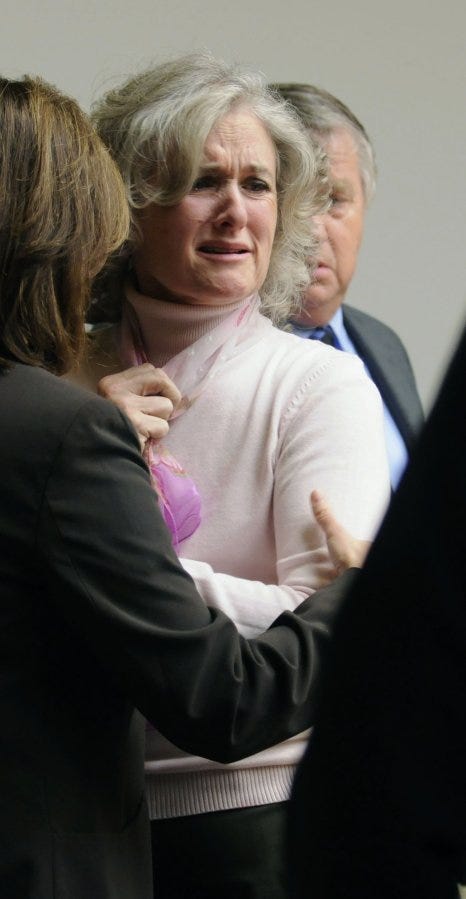
When two law-enforcement officers arrived, Raynella was face down in the front yard motionless, silent—until one of the officers nudged her with his foot and said “Ma’am,” at which point, according to court filings, she burst out crying and yelling incoherently, unable to catch her breath. One of the officers described her as “overcome by grief.”
The Leaths had been married for 10 years. “We were partners, friends, buddies,” Raynella Leath later wrote. “The kind of togetherness and mutual protection that few people find.”
But inside the house, a detective was growing suspicious. And in 2006, Raynella Leath was charged with her husband’s murder. Soon after, she was indicted on a charge of murdering her first husband as well—a county district attorney, Ed Dossett, whose purportedly accidental death, 11 years earlier, brimmed with peculiarities that could no longer be ignored.
Over the next 14 years, Leath’s case would go tumbling through a torrent of increasingly sensational circumstances and three separate trials—all while the local and national media followed along, the incendiary epithet “Black Widow” tripping off their tongues.
But in the end, Leath was acquitted of David Leath’s murder and never tried for Dossett’s; she was assumed to be living a quiet life as a grandmother, on the same farm outside Knoxville, when she died April 4 at age 77. But setting aside the burden of proof required in a courtroom, this outcome was hard for many in the court of public opinion to accept.
In a 10-part podcast about the case produced by the Knoxville News-Sentinel, which covered that legal epic exhaustively, the late reporter Jim Balloch explains that, “If she indeed did not do this, then she’s one of the most unfortunate women who ever lived in this county.”
Nurse of the year
Raynella Bernardene Large was born Oct. 25, 1948, and grew up in Oak Ridge, Tenn., where her father, Dewey, worked for the Institute of Nuclear Studies and the Atomic Energy Commission, according to a death notice in the News-Sentinel. She studied at East Tennessee State University and later received a master’s degree in nursing from the University of Tennessee-Knoxville, where she subsequently became an associate professor.
In 1970, during her last semester of undergrad, Leath married Ed Dossett, whom she met at East Tennessee State before he moved onto law school. The couple would have two daughters and a son and settled on a 150-acre-plus farm in Solway, an unincorporated suburb of Knoxville, where they raised beef cattle as a hobby.
Raynella, as Raynella Dossett, would eventually become head of nursing at Knoxville’s Parkway Medical Center. In 1975, she chaired an American Nursing Association psychiatric nursing group, and she was the Tennessee Nurses Association district “Nurse of the Year” in 1976. Ed Dossett, meanwhile, was elected Knox County’s district attorney in 1982. Knoxville was a small but prideful city at the time. (In 1980, a Wall Street Journal article described it derisively as a “scruffy little city”; almost five decades later, “Keep Knoxville Scruffy” shirts are still being sold.) The Dossetts were described as one of the community’s power couples—well-known, well-connected and well-liked.
In 1991, after winning re-election for a second term, Dossett was diagnosed with terminal cancer. By the following summer, his health had deteriorated. One morning in July 1992, Raynella said, she found him dead in their cattle corral, a hoofprint on the chest of his overalls, apparently knocked down and trampled as he fed the herd. He was 44.
Early the following year, Raynella remarried David Leath, a local barber who, according to the News-Sentinel, was Ed Dossett’s best friend. One of Raynella’s daughters would later testify as to the sweetness of David and Raynella’s relationship. “The first time they went out on a date was on a Thursday,” she said, “and after that, every Thursday he gave her a rose.”
In December 1994, Raynella’s son, Eddie Dossett Jr., was thrown through the window of their truck when a driver with a suspended license slammed into them. Eddie died two days later. He was 11. (Leath’s two daughters survive her.)
Then, in the spring of 1995, a whole other thing happened: A local man, Steve Walker, alerted Raynella Leath that his ex-wife had an affair with Ed Dossett while he was alive. And Walker had just learned during divorce proceedings that the child he thought was his was actually Ed Dossett’s. Walker told police and the press that, following this disclosure, Leath lured Walker to her farm, pulled a gun on him and fired at him as he ran away. Leath claimed Walker was trespassing and “trying to piss” on Dossett’s grave. (Dossett was buried on a hilltop at the farm, as was Eddie Jr.)
Leath was charged with attempted murder, but pleaded to a lesser charge and got six years of probation.
When Leath was charged with the murders of her two husbands a decade later, the confrontation with Walker made news again, but amounted to a baffling and salacious sideshow, its significance unclear. As Walker himself put it to CBS’s “48 Hours:” “I’m a crouton on a real big salad here.”
Reinvestigation begins
By the time Raynella Leath was charged with David Leath’s murder in November 2006, David’s daughter—Raynella’s stepdaughter—had already sued Raynella, alleging that Raynella had murdered David and therefore couldn’t receive any of his estate. (This subplot was loosely tied into a larger, more Byzantine subplot about the whereabouts and authenticity of David Leath’s will.)
Prosecutors soon began reinvestigating Ed Dossett’s death, too. A medical examiner had quickly ruled it an accident without waiting for a toxicology report. (That medical examiner was later revealed to have drugged several underage boys in his home and taken nude pictures of them while they slept.) But the toxicology report subsequently showed a huge amount of morphine in Dossett’s system. Had Raynella drugged him and staged an accident? Then again, Dossett, who was dying of cancer, also had a morphine pump surgically implanted in his chest. Maybe the cows had burst it when they trampled him, flooding him with the drug.
The government sought to exhume Dossett’s body for a more-thorough autopsy. But its legal maneuvers failed, leaving it to pursue the stronger case against Raynella first, the one for the murder of David Leath. It went to trial in March 2009. “There is no case at all against this very nice lady,” Leath’s attorney, who was also a family friend, said in his opening statement.
From there, the ins and outs of the trial are difficult to summarize. Essentially, the defense argued that David Leath had been diagnosed with early stages of dementia and was depressed, pushing him to suicide; whereas, the prosecution—though it couldn’t seem to land on a specific motive—meticulously arrayed a wealth of circumstantial evidence into a story line in which Raynella drugged her husband, staged the shooting to look like a suicide, then playacted her way through a series of errands and encounters that morning to establish alibis.
But there were three shots fired that morning in the bedroom. One bullet hit the headboard. One went into the mattress. And there was clear ballistics evidence that the one that entered Leath’s forehead, severing his brainstem instantly, had been the second shot fired, and not the last. It was an impossible-seeming scenario for a suicide—though, the defense argued, not completely unheard of.
In the end, the jury was hung—unable to break an impasse with a single juror who wanted to acquit.
The trial was rerun in early 2010. This time, she was found guilty.
Leath was sentenced to life in prison, not eligible for parole for 51 years.
The addict judge
Leath had served six of those years when her family reached out to a new, more-formidable legal team, led by an attorney in Washington, D.C., to mount another appeal.
Joshua D. Hedrick, a Knoxville attorney who joined the team, recalled visiting Leath for the first time in a Nashville prison. “She walked into the visitation room unfazed that she was in prison, greeting the guards by name,” he said. “And I don’t know if I looked a little harried or rushed, but the first thing she said to me was, ‘Did you have lunch?’ ”
The petition for postconviction relief they eventually filed raised several procedural and evidentiary wrinkles in Leath’s case, but the biggest problem they identified was the judge.
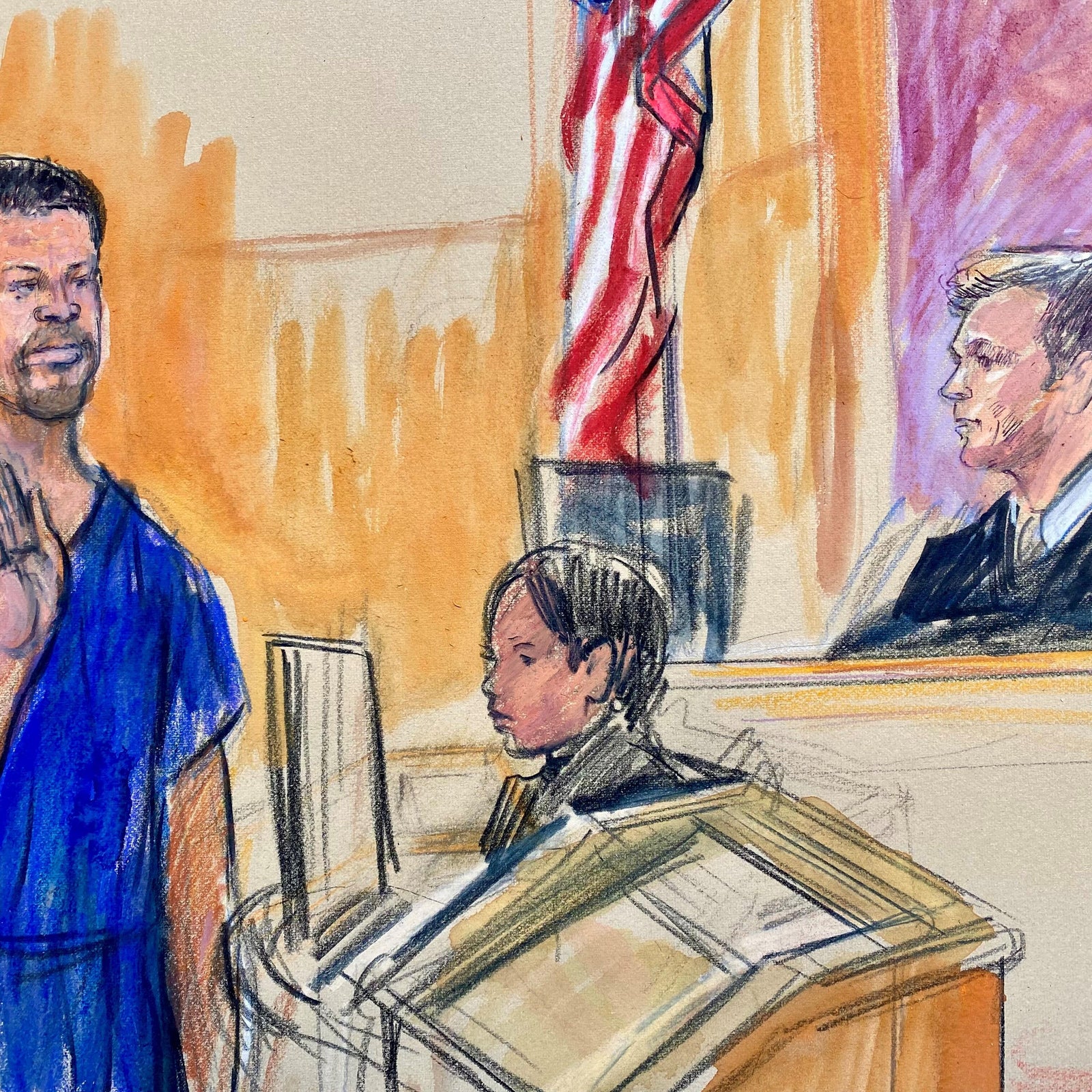
Judge Richard Baumgartner, the Knox County judge who had presided over the second trial, was convicted of misconduct and resigned shortly after. He had been an opioid addict, sourcing pills through a defendant in his drug court with whom he was also having sex. It was an open secret around the courthouse that Baumgartner had seemed impaired during trials: visibly disoriented, having difficulty reading documents and occasionally just plunking his head down and closing his eyes. During Leath’s trial, according to subsequent court filings, it had happened with a witness on the stand.
Questioned by Hedrick in a 2016 hearing, Baumgartner’s longtime bailiff explained that during Leath’s trial she had taken to reaching back to slam the door behind her to rouse the judge from his sleep. The bailiff had already raised alarms about Baumgartner’s addiction and incapacitation “to everybody in power that I could think of,” she explained, but “Nobody came forward. Everyone turned their back.” (Baumgartner died in 2018.)
Ruling on Leath’s petition, Senior Judge Paul Summers said, “The system failed.” Her conviction was tossed out, setting up one more trial.
This one lasted eight days and—maybe inevitably—took one more improbable turn at the end. Judge Summers responded to what’s ordinarily a pro forma motion before handing the case to the jury and, instead, issued what’s known as a directed verdict of acquittal, ending the case single-handedly, then and there.
Issuing a final order, Summers wrote that he was taking this extraordinary step because the state’s case was extraordinarily inadequate. The state sufficiently proved that David Leath was murdered, he wrote, but “No evidence other than innuendo and conjecture identify Ms. Leath as having killed her husband.” Prosecutors hadn’t even offered any proof that Raynella was at home at any point during the three-hour window in which Leath likely died, he noted. She wasn’t proved guilty “even by a mere preponderance of the evidence,” Summers wrote, let alone “beyond a reasonable doubt.”
The case was dismissed. Leath was free.
Afterward, several jurors expressed their shock and exasperation; they’d sat through the whole trial, they told the press, and were ready to convict. Even Summers was compelled to point out, in an interview with “48 Hours”: “There’s a difference between being not guilty and being innocent.”
TV cameras caught Leath leaving the courthouse with one of her daughters. Reporters asked, “How are you feeling, Raynella?”
Leath didn’t say anything. Her daughter said softly: “You guys weren’t worried about her before, so leave her alone now.”