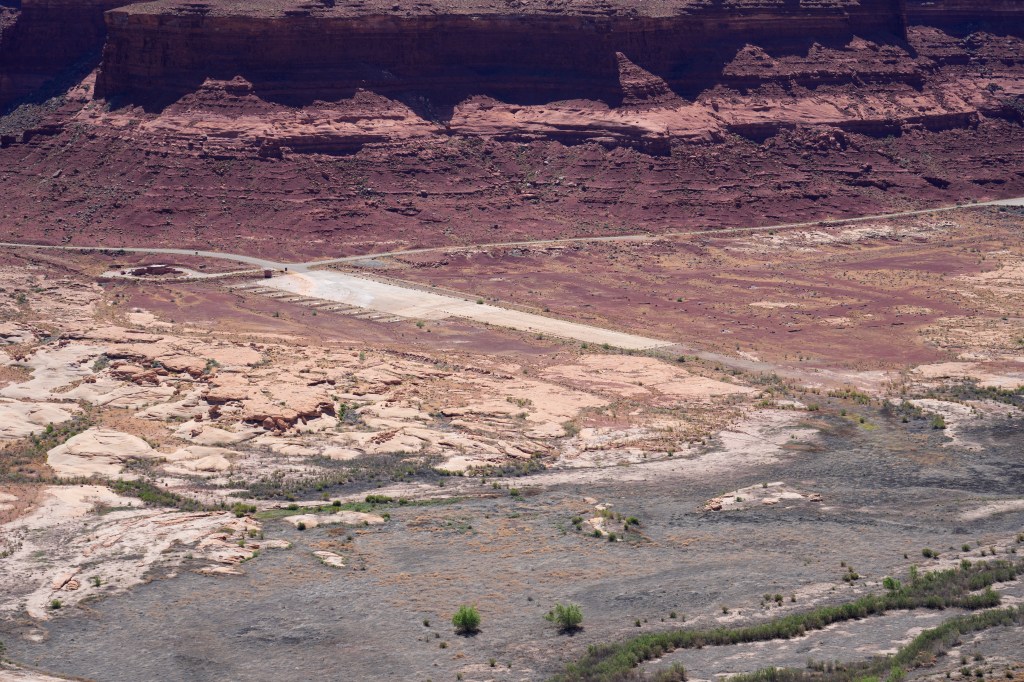
Lake Powell is projected to receive only 13 percent of its typical April-to-July runoff this year, the lowest on record since the reservoir’s creation in 1963, according to the federal forecasters, which is a problem considering it’s a part of the Colorado River system that irrigates more than 5 million acres of farmland and supplies water to 40 million people across the West.
The forecast equates to about 800,000 acre-feet of inflow during spring and early summer, down from 1.4 million projected in last month’s outlook.
Lake Powell—the second-largest reservoir in the U.S.—is situated on the Colorado River. The system also includes Lake Mead, the nation’s largest reservoir.
The grim update for Lake Powell comes after water managers had already warned that declining reservoir levels could threaten hydropower production at Glen Canyon Dam, whose turbines are fed by water from the lake and power half a million U.S. homes.
What‘s Impacting Lake Powell’s Water Levels?
The Colorado Basin River Forecast Center (CBRFC) forecast came after a record dry November-March period across Colorado and Utah, as well as a March heatwave that officials said ranked among the warmest on record, leading to significant snowmelt.
CBRFC forecaster Cody Moser said Thursday that since October 1, about 408,000 acre-feet have reached the reservoir, and the expected flow of water into Lake Powell this year is roughly 800,000 acre-feet, with forecast confidence increasing as the season advances, according to the Colorado Sun.
If the latest forecasts are accurate, “it would be the lowest April through July volume on record for Lake Powell,” Moser reportedly said.
Flaming Gorge Release and Long-Term Concerns
Federal water managers previously announced they would be taking steps to prop up Lake Powell’s falling water levels, with the U.S. Bureau of Reclamation (USBR) outlining plans in April to draw water from Flaming Gorge Reservoir upstream, as well as cutting releases downstream to Lake Mead.
While the moves are intended to prevent Lake Powell from dropping below critical thresholds, officials and experts have warned that they could impact future water supplies, disrupt recreation and local economies, reduce downstream power output, and damage fish populations.
A statement from Becky Mitchell, who represents Colorado on the Upper Colorado River Commission, sent to Newsweek said the “significant volume of the release may limit the availability of water to respond in future dry years, and impact flexibility and available resources in the future.
“This highlights the need to move to more sustainable, supply-driven operations at Lake Powell and Lake Mead that would not require this type of crisis management,” Mitchell said.
What Happens Next
In a Monday email to Newsweek, forecasters at AccuWeather said above-average heat is expected across the western U.S. through Tuesday, with some inland areas nearing or surpassing 100 degrees.
“The heat will also continue to melt away the dwindling snowpack that is near-record low levels, bringing concerns for the water supply,” said AccuWeather meteorologist Kai Kerkow.
According to Climate Prediction Center outlooks for the May 14-20 period, much of the country is favored for above-average temperatures, with near-normal or wetter-than-normal conditions favored.
As of May 9, Lake Powell was just 23 percent full, with storage levels 39 percent of average for the date, according to USBR data.
Related Articles