There are places people go to get away from the news. Trails with little cellphone service and usually, even fewer headlines.
You’d think someone would have to live alone in a hut in the middle of the mountains to not know about Colorado’s record-breaking drought this year.
Actually... the guy living alone in the middle of the mountains knows this story better than anyone.
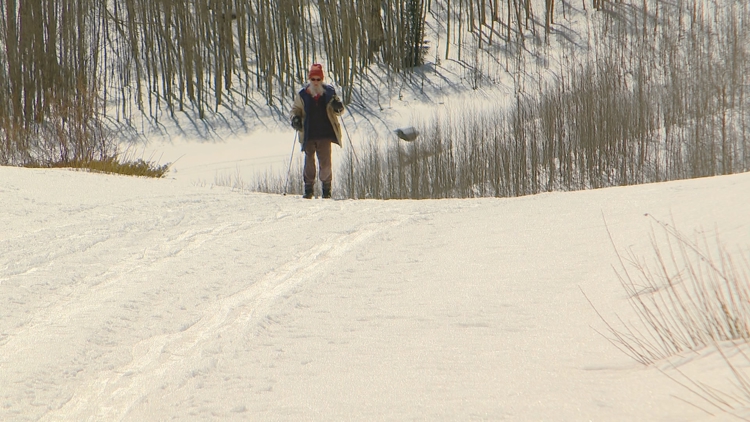
"The whole hermit thing… first of all you’d have to define that, but I’m very social. I just like being alone," said billy barr in an interview in his house 4.3 miles into the Colorado backcountry outside Crested Butte. "The fact that I’m here and I’ve been here a long time and I look like the Unabomber. It adds a bit of a novelty to it."
billy barr, who spells his name entirely in lowercase, has tracked snowfall, snow depth, temperature and precipitation from his home in Gothic, Colorado, every single day for 52 years. This winter, he said, is unlike anything he has ever recorded.
"First and foremost, it's really bad," barr said.
barr lives in Gothic, a small "town" home to the Rocky Mountain Biological Laboratory. The majority of the winter there are few people nearby, though students come to do research and tourists come to hike in the summer.
barr said the snowpack outside his home during the visit in March currently sat at roughly half of what it should be for that time of year.
"I think the average snowpack on this date is 58 inches," barr said. "It should be twice that."
The data barr has compiled stretches back further than state records, giving scientists and researchers a rare window into long-term climate patterns. His numbers are used by researchers at the Rocky Mountain Biological Laboratory to help inform their work.
barr began keeping data in notebooks in the 1970's. He still keeps them all.
"It can show point blank, here’s what’s happened," barr said while looking down at books five decades old.
This winter has shattered temperature records at a pace barr said he can hardly keep up with. He said the region has already broken 26 record high temperatures, with more than two and a half months of winter still remaining.
"On February 28, the new record high was 56," barr said. "The old record high was 46. To beat a record high by 10 degrees is unheard of."
barr said he is currently 54% below average snowfall for the winter — and the consequences extend well beyond recreationists.
"It's just a lot worse for the environment, for agriculture, for ranching, for recreation, for wildlife, for vegetation," he said. "Everything. Water controls everything."
barr, who wakes before sunrise each morning to record measurements and still cross-country skis nearly 1,000 miles a year, said he has watched the climate shift dramatically over his more than five decades in Gothic — with the most significant changes accelerating around the year 2000.
"It's changed way, way drastically," he said. "Especially since around 2000."
When asked whether the region is at a turning point, barr was blunt.
"I wouldn't say we're at a turning point now. I think we've gone past the turning point." barr said. "Everybody is going to be fighting for something that doesn't exist, because there isn't the water."
barr said he does not consider himself a scientist. He is careful to draw a distinction between his role as a data recorder and that of trained researchers.
"I'm not a meteorologist. I'm not a hydrologist," he said. "I record the data."
Still, after 52 years of daily measurements, he said the evidence is undeniable.
"Today, over all those years, has the least amount of snow on the ground than any other winter since I've been here," he said.
barr said he intends to remain in Gothic as long as his health allows.
"I plan to be out here as long as I'm healthy enough to be," he said.