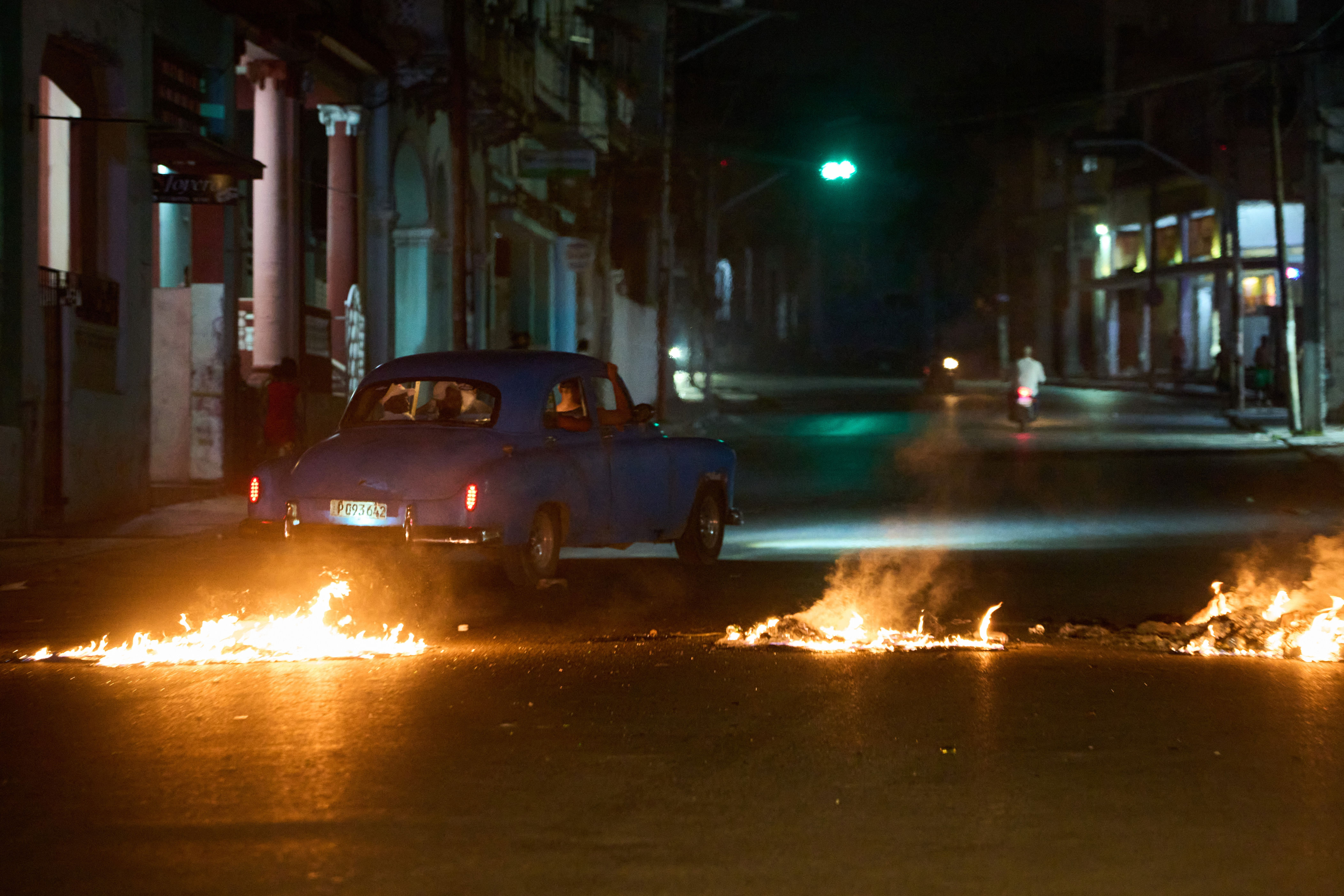
Protests erupted in Cuba’s capital of Havana on Wednesday evening as the country grapples with its worst blackouts in decades amid an ongoing U.S. fuel blockade.
Videos posted to social media show police officers repelling blows from protesters in the Playa neighborhood of southwestern Havana, with barricades erected in the streets.
Crowds of demonstrators blocked roads with burning rubbish, and chants of “turn on the lights” could be heard in the city, according to the Reuters news agency.
Blackouts have significantly worsened on the island since January, when President Donald Trump threatened to slap tariffs on any country that exported oil or petroleum products to Cuba, while doubling down on sanctions against Cuban officials and alluding to a possible U.S. invasion of the island.
When U.S. forces captured then-Venezuelan leader Nicolás Maduro in Caracas at the start of 2026, Cuba was heavily dependent on Venezuelan oil exports that quickly trailed off.
The island is now clinging onto a lifeline of limited fuel deliveries from Russia that the U.S. has allowed through to Cuba’s ports.
But Cuba’s energy minister, Vicente de la O Levy, described the country’s energy system as in a “critical state,” telling state media on Wednesday Cuba has completely run out of diesel and other types of fuel, with only small amounts of gas remaining.
Gathered residents cheered when power returned to the area where a protest was unfolding on Wednesday, demonstrators quickly leaving the area, Reuters reported.
Blackouts have lasted up to 22 hours in the capital, de la O Levy said.
United Nations experts warned last week the U.S. blockade amounted to “energy starvation” saying essential services have been pushed “to the brink” and this could violate the human rights of Cuba’s population.
Tens of thousands of people are waiting for surgery, including around 11,000 children, Cuban authorities said in mid-March. Tourism, a major economic stream for Cuba, has dwindled.
The U.S. says Cuba has repeatedly refused to accept $100 million in humanitarian aid in exchange for “meaningful reforms,” which Cuba denies.
Cuban President Miguel Díaz-Canel has described the energy situation as “particularly tense” and said the crisis rippling through Cuba “is the fruit of the harsh economic war imposed on us and the energy persecution.”
The Trump administration has cast Cuba as a “failed state,” suggesting the country’s government could collapse without U.S. intervention while keeping U.S. military operations firmly on the table. U.S. Secretary of State Marco Rubio—the son of Cuban immigrants and a vocal critic of the government in Havana—told Fox News aboard Air Force One that Cuba’s economic fate could not change under the current authorities.
Trump joked earlier this month that the U.S. could “almost immediately” take over Cuba, suggesting the world’s largest aircraft carrier, the USS Abraham Lincoln, may approach Cuban shores and force officials to “give up” once the U.S. ends its war against Iran. But Washington is not looking to launch military action against Cuba in the near future, anonymous U.S. officials told The Associated Press last week.
Díaz-Canel told Newsweek during an interview in the Cuban capital last month that the country would retaliate against any U.S. military attack with guerilla-style tactics, which would incur “immense losses” on both sides.
The U.S. announced two more rounds of sanctions this month, including measures targeting Cuba’s defense and energy sectors. Washington also singled out Cuban officials it accuses of being “complicit in government corruption or serious human rights violations.”
Update 5/14/2026 at 5:42 a.m. ET: This article was updated with additional information.
Related Articles