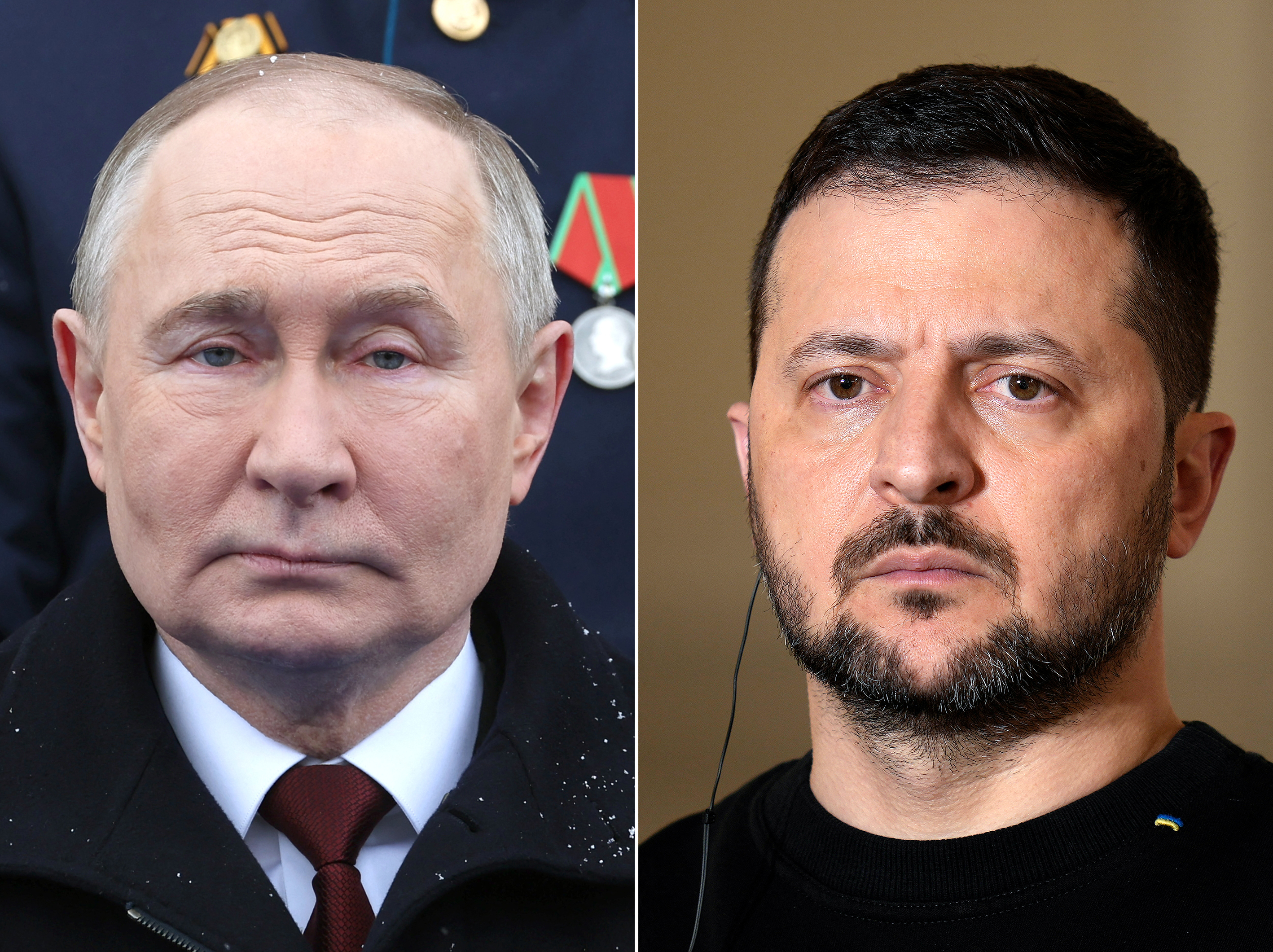
Russia and Ukraine have called for different ceasefires amid the anniversary of the end of World War II in Europe, teasing the prospect of a longer pause and the viability of negotiations to end the four-year conflict Moscow started.
The annual Victory Day celebrations on May 9 commemorates the Soviet role in defeating Nazi Germany and is usually a display of military might in Red Square, which Putin has leveraged to promote patriotism and invoke parallels with his full-scale invasion of Ukraine. However, Russia has said this Friday’s event for the 81st anniversary would be a scaled-back version—with no tanks, missiles or military equipment on display—and its Defense Ministry has called for hostilities to cease on May 8 and May 9.
Ukrainian President Volodymyr Zelensky said Kyiv had not received an official Russian appeal for a Victory Day ceasefire, but in issuing a challenge to Russia, he added that Kyiv would unilaterally enact a ceasefire from midnight on Tuesday and maintain it if Moscow reciprocated. Ukraine has repeatedly called for a full and unconditional ceasefire, and Zelensky suggested that such a pause starting May 5 could test the prospect of a longer end to fighting.
“Both sides would welcome a respite from a war that seems unlikely to end any time soon,” said James Rodgers, the author of The Return of Russia: From Yeltsin to Putin, The Story of a Vengeful Kremlin, which outlines the development of Russia’s relationship with the West since the collapse of the Soviet Union in December 1991.
“Zelensky would like to see the people of Ukraine, and especially the army, get some respite, however brief,” he told Newsweek on Tuesday.
“Putin presumably would, too, but he is also probably more worried—at a time when Ukraine continues to strike at Russian oil infrastructure—that the Victory Day parade on May 9 will be overshadowed by an attack,” said Rodgers, who is also an associate professor in international journalism at City St. George’s, University of London.
A Ukrainian drone crashed into a high-rise building in an upscale Moscow neighborhood on Monday, the same day as Russian strikes killed nine people across Ukraine, according to Ukrainian authorities.
The threat of drones hitting Moscow is the official reason the Kremlin has given for restricting mobile internet and messaging services in the Russian capital for fear that cellular networks were being used for navigation or targeting, a prospect hovering over the annual Red Square event—the centerpiece in Putin’s projection of power.
Zelensky wrote on X that it was time for Russian leaders to take real steps to end the war, “especially since Russia’s Defense Ministry believes it cannot hold a parade in Moscow without Ukraine’s goodwill.”
Russia’s Defense Ministry has warned that any Ukrainian strike on Moscow during Friday’s celebrations would be met with a “massive missile strike on the center of Kyiv.”
“The news that Russia is to scale down its victory parade is a disaster for Vladimir Putin,” Rodgers said, adding, “More than four years since he launched what was supposed to be a quick conquest of Ukraine, he is unable even to hold the parade he wants on Red Square—never mind in Kyiv.”
Internet outages in Moscow “have reminded people in the Russian capital that their country is at war in Ukraine,” Rodgers added. “More of the same is expected as Victory Day approaches—and this in one of the most tech savvy cities on earth.”
In a Substack published on Tuesday, exiled Russian opposition activist Mikhail Khodorkovsky wrote that a truce timed to the parade would give the Russian state a few days of staged calm and suspend Ukrainian strike activity at the moment Russia is most exposed to it, allowing the celebration to proceed without the embarrassment that has been building.
“If Kyiv accepts, Russia gets a reprieve,” Khodorkovsky wrote. “If Kyiv refuses, Russia gets a propaganda dividend, a chance to argue that the obstacle to peace is in Ukraine.”
On April 25, a long-range Ukrainian drone strike hit Shagol airfield in Russia’s Chelyabinsk region, deep in the southern Urals, over 900 miles from Ukraine, striking several Sukhoi Su-57 fighter jets worth about $100 million each and a Sukhoi Su-34 aircraft, according to Ukrainian media.
Ukraine’s drones also continue to wreak havoc inside Russia, with the oil refinery and export terminal in the Black Sea town of Tuapse being hit four times in two weeks.
Previous Failed Ceasefires
Despite the calls for a truce, distrust between the sides remains high, and there is no end in sight to the war, which has raged for longer than World War II, also known in Russia and other parts of the former Soviet Union as the Great Patriotic War.
During a 32-hour Orthodox Easter ceasefire, each side accused the other of thousands of violations. During last year’s 80th anniversary celebrations, Ukraine said a Russian-declared “humanitarian ceasefire” collapsed within hours, and that Moscow committed over 700 truce violations—including assault operations and drone and missile strikes.
U.S.-led diplomatic efforts to end the war have stalled as Washington shifts its focus to conflict in the Middle East. Russian Foreign Minister Sergey Lavrov said last month that talks with Ukraine were not a priority for Moscow, and major disagreements continue to block progress.
Ukraine has said freezing the current front line could be a basis for a ceasefire, but Moscow has rejected that proposal, calling instead for Ukrainian forces to withdraw from parts of the Donbas region—a move Kyiv has rejected.
Richard Gardiner, a senior analyst at the global intelligence and cybersecurity consultancy S-RM, told Newsweek that given the violations in previous truces, a full-scale ceasefire was highly unlikely to be observed.
“Ukraine likely views Russia’s unilateral ceasefire declaration with significant skepticism, particularly as earlier Ukrainian initiatives for broader or longer-term ceasefires have been largely ignored or sidelined by the Kremlin,” he said.
Ukraine’s counterproposal linking a short pause to a more substantive, longer-term ceasefire, places the onus back on Moscow to demonstrate whether it is willing to de-escalate in practice rather than symbolically, Gardiner added.
But even if there were reduced large-scale airstrikes, it is unlikely to significantly alter the trajectory of the conflict, he said. “Russia’s core objectives, including full control of the Donbas region and leverage for political concessions, remain unachieved.”
Zelensky has drawn attention to Russia’s recent deadly attacks against Merefa in the Kharkiv region and Dnipro, as a map by Newsweek shows the latest state of the front line. Russian forces are continuing offensive operations in the northern Sumy region, north and northeast of Kharkiv City, and southeast of Kupiansk—where Ukrainian troops have responded with counterattacks, according to the Institute for the Study of War (ISW).
An Agence France-Presse analysis of ISW data showed that Russia lost more territory than it gained in Ukraine in April for the first time since a Ukrainian counteroffensive in 2023, with Moscow ceding control of about 46 square miles.
ISW, a think tank in Washington, said on Monday that Russia’s priority is to seize the Ukraine’s main fortified line, the “Fortress Belt,” in the east—which includes Kostyantynivka—but at the moment is choosing to reinforce the Pokrovsk direction.
Related Articles