It is destined to be a quiz question in the future: Having won four trophies the previous year, which head coach was sacked just after his team won a semifinal 8-0?
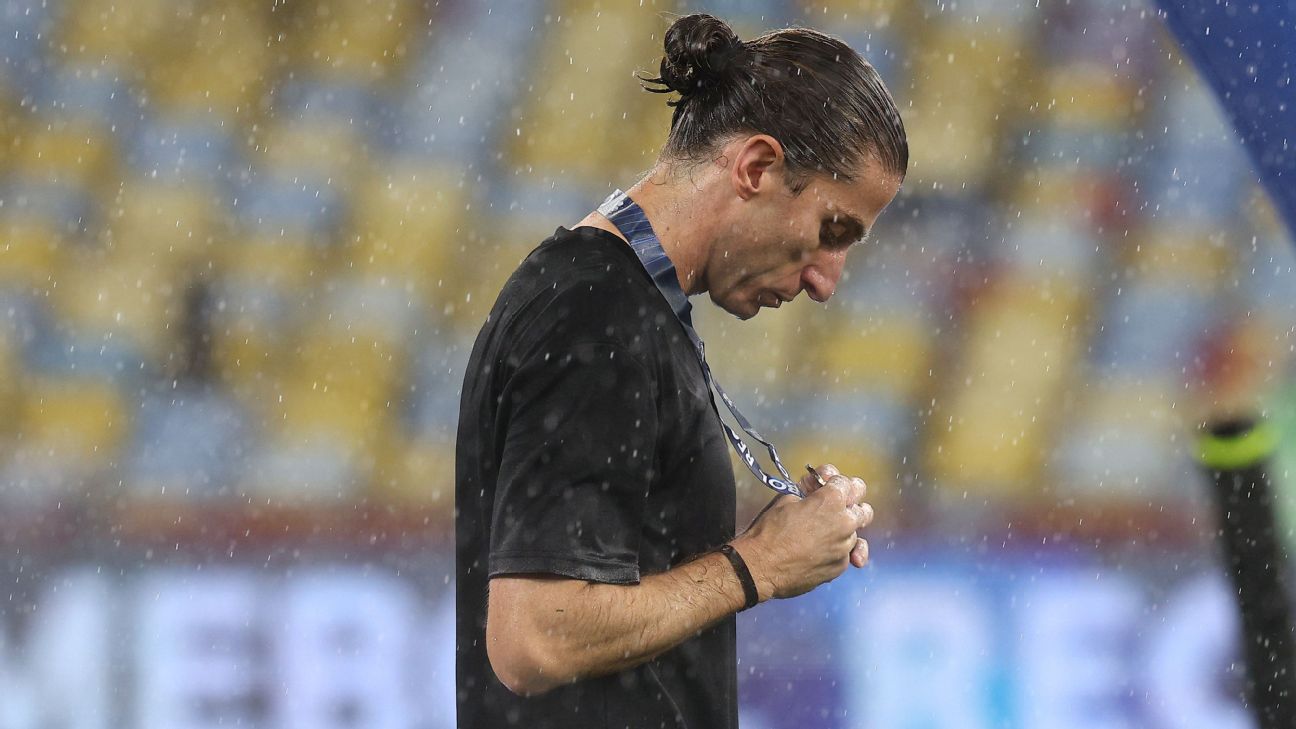
The answer, of course, is Filipe Luís, the former Atlético Madrid, Chelsea and Brazil left back, whose highly successful first coaching job in charge of Rio de Janeiro giants Flamengo came to an abrupt end on Monday night.
In the Maracanã stadium, Filipe Luís' team completed an 11-0 aggregate rout of Madureira in the semifinals of the Rio State Championship. But then, after a reported 30-second conversation in the dressing room, he was informed that his services were no longer required.
Flamengo may well live to regret this extraordinary turn of events more than the man they have just fired; Filipe Luís is one of the most promising coaches around. Disciplined, serious, intelligent, and a player who always appeared destined for a coaching career, Filipe Luis quickly made the transition between the two functions look seamless at Flamengo.
After a decade and a half in Europe, he rounded off his playing days with an excellent four-year spell with Flamengo, retiring at the end of 2023 and immediately becoming youth team coach. He had an eventful 2024, moving from manager of the U17s to the U20s, before taking over the first team at the end of September after former Brazil boss Tite was sacked when Flamengo were surprisingly knocked out of the Copa Libertadores.
Filipe Luís was in the right place at the right time, and he looked entirely at home in his new role. He soon took the team to the Copa do Brasil, and early in 2025 also claimed the Rio de Janeiro State title. Elimination by Bayern Munich in the summer's FIFA Club World Cup was a setback, but come the end of last year the serious silverware rolled in.
Flamengo won the Libertadores and followed it up a few days later by clinching the Brazilian Serie A title. Then, on Dec. 17, they took UEFA Champions League winners Paris Saint-Germain all the way to a penalty shootout in the final of the FIFA Intercontinental Cup.
This is where a number of problems began.
Firstly, there was a need to renegotiate Filipe Luís' contract. Up until this point, he had been an inexperienced cut-price stand in, but he had clearly proved himself as something more, and this had to be reflected in a new deal. The negotiations were not easy; tensions opened between the coach and the directors (Flamengo's president Luiz Eduardo Baptista later claimed that one of the reasons Filipe Luís was sacked was because he had spoken to Chelsea about their head coach position), and the club began to think of hiring an alternative -- namely Leo Jardim, a Portuguese coach who had a splendid season in Brazil with Cruzeiro. But on Dec. 29, Filipe Luis did sign new terms until 2027.
Secondly, the fixture calendar offered no reprieve. The Flamengo players went through a sequence of high-profile competitive matches all the way to mid-December and the new domestic season kicked off in mid-January, with the national league starting at the end of the month, much earlier than usual. It was hard for the players to ease their way into the season and, with little holiday or pre-season training, they were hurled straight into matches played in searing summer heat.
Filipe Luís' model of play is based around pinning the opposition back -- which requires high levels of intensity -- and, after losing the ball the team must press collectively to win back possession. But they lacked the physical condition to do this, and were vulnerable to a counter attack which saw the club make its worst start to a season in the last 10 years with four points from the opening three games.
Thirdly, all of those titles created the expectation of winning more titles. A certain swaggering braggadocio is part of Flamengo's DNA; they see themselves as a kind of Brazilian Real Madrid. Bringing back 28-year-old midfielder Lucas Paquetá from West Ham United this summer for $49.4 million, by far the most expensive acquisition in the history of Brazilian football, stands as a testimony to the size of their ambition.
But, as Paquetá said himself, he needed Flamengo more than Flamengo needed him. His best position -- attacking midfielder -- is already filled by Uruguay's Giorgian De Arrascaeta, a club legend and the player voted the best in the Americas last year. The acquisition of Paqueta was a boon for Filipe Luís, but it was also a burden, and it raised questions over how he would fit in. What the team really needed was a quick, mobile striker, able to open up space and attack in behind the defensive line. Instead, they signed another player who is happiest with the ball passed to his feet.
And then there were the Super Cups: one domestic and one continental. It is debatable whether these are genuine titles -- they could be seen as merely the consequence of winning other titles -- but are taken very seriously in Brazil.
Early last month Flamengo lost the domestic Super Cup (league champions against cup winners) to Corinthians. Then, in late February, came the two-legged South American Super Cup (the Libertadores champions against the holders of the second-tier Copa Sudamericana) against Lanús of Argentina.
Flamengo were huge favorites; Lanús are tiny in comparison, a neighborhood club from a suburb of Buenos Aires. But the Argentines came out on top 1-0 at home and then, with two goals late in extra time, stunned the Maracanã to win the second leg 3-2. Paquetá, the club's shiny, expensive new toy, was left on the bench for over an hour.
The fans were angry, and social media was full of grumblings about Filipe Luís. This mini crisis could easily have been forgotten on Sunday if Flamengo team had beaten Fluminense and claimed another title in the Rio State final, but that is why the Flamengo directors decided that they had to act now. They could not allow him the chance to consolidate his position with a lap of honor.
The 8-0 win over Madureira, then, was of no relevance; Filipe Luís could have overseen a 20-0 triumph and still found himself out of a job.