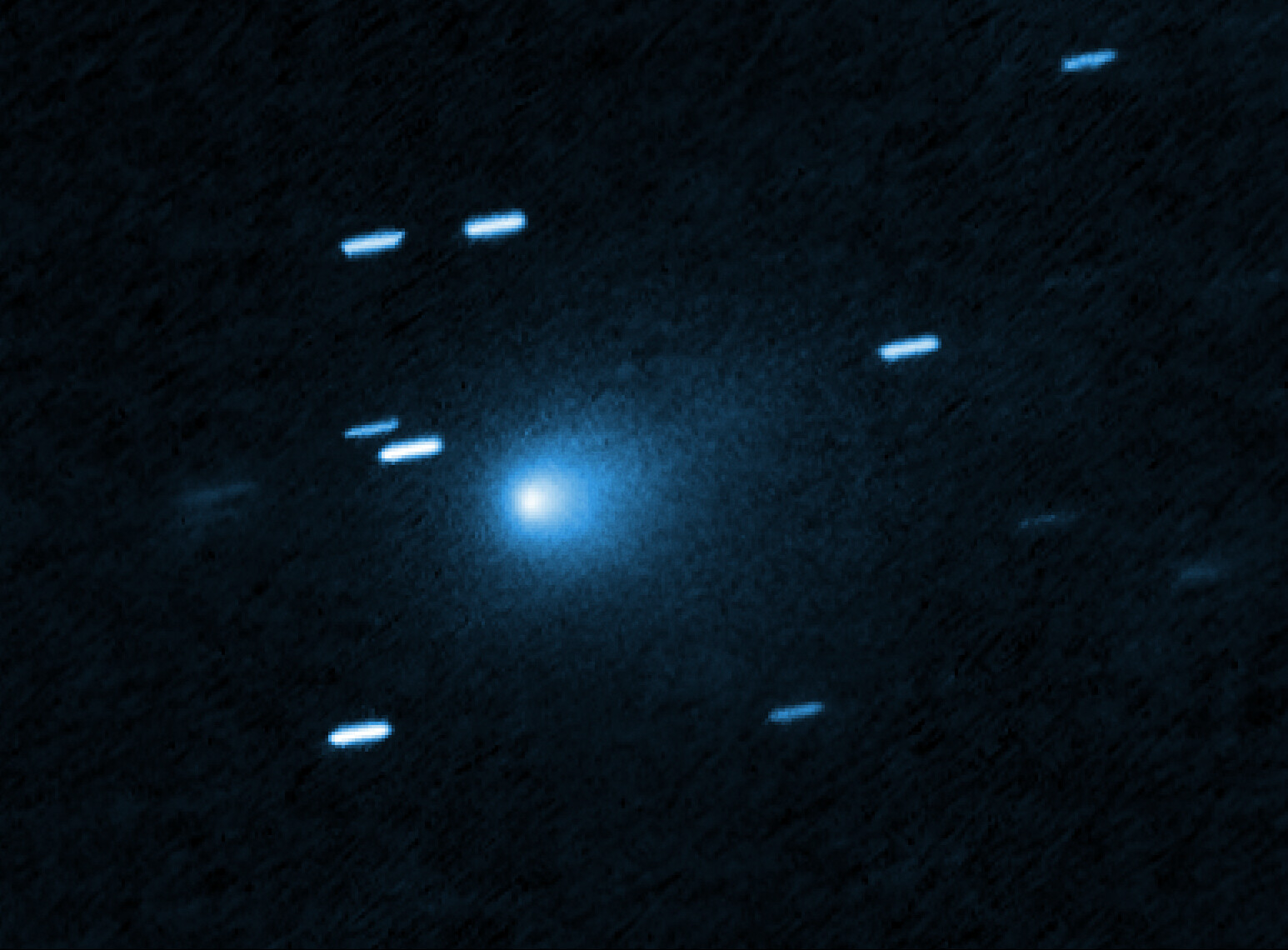
even a comet not at home can leave the impressions of fingers on which it is not. The object, named 3I/ATLAS was the third known interstellar object to go through the solar system ever. And, unlike a normal long-period comet, which is an ice-cold corpse loosely attached to the Sun, 3I/ATLAS comes in on an acutely unbound orbit, travelling too rapidly to be retained, and becoming an interstellar visitor once more. It is precisely this fly-through status which renders it valuable: the comet has spent the vast majority of its history out of the thermal cycling, collision, and radiation environment that actively works on native solar system small bodies.
The label of time capsule is not figurative. According to its movement through the galaxy, scientists have attributed 3I/ATLAS to a more ancient stellar population, and one study claims it may be older than the solar system. Oxford scientists gave a two-thirds probability that it is older than the Sun and highlighted how it could have been contained around an ancient star in the thick disk of the Milky Way, a hypothesis that is summarized in a discussion on the possible age of the comet. The issue of age is chemical because the chemical environment of the early Galaxies was different in terms of both metals and dust and ice resources to form planetesimals. An object created in such circumstances can hold a record of what were the appearance of the so-called raw ingredients prior to the acquaintance of the solar system with its own recipe.
The difference between 3I/ATLAS being an orbital curiosity and a chemistry story is that it has been characteristically been observed to be active at a few astronomical units of the Sun. That is, the comet atmosphere a coma can be interrogated using spectroscopy. During a vigorous observational effort, the actual appearance of optical gas emission was observed, and a weak but growing CN characteristic was found as the comet moved inward between approximately 3.2 and 2.9 AU. The work records a CN production rate of approximately at the lower end of solar system comets, and dust production proxies (Af 3 ) of approximately 300 cm. These are obtained as a result of a 10-night spectroscopic and photometric campaign, in which 3I/ATLAS was not treated as a stationary target, but as an active laboratory.
A more interesting signature, which is indicated by the same data, is the depletion of carbon-chain. The value of the C2-to-CN ratio (recorded in the monitoring write-up as logQC2)/QCN<1.05) was upper-bounded by the observers, placing the comet among the carbon-chain-depleted ones to date. That would, in practice, imply that common optical radicals of a sort that would be expected to be in association with carbon bearing parent molecules are paradoxically low in concentration compared to CN. The operational, the simplest engineering implication is not a philosophical one: various volatiles lead to different activity regimes at various distances. The coma of one species and the mute of another is recreating the aesthetic of what instruments are to emphasize, bandpasses, exposure schemes, calibration schemes, when a future interstellar visitor arrives almost without warning.
The chemical picture is further refined by the use of Infrared observations. Surveys of space-telescopes measurements define 3I/ATLAS as being unusually abundant in carbon dioxide, with lesser concentrations of water-related species and carbon monoxide being detected in the coma. Existence of high CO2 partial pressure is an indicator of the formation temperature: carbon dioxide ice can only exist above a CO2 frost line in a protoplanetary disk and its presence indicates CO2-heavy objects must have been formed under very low temperature conditions and subsequently ejected through gravitational interactions. That story is part of the general model of understanding other previous interstellar visitors, which states that giant planets and stellar flybys are capable of throwing planetesimals out of the system and putting wanderers in the galaxy.
Finally, 3I/ATLAS is akin to a spectacle as a calibration of the existence of an extrasolar comet chemistry as opposed to a spectacle. It provides an uncommon opportunity to compare volatile inventories and dust behavior and activation threshold against the most studied native comets without the confounding hypothesis that all comets were formed out of the same local stockpile. When the comet passes and disappears it leaves behind it its spectra: a tight-fitting record of what at least one other planetary system thought normal building material at least once long ago and far away.