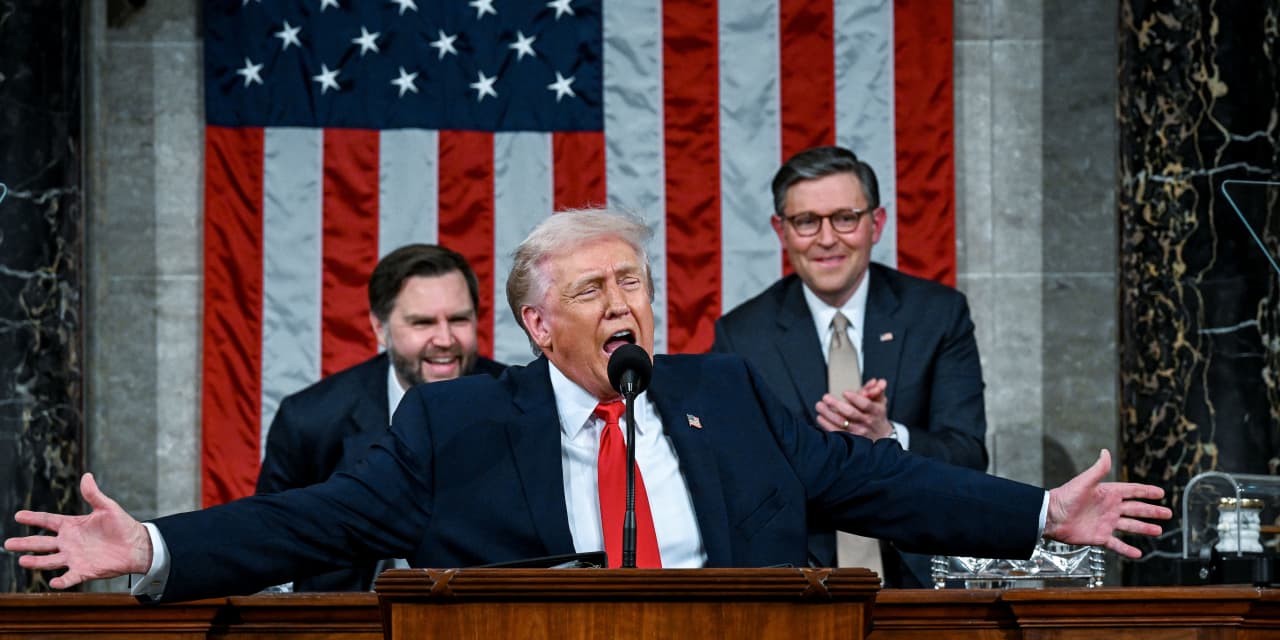
President Donald Trump signed an executive order Thursday to extend access to retirement plans to the millions of workers whose employers don’t provide one, following a promise made during the State of the Union address to bolster Americans’ retirement security.
Under the plan, the Trump administration will combine the effort with the Saver’s Match, which was created through the Secure 2.0 Act of 2022 and directs the federal government to match retirement-plan contributions for workers making less than $35,000, with up to $1,000 a year starting next year.
The Treasury Department will launch a new website, TrumpIRA.gov, to publicize the matching funds and issue guidance for private-sector donors who want to contribute to workers’ accounts.
In signing the executive order, Trump called the move “revolutionary,” saying it would provide low-income American workers “access to the same same type of retirement accounts that federal employees enjoy through the Thrift Savings Plans, which are incredible, as part of the federal Saver’s Match program.”
About 56 million Americans lack access to a retirement plan through their employer, according to AARP. About 27 million who qualify for the Saver’s Match do not have access to a plan where they can collect the benefit, Semafor reported.
“Getting 56 million workers into an account with a real federal match is the largest potential expansion of retirement coverage since Social Security,” said Teresa Ghilarducci, director of the Wealth Equity Center at the New School for Social Research.
The Trump administration said it would seek Congress’s approval to expand the program to workers in the middle-income range and above.
Americans, overall, are struggling to save for retirement. A recent study from the National Institute on Retirement Security found that the median amount American workers have saved for retirement — including those who have nothing saved at all — was $955.
Meanwhile, Social Security is facing insolvency in 2032 if Congress doesn’t act to shore up its finances. At that point, Social Security benefits would be cut by about 24%. The current average Social Security check is just over $2,000 a month.
“This is a big moment for retirement. Federal action to address the access gap is something huge,” said K.C. Boas, the retirement-savings initiative lead at the Aspen Institute Financial Security Program. “But this cannot and should not replace Social Security stability. Social Security remains the foundation for retirement.”
Last year, the president unveiled “Trump accounts,” which are investment accounts for children under 18. Babies born between 2025 and 2028 are eligible to receive $1,000 in seed money for these accounts.
Read: 3 things to know about ‘Trump accounts’ — the new investment vehicle for kids
The retirement-account match may be a powerful incentive for workers, who tend to contribute more when employers match their contribution, the Congressional Budget Office found in 2019.
“Americans are 15 times more likely to save for retirement when they have access to a workplace savings plan, but roughly half of all private-sector workers currently lack access to one. The bipartisan efforts from leaders in Congress and this administration, through today’s executive order and the implementation of the Saver’s Match program, will make real progress in expanding access to retirement accounts,” said AARP senior vice president of government affairs Bill Sweeney.
Small businesses are especially likely not to have an employer-based retirement plan in place. As many as 78% of businesses with less than 10 employees do not offer an employer-based retirement plan, according to AARP.
Those without access to employer-based retirement plans are more likely to be nonwhite, AARP found. About 63% of Hispanic workers, 52% of Black workers and 44% of Asian-American workers lack access to an employer-provided retirement plan.
Those without employer plans also tend to be lower-income workers. Almost 80% of the workers who lack access to an employer-based retirement plan make less than $53,000 per year, AARP said.
“Expanding enrollment in retirement accounts for workers without employer plans sounds like it could be a good thing. There are tens of millions of workers who currently lack access, and making it easier to open an account could help at the margins. That said, access alone isn’t the main barrier to saving,” said Romina Boccia, director of budget and entitlement policy at the Cato Institute, a libertarian think tank.
“Eligibility is quite limited — the full match is only available to low-income workers … and individuals have to contribute their own money to receive it,” Boccia said. “For many households living paycheck to paycheck, that’s a significant hurdle, so take-up may be more modest than proponents would hope — especially since those savings would be locked up until 59½ years of age or be subject to tax penalties.”
Others agreed that access to retirement accounts alone isn’t enough.
“This is coming at a moment where we have an affordability crisis. We need to prioritize making daily life more affordable” Boas said. “This is a down payment on a good idea if implemented well. Access alone isn’t enough.”
Boas said details such as access to funds and emergency-saving features, as well as auto-enrollment and auto-escalation of savings rates, will be critical to watch.
Read: Target-date retirement funds are more popular than ever. Critics say you can do better.
Ghilarducci warned that Trump’s executive order alone was insufficient. To be permanent and reach all the workers who need it most, Congress must pass the Retirement Savings for Americans Act, bipartisan legislation already before both chambers.
“And critically — Social Security and Medicare must be fully funded and expanded. Without shoring up Social Security, no retirement reform is truly adequate,” Ghilarducci said.