A top Trump appointee at the Interior Department acknowledged that she has been involved in changes to grazing policies that benefit ranching businesses like her family’s, according to a video of her remarks — a claim that some ethics experts say could violate federal law.
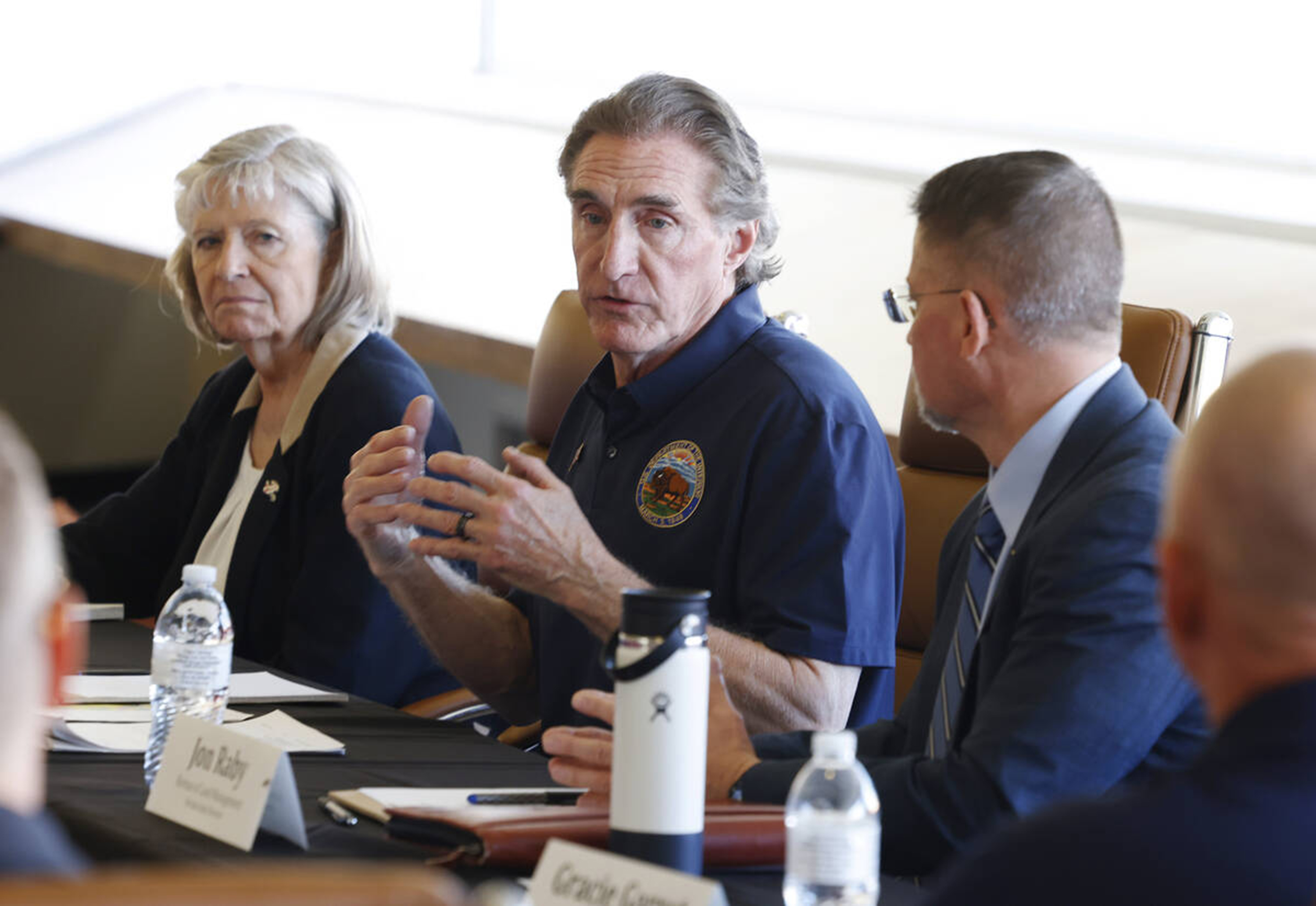
Associate Deputy Secretary Karen Budd-Falen told a Congressional Western Caucus event in December that grazing policy is part of her job, and “the thing that probably was the closest to my heart was grazing regulations,” according to a video that Senate Western Caucus Chairwoman Cynthia Lummis (R-Wyoming) uploaded to her public YouTube page. The remarks, which have not previously been reported, prompted at least one nonpartisan watchdog group to call for an investigation into whether she violated ethics laws.
The official’s comments are the latest example, three independent ethics experts and two watchdog groups said, of this administration’s appointees apparently disregarding conflict-of-interest laws. For instance, White House and Justice Department officials’ ownership of cryptocurrency has also drawn scrutiny.
President Donald Trump — who has major interests in his own cryptocurrency, real estate and social media companies — is exempt as president from the main federal conflict-of-interest law and is the first president not to agree to abide by it voluntarily.
Budd-Falen and her husband own at least five cattle or ranch operations in Nevada and Wyoming, according to her federal financial disclosure forms, each valued at more than $1 million. The couple’s companies additionally hold allotments that allow them to graze cattle on about one-quarter-million acres of federal land overseen by the Interior Department’s Bureau of Land Management.
In the video, Budd-Falen discusses relaxing limits on grazing using a “categorical exclusion” that also applies to land controlled by her husband, following the death of her father-in-law. She said that she aims to increase the number of grazing allotments handed out to ranchers and no longer declare areas as critical habitat for endangered species, a designation that can hurt landowners.
In her senior role at Interior, Budd-Falen has the ability to weigh in on a wide array of policies, although it is difficult to discern individual officials’ level of involvement in specific policies.
Campaign for Accountability, a nonpartisan watchdog group, said it planned to send a letter Saturday to the Senate Homeland Security and Governmental Affairs Committee and the House Natural Resources Committee demanding that Congress investigate whether Budd-Falen violated ethics laws, and to look into whether the Interior Department’s ethics office failed to act as an independent check on her conflicts of interest.
Michelle Kuppersmith, executive director of Campaign for Accountability, said the group had been monitoring Budd-Falen’s activities given her financial holdings and found the YouTube recording of her speaking at the event, where she is sitting alongside Lummis.
“The situation with Karen Budd-Falen seems to be quite brazen in the scheme of conflicts of interest,” Kuppersmith said. “She is, by her own admission, working on policy for grazing that will likely directly impact her own financial interests. And they’re not even trying to hide it.”
In a statement, Interior Department spokeswoman Aubrie Spady said Budd-Falen “has complied, and continues to comply, with any and all legal requirements, ethical standards and ethics guidelines.”
She has been subject to the same “rigorous” ethics screening by the Interior Department and the Office of Government Ethics as other Trump administration Interior appointees, Spady said.
“Karen Budd-Falen is a highly qualified, principled public servant who brings the utmost expertise to her role at the Department,” she added.
Beyond its statement, the Interior Department did not respond to detailed questions sent by The Washington Post regarding the allegations against Budd-Falen.
Budd-Falen and her husband, Frank Falen, did not respond to requests for comment.
Some might argue that Budd-Falen’s experience ranching is what makes her qualified for the job, said Richard Briffault, a Columbia Law School professor specializing in government ethics. If she is making decisions that benefit not only her interests, but also those of a larger group like ranchers in general, it falls into a legal gray area, he said.
Budd-Falen may have a conflict of interest, and the “revolving door” between industry and regulators is a problem in Washington, but that does not necessarily make it illegal, Briffault added.
Ranchers have lobbied the Trump administration to relax environmental restrictions and expand their access to public land for grazing, while environmental advocates say increased cattle grazing comes at the expense of wild animals and their habitats.
Richard Painter, formerly the chief ethics lawyer under the George W. Bush administration, said that if Budd-Falen has received federal grazing rights from Interior, while also creating grazing policy at the department, “that would be a pretty slam-dunk financial conflict of interest.”
Lummis said in a statement that she supported the Trump administration’s changes to grazing policies, but she did not respond to specific questions about Budd-Falen.
During Trump’s first term, Interior issued an ethics waiver for Budd-Falen that allowed her family to retain their ranching holdings but prohibited her from working on or discussing grazing policy. The department did not issue a new ethics waiver when she rejoined early last year, according to Office of Government Ethics records, but issued one in March. That waiver broadly allows her to participate in grazing policy.
The Interior Department did not respond to questions about the waiver.
Painter said it was “wrong,” “unacceptable” and unusual for the government to issue a waiver like that, but that it would offer her protection going forward. It would not apply to her actions for the first year in office before it was issued, he added.
The waiver does not make a case for why Budd-Falen’s expertise is so valuable to the government that it would outweigh concerns about her conflicts of interest, said Kathleen Clark, a law professor at Washington University in St. Louis and a government ethics lawyer. It also does not consider how much Budd-Falen could benefit from her own policies, undermining its validity, Clark said.
Speaking to the event for the Western Caucus, a conservative group of federal lawmakers from Western states, Budd-Falen said the Interior Department had issued additional exemptions from grazing rules — known as categorical exclusions — and sought to avoid expanding endangered species protections to help ranchers. It is unclear when the exemptions were issued.
“You have places like northern Nevada where my father-in-law’s place is. It’s lots of cheatgrass. And you’ve got to graze that cheatgrass at the right time of year, and so we added categorical exclusions so you could move cattle in there temporarily,” Budd-Falen said in the video.
She also discussed allowing grazing in more areas to reduce the risk of wildfires.
“Because I’m a rancher, the other thing we’re bringing in is we’re going to lean very far forward on bringing cattle in to reduce fuel loads,” she said at the event. “There are around 1,300 vacant allotments for the BLM right now. By the end of next year, every single vacant allotment will be filled by a rancher.”
Sen. Richard Blumenthal (Connecticut), the top Democrat on the Senate Homeland Security and Governmental Affairs’ Permanent Subcommittee on Investigations, said Congress should open a review of the administration’s actions that may have benefited Budd-Falen.
“You don’t have to be an expert on land management to know that when she talks about how policy changes are going to benefit ‘private landowners,’ she’s talking about herself,” Blumenthal said in a statement to The Post.
Rep. Jared Huffman (California), the ranking Democrat on the House Natural Resources Committee, acknowledged Democrats in the minority cannot initiate an inquiry unilaterally, but said in an interview, “This is definitely one of the things that a Democratic Congress would investigate and spotlight” if the party prevails in the November midterm elections.
Painter and Dylan Hedtler-Gaudette, vice president of policy at the Project on Government Oversight, an independent watchdog group, said the ethics questions surrounding Budd-Falen are unlikely to lead to any consequences because even if Democrats could conduct an investigation, any criminal case would be handed over to the Justice Department. The department would be unlikely to pursue a case under Trump, they said.
The Campaign for Accountability’s complaint marks the second set of ethics questions raised regarding Budd-Falen this year. In January, House Democrats demanded that Interior’s inspector general investigate her role in the 2018 approval of a lithium mine when she served as Interior deputy solicitor. A year before the decision, her husband had signed a deal to sell water from a family ranch to the mining company behind the project.
Interior’s acting inspector general has not announced any actions in response to the ethics questions. Erica E. Paulson, a spokeswoman for the inspector general’s office, declined to comment, stating that it has a policy not to confirm or deny investigative activities.
Painter and other ethics experts said it is fairly rare for an official to be tried, let alone convicted, under the primary ethics law governing federal officials and staffers, known as U.S. Code 208. Past administrations generally removed officials with clear conflicts before the situation reached the point of litigation.
Normally, the Office of Government Ethics leads efforts to comply with the law. But Trump fired the permanent director in February last year, three months after the Senate had confirmed him to serve a five-year term.
Most Read From The Washington Post
- She had four kids with Elon Musk. Now she’s central to his courtroom fight.
- Inside a MAGA influencer’s turn against the right-wing machine
- How a new breed of hacking tools is forcing a White House reset
- Elon Musk went to court. The judge wasn’t amused.
- See which jobs are most threatened by AI and who may be able to adapt