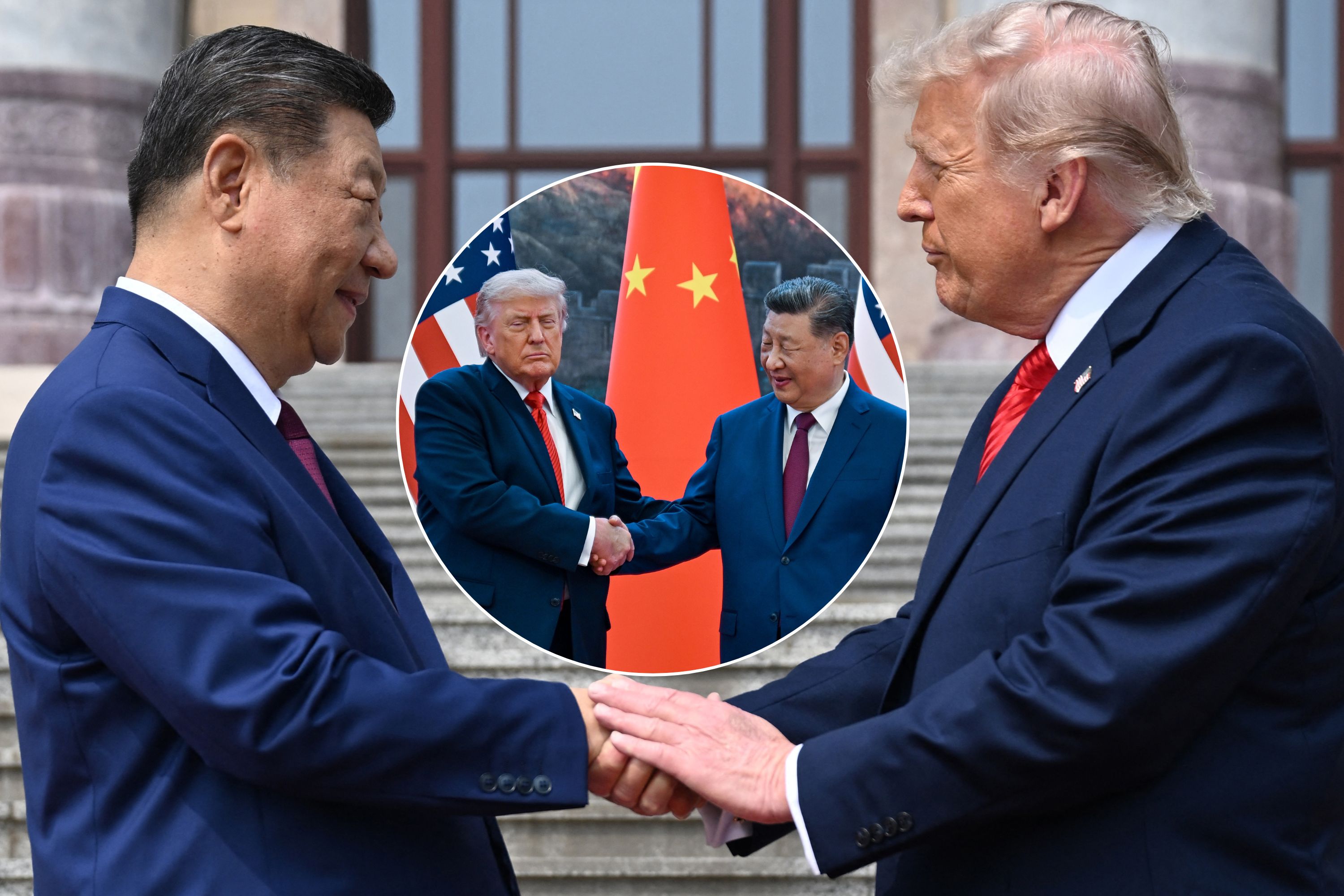
As President Donald Trump and Chinese leader Xi Jinping greeted each other on Thursday, every step, glance and gesture was on display for the watching world, offering early signals about tone, control and positioning at a high-stakes summit.
Body language experts say these moments—often brief and highly managed—can still offer insight into positioning, intent and control.
Trump is known for a larger-than-life physical style with other leaders, often using his trademark handshake to assert presence—pulling counterparts closer, prolonging contact or reinforcing the grip with a second hand.
Any friction between the world’s two largest economies has implications that extend directly to American households. Ongoing trade disputes, export controls on critical technologies and concerns over supply chains have already influenced prices, jobs and investment in the U.S., while flashpoints including Taiwan and regional security continue to test diplomatic ties.
Any sign of cooperation—or escalation—at the summit could shape not only global markets, but the economic and security environment facing Americans in the months ahead.
The U.S. president arrived at around 10 a.m. local time to a carefully choreographed welcome at the Great Hall of the People, where a large military entourage and flag-waving children lined the venue. The atmosphere appeared friendly as the two leaders met on a red carpet and shook hands before proceeding inside.
In opening remarks, Xi said the United States and China should be “partners not rivals” and noted that “the whole world is watching” their engagement. Trump, standing alongside him, called it “an honor” to meet Xi and said he was looking forward to what he described as “the biggest summit ever.”
Reading the Power Play
Psychologist, former Oxford University don and author of How to Tell What People Are Thinking Peter Collett said the leaders’ opening interaction, while brief, contained “several fleeting, but nevertheless highly revealing features of power-play.”
One of the most notable elements, Collett said, was the movement leading into the handshake.
“When Trump arrives, he walks over to Xi, who, even though he’s the host, makes hardly any effort to move towards Trump or to express any enthusiasm for the imminent meeting,” Collett told Newsweek. “This gives the impression that Trump is doing all the work, both literally and figuratively.”
A Different Kind of Handshake
“Trump did not deploy his usual ‘yank-shake’ handshake style in this meeting, which he typically uses to assert dominance,” Collett said, noting this can depend on whether he views the counterpart as an equal.
Last month, Trump notably deployed the handshake when meeting King Charles III during the British monarch’s White House visit—so why did Xi not receive the same treatment?
“There appear to be two occasions when he doesn’t do this—either when there’s no need to be overbearing or when he considers the other person to be his equal, or at least doesn’t want to disturb the illusion that that’s how he thinks of them,” Collett said.
“Trump’s palm-up hand position, which is conventionally seen as submissive, is something he frequently uses as a performative gesture of openness,” Collett said.
Subtle Signals of Control
Other details during the handshake further illustrated what Collett described as a balance of power between the two leaders.
Collett said Trump’s brief pat on Xi’s hand could be read as a subtle status signal, while Xi’s lack of response reflected a more restrained diplomatic style. He added that these small gestures suggested a carefully balanced exchange of control between the two leaders.
Contrasting Styles on Display
More broadly, the interaction highlighted a contrast between Trump’s typically expansive style and Xi’s more controlled approach.
Xi has developed a reputation for a composed and contained presence during diplomatic encounters, often maintaining an upright posture, limited upper-body movement and a consistent physical distance from counterparts.
Trump, by contrast, often steps into interactions more physically. But on Thursday, that contrast appeared more evenly matched.
“Trump likes to think of himself as the past master of power-play,” Collett said. “But in Xi he appears to have found his match.”
Additional visual details reinforced that balance, he noted, including Xi wearing a lighter-colored suit—which can make a figure appear more prominent—and a more pronounced arm swing as the two walked, creating an impression of energy and movement.
Related Articles