
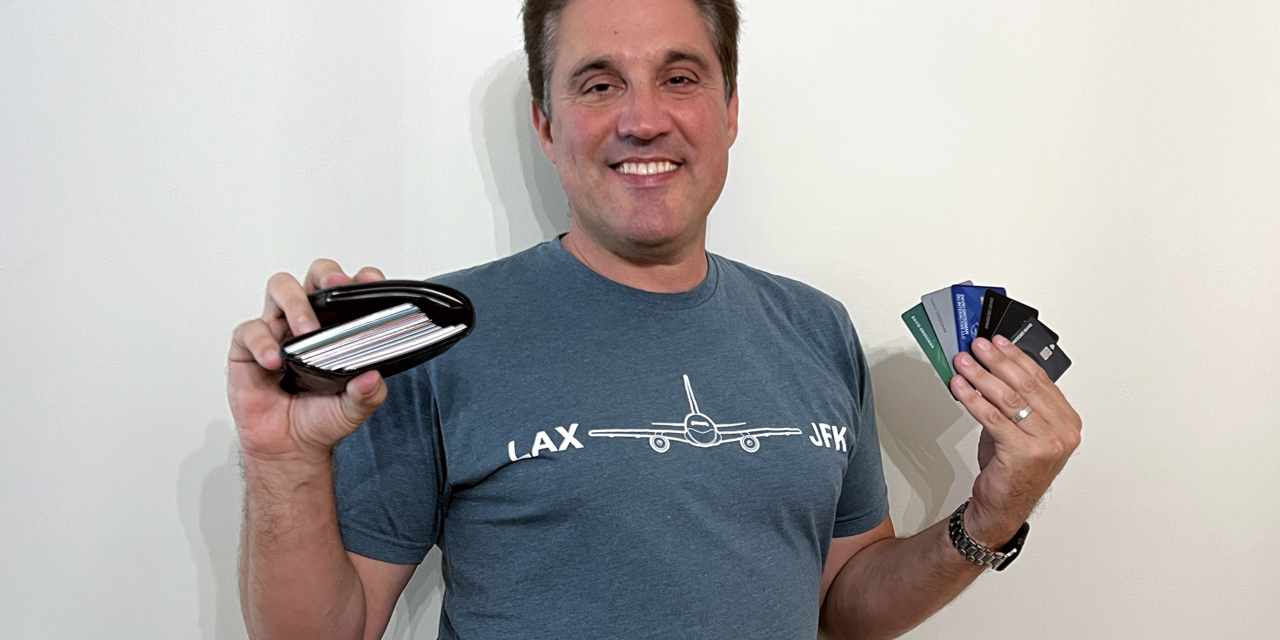
Most people keep a few credit cards in their wallet for their spending needs. Dave Grossman has an army’s worth at his disposal.
To be specific, Grossman, a 49-year-old entrepreneur who calls suburban New York City home, has about 45 credit cards. Admittedly, he doesn’t keep all of them in his physical wallet, though he admits his billfold is George Costanza-worthy, to borrow a “Seinfeld” reference.
Some of this card mania ties in with Grossman’s work: Among other enterprises, he’s the founder of the MilesTalk website and its companion Your Best Credit Cards, two platforms that provide information about cards, loyalty programs and strategies for maximizing rewards.
But Grossman’s fascination with credit cards goes back about three decades. He got his first card — a Discover card — while in college, in order to earn cash back on purchases. He got the travel bug in his 20s and once he started learning about airline and hotel loyalty programs, he immediately began looking into cards that let him earn rewards to see the world.
And he hasn’t stopped, acquiring card after card and figuring out which one is best to use for what purpose. “I’m a life optimizer,” Grossman says of his philosophy.
At a time when credit cards have been in the news — with announcements about the revamped Chase Sapphire Reserve card and future changes to the American Express Platinum card — we spent some time with Grossman to learn about what he does. Just as important: We wanted to hear what suggestions he might have for those of us who want to optimize as well, but perhaps with a thinner wallet.
Here’s what we learned.
First things first: Pay your credit card bills in full every month
Grossman makes this point up front: Any card-optimizing strategy he employs is built around making full monthly payments. There’s no logic in paying interest rates that can easily top 20% to garner a reward worth 2% to 5%. “If you struggle with credit, don’t use credit cards,” he says.
How many cards do you really need?
Yes, 45 is overkill. In truth, Grossman relies on about a dozen cards for most of his purchases and concedes that he rarely touches some of his other cards. But those 12 get pretty good use. “I’m very intentional with every card I have,” he says.
Grossman says you can build an effective strategy with as few as two to four cards. American consumers on average have about four credit cards.
Grossman says he doesn’t usually cancel cards, especially if they’re ones that don’t carry an annual fee, since he sees no harm in keeping them active. If anything, canceling a card can negatively affect your credit rating in certain instances — it all has to do with your credit-utilization ratio, or how much credit you use compared with your available credit. One big no-no is canceling your oldest cards, he says, since your credit history also affects your score.
What cards should you think about?
Grossman is all about building up his points on various cards to use for travel, which he says is a far more lucrative way to play the rewards game than opting for cards that give you cash back. But this has to do with personal preference, he notes — if you’re not into travel, you may be better off with the cash. Points can also be redeemed for other things, such as gift cards or merchandise, but he says travel is where you’ll typically get the most bang for your buck.
Grossman also generally prefers cards that let you transfer the points to any number of travel partners, as opposed to ones that let you earn with a specific hotel or airline. He likes the flexibility and notes there are often transfer bonuses that you can take advantage of — meaning you’ll get more than the standard 1-to-1 exchange.
“Let’s say you have 1 million points. That doesn’t need to be 1 million miles. It can be 1.4 million miles,” he explains.
But different cards have different bonus categories, which is where another facet of optimizing comes into play. For example, Grossman often relies on his Amex Gold Card to pay for groceries and dining, since it offers a solid 4% return in those categories. But he puts his rent payments on his Bilt Mastercard: While it offers just a 1% return for that category, he notes it’s the only card with any rewards for rent.
In some instances Grossman does consider a hotel- or airline-specific card — mostly to gain perks that are unique to that card. He has a World of Hyatt card because it helps him earn top-tier status with a hotel brand he values. It means forsaking some points he could receive with other cards that offer respectable bonuses in the travel category, but he says it’s a tradeoff he’s willing to make.
What if there’s a purchase that doesn’t fit into any particular bonus category? Grossman has a go-to general-purpose rewards card — in his case, the Citi Double Cash Card which offers a 2% reward (in the form of what Citi calls ThankYou Points) across the board. There are also other 2% reward cards on the market, he notes.
How do you keep track of all these cards and rewards?
“I do it in my head,” Grossman says matter-of-factly, though he admits it’s a challenge. Other reward optimizers rely on spreadsheets, and there are apps that can help with tracking as well.
To keep payments in order, Grossman sets up all his card accounts with autopay — meaning the full statement balance is automatically deducted from his checking account. In the rare instance when he’s forgotten to do that and missed a payment, he quickly fixes the mistake and ponies up the money. He notes that card issuers will sometimes reverse a late-payment penalty and interest charges if you politely request it within a couple of days of the error.
There are some other pesky details: Some loyalty programs require that you make at least one transaction within a certain period — say, every two years — or you will forfeit all your points or miles. In that case, Grossman will set a reminder on his calendar to transfer a small amount of points — as little as 1,000 — from one of his credit-card platforms so that he remains in good standing.
For that matter, some card issuers will cancel a card if the user doesn’t charge anything on it after a set period of time, so Grossman has to keep that in mind as well, if the card is valuable enough to him.
What are some of the best perks you can get?
Grossman says he has seen the world because of the ways he’s optimized his rewards. And he’s often done it in style. “I’ve flown internationally first-class on at least eight different airlines,” he says.
What about sign-up bonuses?
No question, these bonuses can be a nice incentive, Grossman says, although they require a certain amount of initial spending to earn the bonus points or cash. He says has taken advantage of some offers over the years, but as with anything else, he tries to optimize them, since the bonus can vary over time.
“It doesn’t need to be the best it’s ever been, but it needs to be at the end of the upper range,” he says.
How does all this affect your credit score?
If you do things correctly — again, by paying your bills in full every month and not canceling cards needlessly — you won’t necessarily see your score drop just because you have lots of cards, Grossman says. You do get dinged a small number of points when you apply for a card, he adds, but your score bounces back within a few weeks.
As for Grossman’s score, he says it’s around 800.
How big a wallet do you need to execute this strategy?
Not that big at all, Grossman says, since you can keep your cards in a virtual wallet on your mobile phone. But he prefers physical plastic in most instances — it’s a fail-safe option, he explains — so he has most of his preferred dozen cards with him at all times.
“I have a Costanza wallet,” he says.