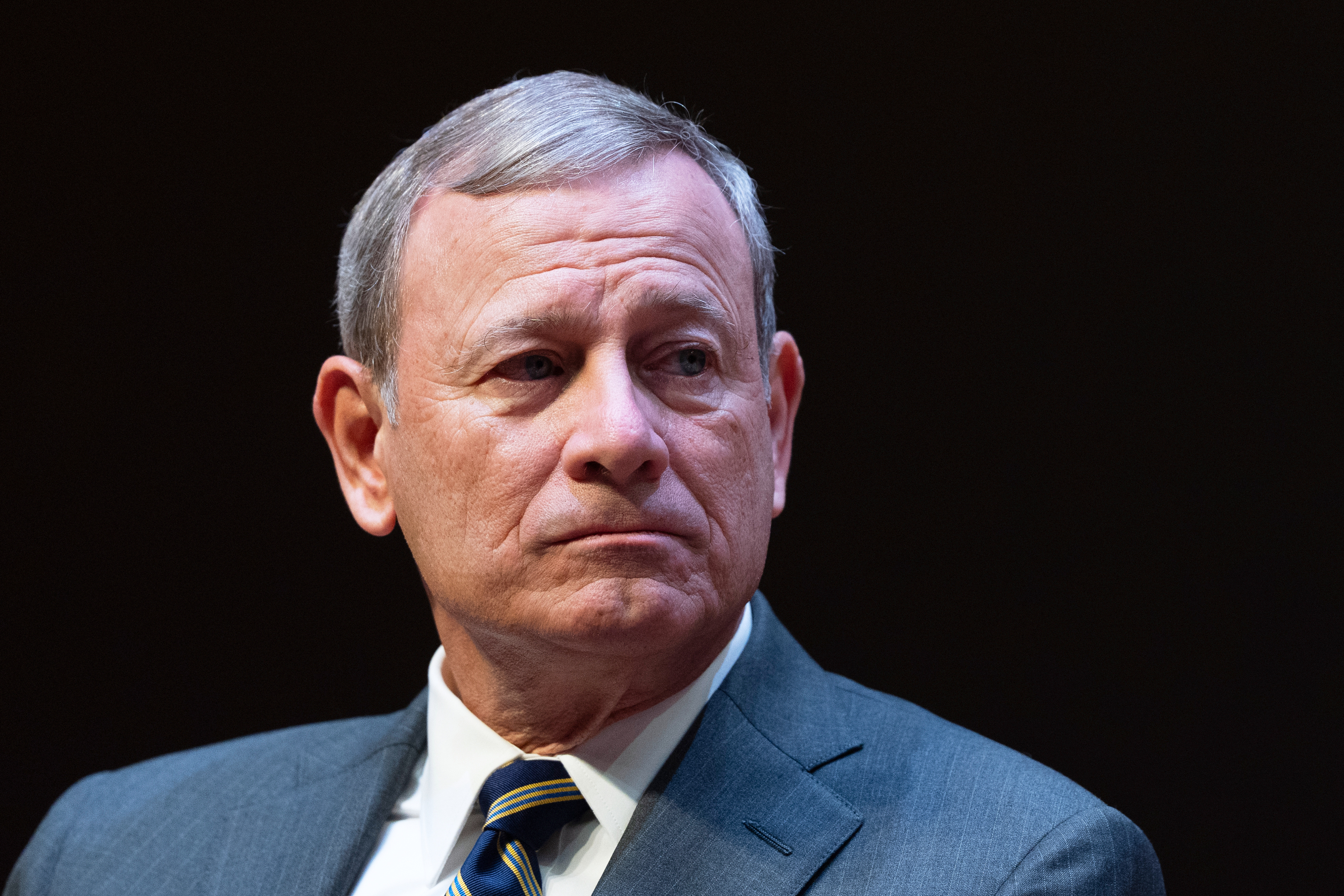
Chief Justice John Roberts pushed back at accusations that the U.S. Supreme Court is political, saying he’s concerned that people don’t “grasp that.”
The Supreme Court has faced claims of impartiality in the past, amplified by a recent ruling that narrowed how race may be considered under the Voting Rights Act, while leaks showing how a 2016 decision was made caused optics headaches, too.
At a conference of attorneys and judges in Pennsylvania, organized by the 3rd U.S. Circuit Court of Appeals, Roberts was asked what he felt Americans most misunderstood about the institution.
“At a very basic level people think we’re making policy decisions. I think they view us as truly political actors,” Roberts, who has led the court since 2005 and was appointed by former President George W. Bush, said, “which I don’t think is an accurate understanding of what we do.”
“Certainly, those aspects are open to debate and people should talk about them, but we’re not simply part of the political process and there’s a reason for that and I’m not sure people grasp that as much as is appropriate.”
Louisiana v. Callais and Other Recent Supreme Court Decisions
In its 6-3 decision in Louisiana v. Callais, the Supreme Court struck down Louisiana’s congressional map, narrowing the circumstances under which states may use race-conscious districting to comply with the Voting Rights Act without violating the Equal Protection Clause.
The court’s conservative majority found that Louisiana violated the Equal Protection Clause by creating a second majority-Black congressional district to comply with Section 2 of the Voting Rights Act. Voting rights advocates said the ruling weakened decades of protections against minority vote dilution, while Republican officials said it clarified constitutional limits on the use of race in redistricting.
In February, the court limited Trump’s authority to impose tariffs without congressional authority, sparking backlash from the president.
Meanwhile, in 2024, Roberts granted Trump broad immunity from criminal prosecution over his efforts to overturn the results of the 2020 election loss.
Supreme Court’s Shadow Docket Leak
The Trump administration has increasingly used the high court’s emergency docket, referred to as the “shadow docket” by critics for its lack of transparency, to seek quick intervention from the justices in cases still playing out in lower courts. The high court sided with the Trump administration in about two dozen decisions last year, often lifting orders issued by lower-court judges who found the administration’s policies likely illegal. Such shadow docket rulings come without opinions, meaning judges are unsure of the legal arguments that swayed the justices.
The New York Times reported that recently obtained internal Supreme Court memos have shed new light on how the court’s “shadow docket” has been used in Roberts’ court in the past. The documents show that, in an exchange over five days in 2016, the justices voted 5–4 to block former President Barack Obama’s Clean Power Plan before lower courts had ruled on its legality, and issued only a brief, unsigned order.
“Absent a stay, the Clean Power Plan will cause (and is causing) substantial and irreversible reordering of the domestic power sector before this court has an opportunity to review its legality,” Roberts wrote in one of the memos published by the publication in April.
Related Articles