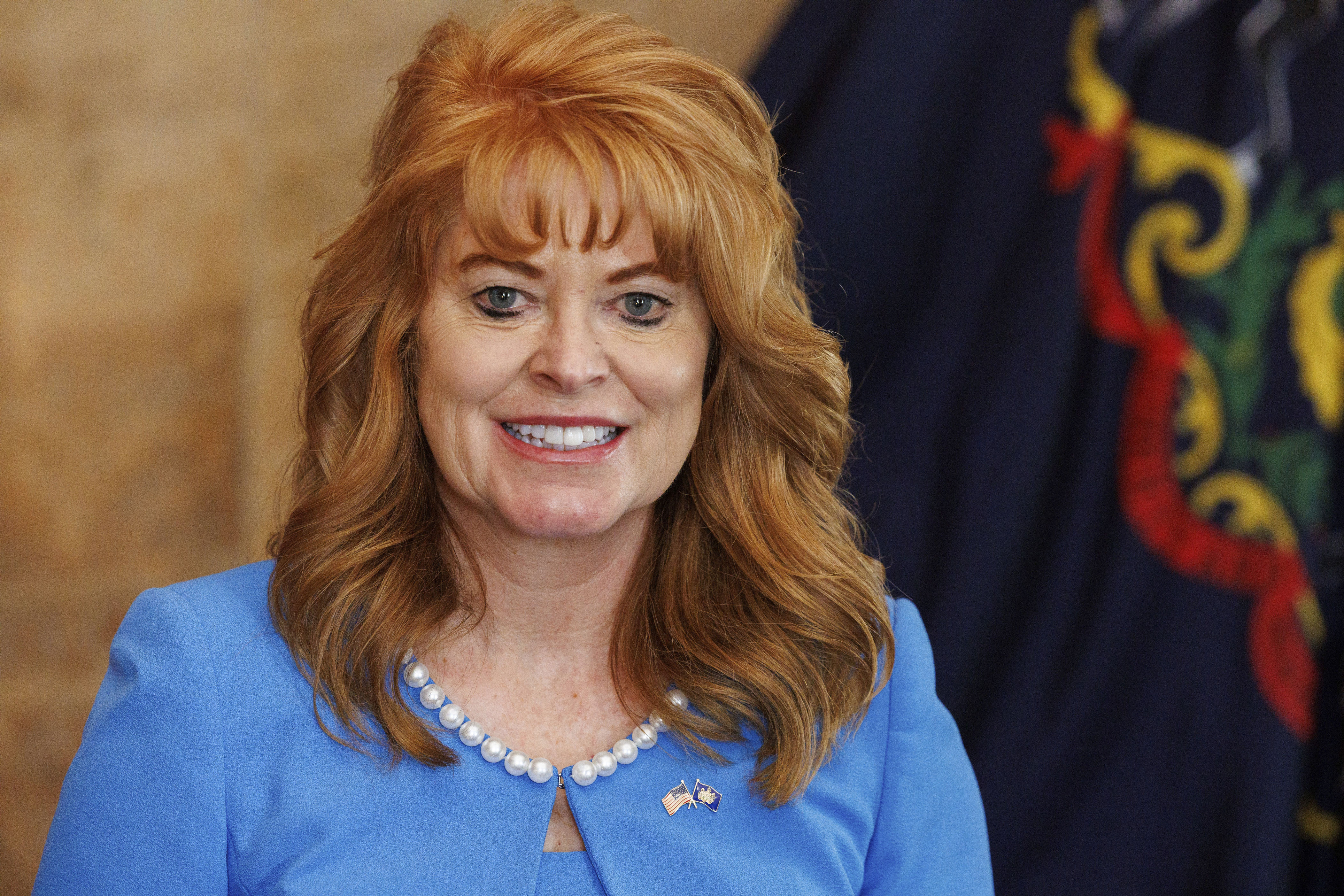
Pennsylvania Treasurer Stacy Garrity is officially the Republican nominee to take on Governor Josh Shapiro in the Pennsylvania gubernatorial election, and ousting him would break a trend that’s been in place for over a decade.
Both Garrity and Shapiro ran uncontested in their primaries, so neither of their victories came as a surprise. Pennsylvania is still a battleground state, flipping parties for president in the last four elections, and the gubernatorial race could impact the 2028 presidential election.
While Shapiro is focused on winning his reelection, he’s widely considered a contender for the 2028 Democratic presidential nomination, and a strong showing in the November election in a battleground state could go a long way toward his presidential ambitions.
Shapiro enters the race with many advantages, including name recognition and popularity, but Garrity has the endorsement of President Donald Trump, which goes a long way with Republicans—though it is a double-edged sword.
Stacy Garrity’s Chances of Defeating Josh Shapiro, According to Polls
Polling shows that Garrity faces a steep challenge in the race to oust Shapiro.
A Susquehanna Polling and Research survey released in April found Shapiro leading Garrity by 22 percentage points, 58 percent to 36 percent, with just 5 percent of voters undecided. When comparing it to past elections, Jim Lee, president of Susquehanna Polling and Research, said Shapiro has the “best trajectory” they’ve seen.
Shapiro widened his lead on Garrity, according to Susquehanna polling. A September poll showed he led by 18 points, with 54 percent of the vote compared to Garrity’s 36.
In January, Trump endorsed Garrity, calling her a “successful businesswoman,” and a “true America First Patriot,” and highlighting her military career. Trump said Garrity would grow the economy, cut taxes and regulations and champion making America energy independent.
Garrity praised Trump for endorsing her, calling it an “honor” and positioning herself as an ally to the president, in contrast to Shapiro, whom she said “has done everything he can to stand in President Trump’s way.”
Nearly 75 percent of Garrity’s supporters say they’re supporting her because she’s a Republican or because Trump endorsed her and she’s a supporter of the president’s, according to the Susquehanna poll.
Other surveys tell a similar story. A Quinnipiac University poll conducted earlier this year found Shapiro ahead 55 percent to 37 percent, while a Franklin & Marshall College survey put the race at 48 percent to 28 percent, with a larger pool of undecided voters. Aggregated polling averages show Shapiro maintaining a roughly 20-point advantage statewide, reinforcing the sense that Democrats currently hold a structural edge in the race.
Josh Shapiro’s Advantages
Shapiro’s approval ratings remain relatively strong. Polling indicates that a majority of voters view his performance positively, with approval hovering in the mid-to-high 50s. That level of support is typically a strong starting point for incumbents.
He also has strong name recognition. Surveys consistently show that a majority of voters say they have not heard enough about Garrity to form an opinion. Analysts say that gap creates a timeline challenge for the Republican nominee, who must define herself statewide before voters lock in their impressions.
Lee told the Pittsburgh Tribune-Review that Garrity needs to fix her “identity problem” and show voters what she stands for because she doesn’t have the “luxury of taking her time introducing herself to the voting public.”
Coalition dynamics favor Democrats. Shapiro commands near-unanimous support among Democrats and leads among independents, a key voting bloc in Pennsylvania. Meanwhile, Garrity’s support remains heavily concentrated among Republican voters, raising questions about her ability to expand beyond the party’s base. Polls also show that as many as 18 percent of Republicans plan on voting for Shapiro, and Garrity can’t afford a fractured Republican base.
Still, Republican officials caution that early polling can be misleading, particularly more than six months before a general election. Historically, incumbents often lead at this stage of the cycle, and races can tighten once challengers gain visibility and messaging becomes more defined.
Garrity’s strategy is likely to center on nationalizing the race and tying Shapiro to broader Democratic policies, while also leaning on her record as treasurer and her military background.
“I’m doing everything in my power to rally the troops, raise funds, build an organization that can help not just win my own re-election, but help Democrats up and down the ballot,” Shapiro told The New York Times.
When Was the Last Time an Incumbent Pennsylvania Governor Lost?
The last time an incumbent Pennsylvania governor lost their reelection bid was in 2014, when Democrat Tom Wolf defeated Republican Governor Tom Corbett by nearly 10 points. Republicans have never ousted an incumbent governor in Pennsylvania, winning only in open seats, either because the incumbent didn’t run or was term-limited and couldn’t run.
Corbett entered that race with unusually low approval ratings and was widely viewed as politically vulnerable. NBC News reported at the time that polling consistently showed him trailing Wolf, and he ultimately lost in what was described as a historic defeat.
The loss was especially notable because Pennsylvania governors had only been permitted to seek consecutive terms since 1970, and no incumbent had been defeated under that system until Corbett.
In that context, Shapiro’s current standing appears significantly stronger than Corbett’s position was in the lead-up to 2014. Polling not only shows Shapiro leading comfortably but also suggests he is benefiting from higher approval ratings and a more unified partisan base than Corbett had.
That contrast underscores the scale of Garrity’s challenge. For her to defeat Shapiro, political conditions would likely need to shift dramatically, whether through changes in national sentiment, economic conditions, or the trajectory of the governor’s approval ratings.
Did Donald Trump Win Pennsylvania?
Another key factor shaping the race is Pennsylvania’s recent voting behavior at the federal level.
In the 2024 presidential election, Trump won Pennsylvania, securing roughly 50.4 percent of the vote to former Vice President Kamala Harris’ 48.7 percent and flipping the state back into the Republican column. The victory delivered the state’s 19 electoral votes and came four years after Trump lost to President Joe Biden. In 2016, Trump flipped the state red after voters went for former President Barack Obama twice.
Trump’s win also reflected broader Republican success across statewide races in 2024. In addition to the presidential contest, Republicans captured multiple down-ballot offices, highlighting the state’s competitiveness despite its recent Democratic wins in gubernatorial elections.
That result provides potential momentum for Garrity, particularly among Republican voters who see an opportunity to build on that success. Her candidacy aligns closely with Trump’s political brand, and she has received his endorsement, which could boost turnout among the GOP base.
However, the split-ticket nature of Pennsylvania politics complicates the picture.
In 2022, Shapiro won the governorship by a wide margin, defeating Republican nominee Doug Mastriano by roughly 14 percentage points. That outcome demonstrated Democrats’ continued strength in statewide executive races, particularly when appealing to suburban and moderate voters.
The juxtaposition of Trump’s 2024 victory and Shapiro’s 2022 win highlights the state’s nuanced electorate. Pennsylvania voters have shown a willingness to back candidates from different parties depending on the race, suggesting that Garrity cannot rely solely on national trends to carry her to victory.
Shapiro told The New York Times that Pennsylvania is the “ultimate swing state.” While Shapiro hasn’t wanted to talk about his 2028 ambitions before his gubernatorial election is over, he hinted to the Times that his ability to win in Pennsylvania bodes well for Democrats.
“It’s the hardest state to win in, and it’s an incredibly hard state to govern in. I’ve managed to win every time I’ve been on the ballot, and we’ve governed successfully,” Shapiro said.
With the primaries officially behind them, both candidates are expected to ramp up their efforts to connect with voters. For Shapiro, he’s likely to reinforce his record as governor and pit himself against Trump, leaning into frustrations over the war in Iran and the economy.
For Garrity, the challenge is twofold. She needs to boost her name recognition while also broadening her appeal with Republican voters. While tying herself to Trump could be beneficial, Pennsylvania has shown that Trump’s ability to win a state doesn’t always translate to down-ballot victories. A boost in the economy could also help Garrity’s campaign.
Related Articles