SHREVEPORT, LA — The Rev. James Green was in the middle of delivering a sermon at Union Mission Baptist Church No. 1 in Shreveport when he learned the unthinkable had happened.
That morning, a National Guard veteran shot two women and killed seven of his kids and one of their cousins. The gunman died after a police chase.
All of this unfolded on April 19 not far from Green’s church in Shreveport, a city of nearly 180,000 people near the Texas border in northwest Louisiana.
Start the day smarter. Get all the news you need in your inbox each morning.
“It was worse than a kick in the gut," recalled Green, also a Shreveport city councilman. “It was like the wind being snatched out of me.”
As his community grappled with the aftermath of the shootings, Green spearheaded a domestic violence summit and hosted community vigils. The nation, he insisted, needs to “zoom in on domestic violence, because it happens every minute – every hour – of our lives.”
But some Americans, already beset with traumatic news amid deep political divisions at home and the wars in Iran and Ukraine, might choose to look away, partly to protect their own mental health.
“We’ve been talking about this in psychology for years, not just with mass shootings, but other incidents of trauma that are replayed over and over again, that we do have to take a healthy level of self-care,” said Apryl Alexander, director of the University of North Carolina Charlotte Violence Prevention Center.
At the same time, Alexander said domestic violence should not be ignored.
“I’m hoping that people are not becoming numb or immune to this,” she said. “In order for us to think about solutions, we all have to be invested in really examining the underlying factors behind these incidents.”
Shreveport shooting is shocking but 'not an outlier'
Police have identified the gunman as 31-year-old Shamar Elkins, who served in the Louisiana Army National Guard from 2013 to 2020 as a signal system specialist and a fire support specialist.
Before the shootings, he told his stepfather on Easter Sunday that he wanted to take his own life and that he was dealing with “dark thoughts,” the New York Times reported. At the time, he was reportedly struggling with a looming separation from his wife, who was gravely injured in the shooting. The other injured woman had previously sued him for child support and was granted joint custody of their child, Sariahh, in 2017, court records show.
Sariahh was among those killed in the shooting. The other victims were identified as: Jayla Elkins, 3; Shayla Elkins, 5; Kayla Pugh, 6; Layla Pugh, 7; Markaydon Pugh, 10; Khedarrion Snow, 6; and Braylon Snow, 5.
Their deaths are part of a particularly horrific phenomenon called “family annihilation” in which people kill many relatives, sometimes an entire family. Between 2020 and 2023, such killings happened once every five days on average nationwide, according to an investigation by the Indianapolis Star, which is part of the USA TODAY Network. Several high-profile cases have captured national attention, including those involving Alex Murdaugh, Andrea Yates and Elizabeth Diane Downs.
The attack in Shreveport was among the deadliest mass shootings since January 2024. In some ways, it was "not an outlier," said Walter Dekeseredy, who teaches sociology at West Virginia University and directs its Research Center on Violence.
“Good criminological research shows that it’s typically a man killing his wife or ex-wife and his children,” he said. “That’s the most common form of mass killing.”
Elkins' motives are not entirely clear, but Dekeseredy said leaving an abusive relationship can be the most dangerous time for a partner being abused. Black women are killed by intimate partners at significantly higher rates than any other group.
The shootings in Shreveport left some people wondering what support was missing for the family.
“What were the dynamics at this time for a person to escalate, obtain a firearm — and then again for these women to not be protected?” Alexander asked.
Awareness is crucial, but news can take a toll
Meanwhile, a growing number of people worldwide are turning away from the news, partly because they find it negative and depressing, according a 2025 report by the Reuters Institute for the Study of Journalism and the University of Oxford.
The more people follow news about violence and mass tragedies, the more likely they are to experience distress, according to E. Alison Holman, a professor in the school of nursing and department of psychological science at the University of California, Irvine.
Holman has found, for example, that people who followed the highest amounts of news media coverage of the 2013 Boston Marathon bombing reported higher acute stress than people who were directly exposed to the bombing. This stress, she said, can be compounded because Americans are exposed to a barrage of difficult news, such as the rising death toll of the war in Iran and America's cost-of-living crisis.
“We call it cascading collective stress or trauma,” Holman said.
People who can identify with the victims are more likely to follow news about them, and that can set off a cycle of distress.
“It’s very important that people know what’s going on in the world around them, but don’t over-immerse yourself in that,” she said. “Don’t keep going back and looking at it over and over because that’s not good for your mental health and not good for your physical health, too.”
News coverage about the shootings in Shreveport could traumatize viewers, particularly those impacted by domestic abuse, Dekeseredy and Alexander said. But they also said it is crucial for people to understand the broader societal forces that fuel such violence.
“The rates of violence against women are so high in this country," Dekeseredy said, “that it tells you something about the way our society is organized.”
‘Why don't you lift Shreveport?’
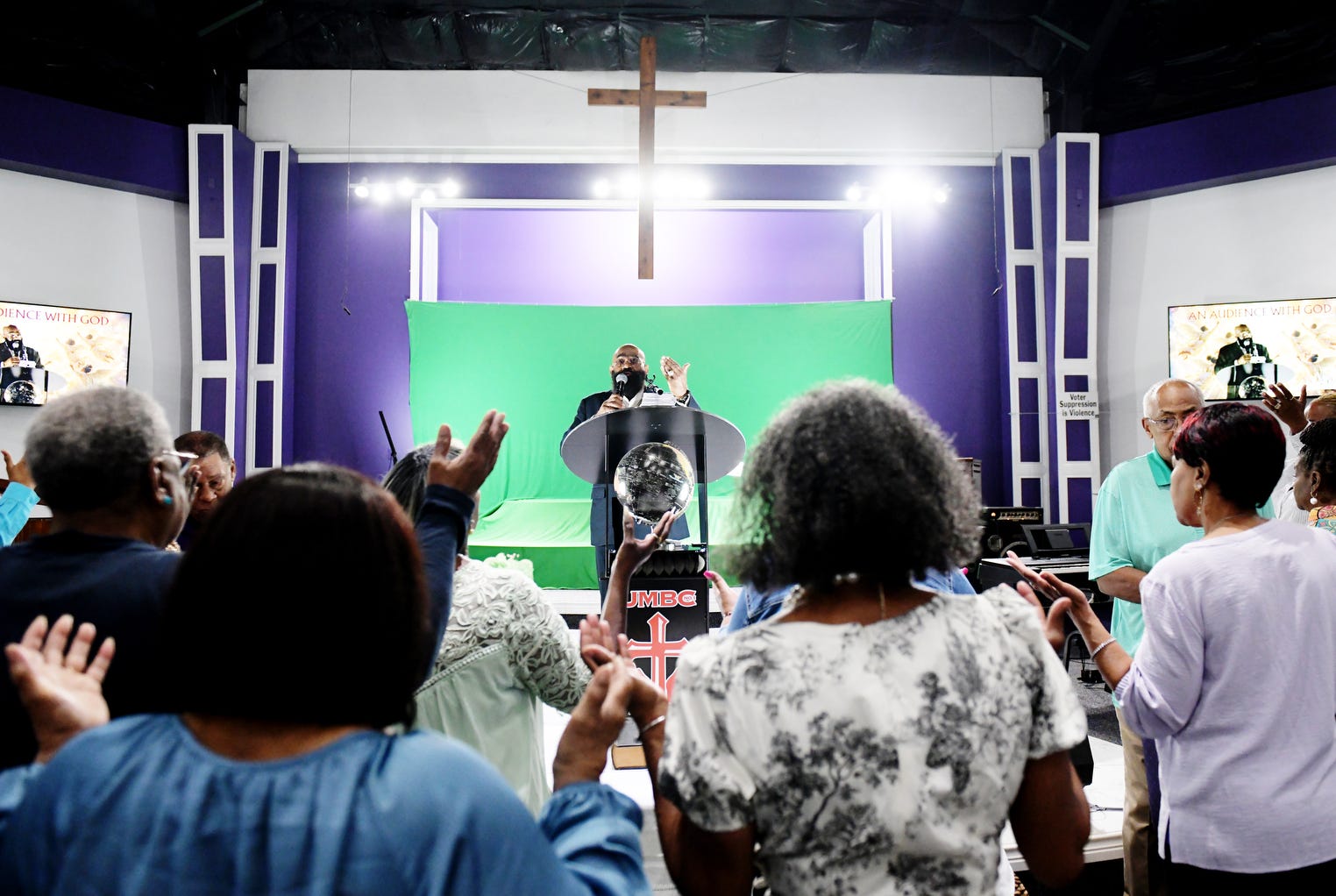
On April 26, the choir at Green’s church in Shreveport performed “I Sing Praises to Your Name” as parishioners filed inside the sanctuary, umbrellas in hand. Eventually, they approached the altar, raising their hands.
"Why don't you lift Shreveport?” Green asked his flock. “Why don't you lift your neighborhood? Why don't you lift the Elkins family, the Snow family, the Pugh family? Why don't you lift your family and other families to the Lord?"
He cited Psalm 13, which encourages people to grieve but also to trust in God.
“No matter where you are in life,” Green said, “once you have an audience with the Lord, once you come into his presence, he will lift that burden.”
His parishioners immediately erupted in applause. Their hope was palpable as they hugged. Before they departed, they were given Amaryllis plants featuring red, trumpet-shaped flowers. Because they bloom in winter months, they can symbolize resilience and determination. The parishioners took them home so they could plant them as a way to memorialize Shreveport’s victims.
Boucher writes for the Shreveport Times, part of the USA TODAY Network; Yancey-Bragg reports for USA TODAY.
If you or someone you know could be a victim of domestic violence, call the National Domestic Violence Hotline at 800-799-7233 or text "START" to 88788. The Suicide and Crisis Lifeline is available at 988.
This article originally appeared on USA TODAY: Shreveport has a message for America: Don't look away