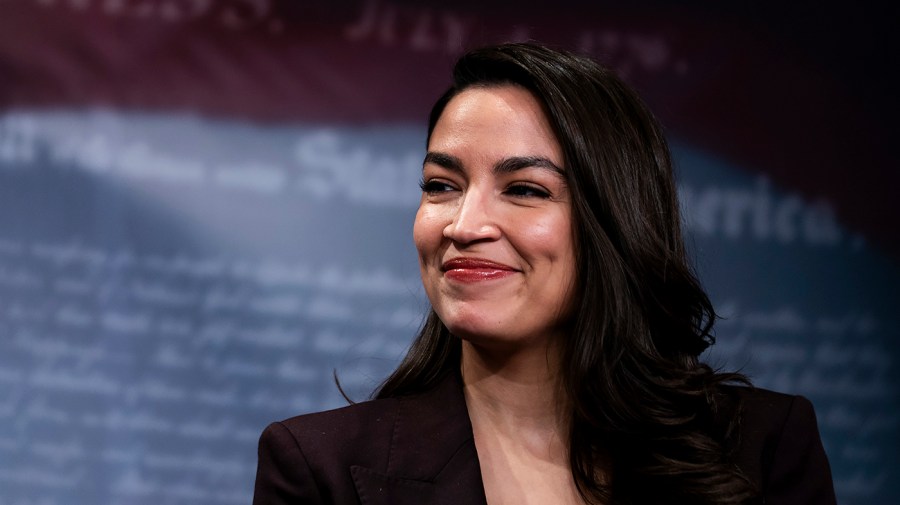
When Rep. Alexandria Ocasio-Cortez (D-N.Y.) sat down with Democratic strategist David Axelrod at a Chicago event last week, she didn’t close the door on a White House bid.
Ocasio-Cortez pushed back on the idea that her political aspirations are “positional,” telling Axelrod that people “assume my ambition is a title or a seat,” when her “ambition is way bigger than that.”
[Join Amie Parnes and Ian Swanson for a live Q&A discussion on the buzz around Ocasio Cortez among other topics at noon EDT on Tuesday.]
“My ambition is to change the country,” the representative known as AOC told Axelrod. “Presidents come and go … elected officials come and go. But single-payer healthcare is forever.”
The comments immediately fueled fresh debate in Democratic circles over whether Ocasio-Cortez, once viewed by some in the party as a niche progressive firebrand, could be among the most viable candidates in the 2028 presidential race.
“She spoke with the confidence of someone who understood the power of their voice nationally and the knowledge that she has the option to mount a national campaign should she ever choose to do that,” Democratic strategist Joel Payne said. “What is impressive is that she was able to assess her value beyond the office she holds.”
While Payne said Ocasio-Cortez’s remarks showed that she’s keeping her options open and isn’t in any rush to decide her next steps, “she’s going to walk into a presidential race, if she chooses to, with 20 percent of the base of the Democratic Party feeling good about her.”
Another Democratic strategist agreed with that sentiment, adding that she would enter the race with more than most candidates.
“You start with ‘who’s more likely to roll into some of these states and have folks ready to go door to door? Who’s lining up to fundraise?’ There’s an excitement around a potential candidacy that most don’t have. And she starts there.”
The renewed conversation around Ocasio-Cortez underscores a broader identity crisis inside the Democratic Party, which has found itself leaderless and searching for direction since its bruising defeats in 2024.
Some establishment Democrats have said she could be too polarizing for a national race and that the party needs to look for a more centrist standard-bearer to win in 2028.
At the same time, some in the Democratic Party now see Ocasio-Cortez as one of its most effective communicators — particularly among voters frustrated with the party’s leadership and overall lack of a message.
And her response to Axelrod on Friday highlighted what many Democrats see as one of Ocasio-Cortez’s greatest political strengths: an ability to answer politically fraught questions with fluency — while avoiding the obvious traps.
“Probably the best answer anyone’s given to this question in … in a very, very long time,” MS NOW host Jen Psaki wrote on the social platform X.
The progressive organization Our Revolution reposted a clip of Ocasio-Cortez’s response, noting “The future is bright.”
The reaction wasn’t limited to social media.
“Regardless of what anyone thinks about her politics, it was one of the best answers anyone has given to what should be an easy question that too many candidates whiff on off the bat,” Democratic strategist Eddie Vale said in an interview.
Vale cautioned, however, against trying to predetermine the party’s nominee this early and that Democrats need “to let go of what they think will make the best candidate, let everyone who wants to run, run, and let the crucible of the campaign trail and voters figure out who rises to the top.”
While Ocasio-Cortez is not the front-runner in early 2028 polling, some surveys suggest she has already emerged as a competitive figure in what is expected to be a crowded field.
An Echelon Insights poll out last month, for example, showed former Vice President Kamala Harris in the lead among likely voters with 47 percent support. California Gov. Gavin Newsom and former Transportation Secretary Pete Buttigieg each received 37 percent support, while Ocasio-Cortez received 36 percent.
She also does well with a younger set of voters. A Yale Youth poll released last month showed that while Harris and Newsom were nearly tied in the lead, Ocasio-Cortez led Harris and Newsom when it came to voters aged 18-34. Voters aged 65 and older said they preferred Newsom.
If she decides to run for president, Democratic strategist Rodell Mollineau noted that Ocasio-Cortez would likely begin a presidential race with a built-in progressive infrastructure and a highly engaged grassroots following.
“She certainly has a lane,” Mollineau said, adding that she’ll inherit some supporters of Sen. Bernie Sanders (I-Vt.) but also has her own following.
More than anything, Mollineau added, “She is a media curiosity.”
“The amount of earned media that she is going to get by running is going to triple that of many other candidates,” he said.
Copyright 2026 Nexstar Media, Inc. All rights reserved. This material may not be published, broadcast, rewritten, or redistributed.For the latest news, weather, sports, and streaming video, head to The Hill.