After military officers staged a coup in Mali, they ordered French troops to leave the country, ending a nearly decade-long Western-led anti-terrorism operation. Instead, the junta turned to Russia for help quelling a sprawling Islamist insurgency.
But in the four years since Russian mercenaries arrived in the West African nation, the militants have only gained strength.
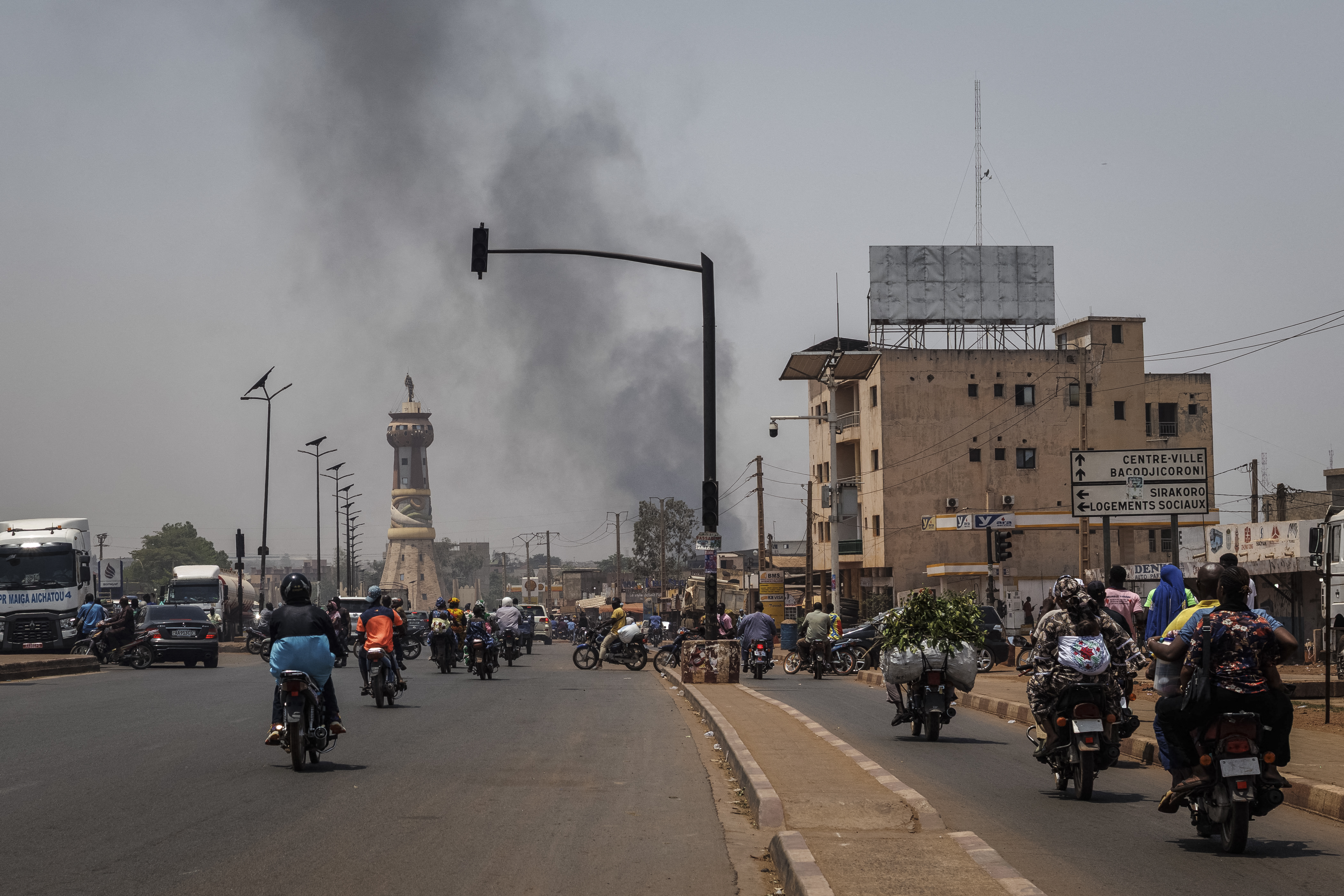
Over the weekend, a powerful al-Qaeda affiliate launched its most shocking offensive in nearly 15 years, coordinated attacks that killed the defense minister, who had been Russia’s chief backer within the government, and forced mercenaries to retreat from several key cities.
The country is now teetering on the edge of collapse, despite assurances in recent days by Malian President Assimi Goïta that he is still in control.
“There is a massive power vacuum here,” said an official in the capital, Bamako, who spoke on the condition of anonymity because of the sensitivity of the situation. “No one knows what is going on. It might sound melodramatic, but it’s not clear what government we still have here.”
Russian President Vladimir Putin has made a priority of the region, aiming to outflank western rivals, including the United States, for power and influence. But the dramatic, public failure of Russian fighters has shown Putin once again unable to deliver for his partners — a pattern illustrated starkly in Venezuela, where the U.S. military seized President Nicolás Maduro and in Iran, where U.S.-Israeli bombing killed the supreme leader, Ayatollah Ali Khamenei.
“We are struggling to make sense of this, even those who have studied this for years,” said Ibrahim Yahaya Ibrahim, deputy director of the International Crisis Group’s Sahel project, adding that the strikes “hit at the heart of Mali’s power.” “The Russians were their main bet, and they really suffered a major setback.”
Beyond the apparent collapse of yet another foreign intervention in Mali, experts said, the recent attacks also raised questions about the country’s future, with potentially grave ramifications for the wider Sahel region, which also includes Burkina Faso and Niger.
If the junta in Mali survives, Ibrahim said, the authorities probably will try to “reestablish their image” by escalating the fight, potentially bringing in more Russian fighters. “If the regime doesn’t survive,” he added, “it could be all hell breaking loose.”
In his first public appearance since the attacks, Goïta met with the Russian ambassador to Mali, according to a post from his office. Also on Tuesday, a spokesman for the al-Qaeda affiliate behind the attacks declared a “total siege” against Bamako. The U.S. Embassy warned of “possible terrorist movements within Bamako” and urged U.S. citizens to shelter in place.
Mali is a sprawling, landlocked nation that France colonized from 1892 to 1960. The country, known for its rich musical history and as a center of Islamic learning, was rocked in 2012 by an uprising of Islamist militants and ethnic separatists that included the takeover of much of the north, including the storied city of Timbuktu.
At the request of Mali’s then-government, a French-led military operation quashed the insurgency and restored a measure of order. That initial mission was followed by a second, Operation Barkhane, which eliminated prominent militant leaders but ultimately failed to stop the spread of various armed groups.
Anger at France — fueled by its neocolonial missteps and by Russian disinformation — boiled over the years, helping propel coups in Mali — in 2020 and in 2021 — and in neighboring Burkina Faso and Niger. French President Emmanuel Macron effectively conceded defeat and withdrew his forces.
The insurgency, meanwhile, kept growing, driven largely by two groups, the al-Qaeda-linked Jama’at Nusrat al-Islam wal-Muslimin, or JNIM, and the Islamic State Sahel Province. By 2022, the Sahel region had become the world’s global epicenter for terrorism.
Other efforts to stem the violence, including a United Nations peacekeeping mission and various U.S. counterterrorism missions, also failed.
“There is a lot of blame to go around,” said Andrew Lebovich, a research fellow who focuses on Mali at the Clingendael Institute, a Netherlands-based think tank. “Everyone has their share of responsibility, including Mali’s government.”
After seizing power from Mali’s democratically elected president in 2021, Goïta — who had received training from U.S. Special Forces — and his top lieutenants turned to Russia for help. The defense minister, Sadio Camara, who was killed at his home in Kati on Saturday, made several trips to Russia in 2021, according to the U.S. Treasury Department, and orchestrated Mali’s agreement with Russia’s Wagner mercenary group.
Wagner’s leader, Yevgeniy Prigozhin, died in a suspicious plane disaster in 2023 after openly challenging Putin and the Russian Defense Ministry over disagreements about the war in Ukraine. In Mali, Wagner fighters were reorganized and renamed the Africa Corps under control of the Defense Ministry in Moscow. Some 1,500 of its fighters helped Mali’s military make gains against militants, including taking back the northern city of Kidal from Tuareg separatists in 2023.
Still, violence increased overall — and experts said that abuses by Mali’s miliary and the Russians were a main driver.
“They didn’t have the same standards nor were they constrained by the same rules of engagement, and they still couldn’t get the job done,” J. Peter Pham, a special envoy for the Sahel in the first Trump administration, said of the Russians.
Referring to Camara, who was killed after suicide bombers hit his house, Pham said: “The biggest partner they had, they could not protect.”
Pham argued that it was in the U.S. interest for the Trump administration to get more involved.
During the Biden administration, the U.S. reduced security support for Sahel countries after their governments were overthrown, at times arguing that the new military leaders did not respect democratic norms or human rights and at other times at the request of the regimes themselves.
The Trump administration intermittently tried to rebuild those relationships, including recently lifting sanctions on Camara and increasing intelligence-sharing by the CIA with the Malian junta.
But as President Donald Trump increasingly focused on the Middle East and Latin America, relatively little attention was paid in recent months to the Sahel. “Having Mali or, even worse, the whole Sahel collapse into one huge Afghanistan is in no one’s interest,” Pham said. “We need to act.”
Corinne Dufka, an independent expert on the Sahel, said the U.S. must think carefully about any intervention, given the “complicated ethnic and political landscape.”
“There are so many moving parts, but what is clear is that there is apparently no military solution to this,” Dufka said.
On the day it mattered most, in the city they had so proudly and publicly seized back from the rebels in 2023, the Russians seemed to be easily overpowered.
Kidal, a city of about 20,000 in northern Mali, has long been a stronghold for Tuareg separatists who feel marginalized by the government and insist they should have their own nation, Azawad. On Saturday, a Tuareg-dominated rebel alliance that declared a partnership with JNIM, mounted a day-long siege against Kidal, hitting the Russians with remote-controlled drones, according to videos they released.
Africa Corps negotiated a surrender, experts said, and social media videos showed Russian trucks and tanks filing out of the city, sometimes towing artillery and rockets.
Soon, Africa Corps was retreating from other cities. In Tessalit, about 125 miles north of Kidal, where Africa Corps had been based, militants posed with a helicopter abandoned by the Malian army and the Russians. In Intahaka, a major gold mining hub in the southeastern Gao region, video showed Malian officers peacefully surrendering to the the Azawad Liberation Front, or FLA.
Africa Corps acknowledged the withdrawal from Kidal, saying it was “a joint decision by the leadership of the Republic of Mali,” and that wounded servicemen and heavy equipment were evacuated first.
As they lost control in the other cities, Africa Corps blamed the West, condemning anyone who supported “terrorists and their French masters” as “pathetic nobodies.”
The next steps by Africa Corps remain uncertain. “If the Russians pull out, then that is a huge problem for the Malian government,” Lebovich, of the Clingendael Institute, said. “There isn’t really another option that would be likely to replace Russia’s force in the short term.”
In Bamako on Tuesday, there was a sense of a turning point.
A 47-year-old shopkeeper, who like others spoke on the condition of anonymity because of the sensitivity of the situation, said he had hoped the Russians would bring long-promised peace. Now, he wonders whether the French would have been better.
“It’s been a total failure,” the shopkeeper said of Russia. “While the French were present, we never even saw an attack in Ségou, let alone Bamako, even though they were insulted with every name under the sun.”
A 33-year-old butcher who previously supported the Russian partnership, said he felt that everything the government had promised “was all a lie, to the point that terrorists came all the way to Bamako.”
“I am so discouraged,” the butcher said. “Today, we are all afraid because there are no more men who can guarantee our security.”
Most Read From The Washington Post
- Charles, Camilla and the Trumps put on a well-styled display of unity
- Trump’s ballroom is about money — not security or state dinners
- I cannot stop thinking about Cheryl Hines at the correspondents’ dinner
- Trump welcomes King Charles III and Queen Camilla for state dinner
- Guests at state dinner honoring King Charles III include Tim Cook, Robert Kraft