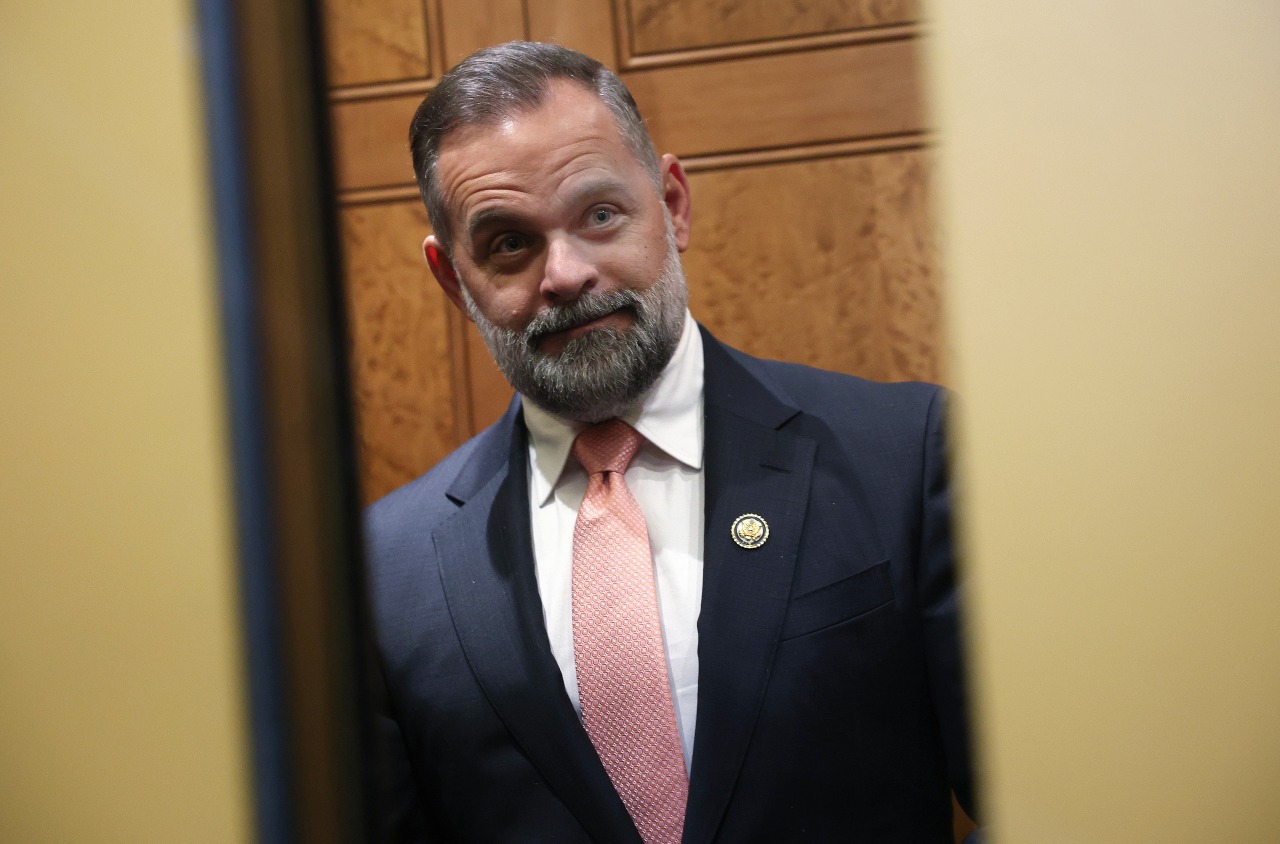
WASHINGTON—Rep. Cory Mills has so far survived a springtime purge of embattled lawmakers on Capitol Hill.
Three of his House colleagues quit over the past two weeks rather than face expulsion votes. But the Florida Republican says his case is different, vows he won’t leave and is putting his fate in the hands of the House Ethics Committee, which runs the chamber’s internal discipline system.
“I’ve never been charged or found guilty of anything of any sort. The worst thing I have is speeding tickets from probably 10 years ago,” said Mills, who has been targeted over allegations related to his personal and professional life. “So why would I resign? Give me a good reason.”
The string of high-profile scandals has put a spotlight on the ethics panel, the tight-lipped body that is investigating the Mills case and ultimately could issue findings and recommend a punishment—ranging from no action to expulsion—followed by a possible House vote. But any resolution could take months, frustrating both Democratic and Republican lawmakers.
Critics say the panel is too opaque and moves too slowly, with investigations sometimes taking years and often ending with no public report if a member leaves. Defenders say the committee has the near-impossible task of policing colleagues, and that due process requires a deliberative pace. The stresses have been exacerbated by lawmakers’ increasing eagerness to attack fellow members—even of the same party—and the narrow majorities in the House.
Some lawmakers are now asking: Is the Ethics Committee up to the job?
The ethics process “must be reformed to act faster, enforce accountability, and let elected officials focus on serving the American people, not cleaning up misconduct,” said Rep. Anna Paulina Luna (R., Fla.).
Freshman Rep. Sam Liccardo (D., Calif.), a former federal prosecutor, who pointed to the Mills case, said that “some of these investigations may be delayed for political reasons, and we need clear rules that require a conclusion” to probes.
Ethics Committee Chairman Michael Guest (R., Miss.) defended the panel’s work. “People want immediate responses to allegations,” he said, thanks to the 24-hour news cycle and social media. But he said the committee is “not going to rush to judgment so that we can reach some arbitrary deadline of two weeks or two months, or whatever the time period may be.”
The recent scandals, many of them rooted in allegations of sexual misconduct, have fueled more scrutiny of the institution as a whole, nearly a decade after the Me-Too movement spurred a reckoning on sexual harassment and violence. Congress is already reeling from years of repeated government shutdowns and GOP revolts against party leadership, with the latest Gallup poll putting its approval at 10%.
Playing ‘Whac-A-Mole’ with rumors
Mills, a two-term congressman, faces allegations of profiting from federal contracts while in Congress and alleged misdeeds related to his military service and campaign finance, as well as physical violence. Police were called to his apartment in Washington last year after a woman with bruises reported an alleged assault. She later withdrew the accusation.
Mills has denied wrongdoing. He often reminds reporters that he referred his own case to the committee last fall—albeit to fend off a vote to censure him. He said he was cooperating with the probe.
“I got tired of playing political ‘Whac-A-Mole,’ ” he said. “Dispel this rumor, dispel that rumor.”
The ethics panel has given no guidance on when the case will be resolved, and party leaders say they are deferring to the committee. Some lawmakers have continued to push for fast action to remove Mills before the committee acts. An expulsion vote would require the support of two-thirds of the House.
“If you’re beating up women, I don’t think that you should be a representative in Congress,” said Rep. Lauren Boebert (R., Colo.). On Mills’s denials, she said: “I mean, who hasn’t denied allegations.”
The resignations earlier this month by former Reps. Eric Swalwell (D., Calif.) and Tony Gonzales (R., Texas) over sexual-misconduct allegations emboldened critics pushing for Mills’s ouster, along with that of another lawmaker, Rep. Sheila Cherfilus-McCormick (D., Fla.), who also stepped down. All three were under investigation by the Ethics Committee when they quit.
Cherfilus-McCormick resigned Tuesday, minutes before an Ethics Committee hearing was set to weigh whether to recommend expelling her. She faced allegations that she used stolen Covid-19 disaster aid to fund her 2021 House campaign.
Luna called Cherfilus-McCormick’s resignation “long overdue” and the yearslong span of the probe a “clear failure of the system.”
Cherfilus-McCormick’s ethics case started in 2023, and she was indicted on related federal charges in November 2025. She pleaded not guilty. Cherfilus-McCormick, who denied wrongdoing and unsuccessfully sought a further delay in the ethics case to fight the criminal charges, said that the House was setting a poor precedent by pushing out an elected representative without full due process.
“That is a dangerous path,” she said.
No ‘rush to judgment’
The Ethics Committee is evenly divided—five Republicans and five Democrats—and is known for working in a bipartisan manner. Investigations proceed in secret, and members don’t discuss the status or timing of current cases except through occasional official statements.
Rep. Glenn Ivey (D., Md.), a committee member who served as a prosecutor and Senate counsel before entering politics, said the panel tries to move as fast as it can.
“The public and members are looking for quick resolutions,” said Ivey. At the same time, he said, “you can’t have a rush to judgment. It’s a tough balancing act.”
Rep. Mark DeSaulnier of California, the top Democrat on the panel, said he is speaking with colleagues about ways to “make our investigations more efficient” while protecting victims and due process.
Guest, the committee chairman, said complicated allegations take time to thoroughly review and said resources like additional staffing could help the committee move faster.
While the panel can subpoena witnesses, he said, it lacks a strong enforcement mechanism if someone refuses to comply. The full House would need to vote to refer the matter to the Justice Department—which then would need to decide whether to bring a case.
Such charges happen “very infrequently,” Guest said, “and I think individuals know that.”
It isn’t known how long the Mills case will take. House Speaker Mike Johnson (R., La.) has emphasized the importance of due process and signaled he wouldn’t make any effort to push Mills out.
“I would like all of this to move a lot quicker as well.” Referring to the committee, he said, “I am confident that they are moving along as quickly as they are able.”
House Minority Leader Hakeem Jeffries (D., N.Y.) said he wants the investigation wrapped up quickly “so we can get an Ethics recommendation and the House can proceed.”
Even seemingly straightforward probes can take years. The panel investigated Rep. Alexandria Ocasio-Cortez (D., N.Y.) over the 2021 Met Gala, where she wore a “Tax the Rich” gown. The case was resolved in 2025 with Ocasio-Cortez agreeing to repay various expenses deemed to be impermissible gifts.
The investigation of former Rep. Matt Gaetz (R., Fla.) launched in 2021 and wrapped up in 2024. In a move that divided the panel and sparked rare public sparring between members of the panel, a majority voted to release the committee’s report even though Gaetz resigned. The report concluded that Gaetz regularly paid for sex and accepted impermissible gifts. Gaetz denied wrongdoing.
Others have moved faster. The committee opened a probe of then-Rep. George Santos (R., N.Y.) in March 2023 and issued a report in November of that year, finding “substantial evidence of wrongdoing.” The House then voted to expel Santos, the first time the House kicked out a lawmaker who wasn’t a member of the Confederacy or already a felon. Santos called the report a “disgusting politicized smear.” He later pleaded guilty to a series of federal charges, including wire fraud, aggravated identity theft, defrauding donors and other fraud schemes related to Covid-relief funds.
Dan Schwager, who served as chief counsel to the House Ethics Committee from 2011 to 2013, noted that the committee was able to move more quickly because it had stopped short of recommending a specific sanction in the Santos case—such as censure or expulsion. That “definitely sped things up in that instance, but it also creates a bit of an expectation for the future,” Schwager said.
That could be an option in the Mills matter, he said, if lawmakers are ready to act without a recommendation from the committee. Schwager estimated that the case could take an additional three to six months to reach a resolution but said that each investigation was different.
Mills faces a competitive re-election bid this fall, and his fundraising has been weak. He was endorsed by President Trump in February, who called him a successful entrepreneur and brave Army combat veteran. In the recent interview, Mills said Trump knew about the allegations against him at the time. He said that Trump told him “very clearly that he believes in me and that he’s been loyal to me the way I’ve always been loyal to him.”
The White House didn’t respond to a request for comment.
Write to Ken Thomas at ken.thomas@wsj.com and Olivia Beavers at Olivia.Beavers@wsj.com